Department of Anthropology, Washington University in St. Louis, St. Louis, Missouri, United States of America.
Department of Geosciences, Virginia Polytechnic Institute and State University, Blacksburg, Virginia, United States of America.
PLoS One. 2020 Nov 4;15(11):e0240930. doi: 10.1371/journal.pone.0240930. eCollection 2020.
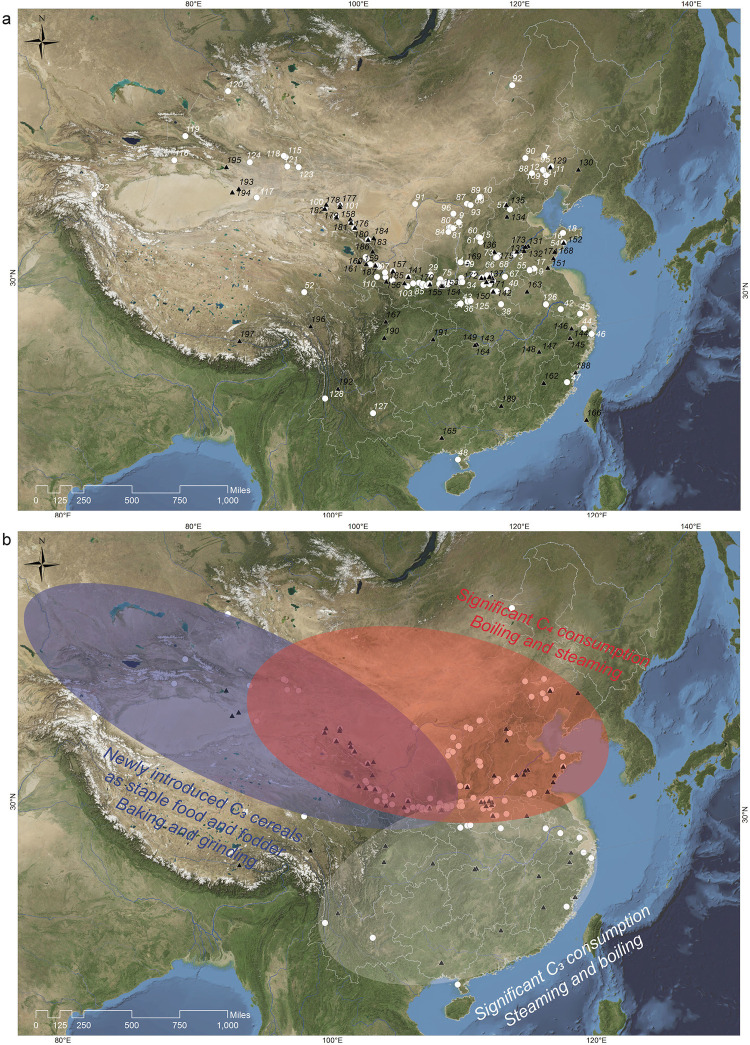
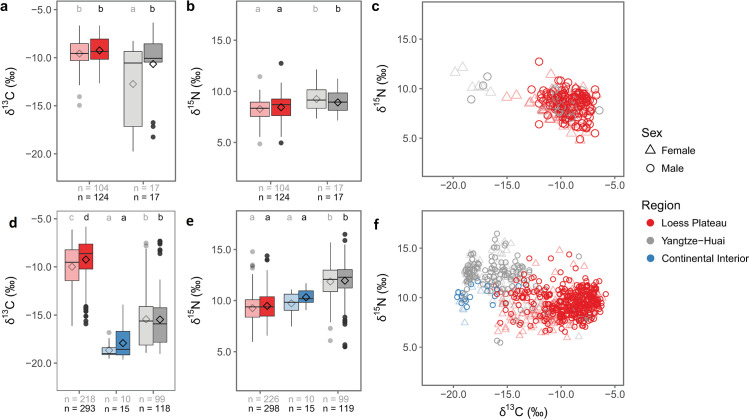
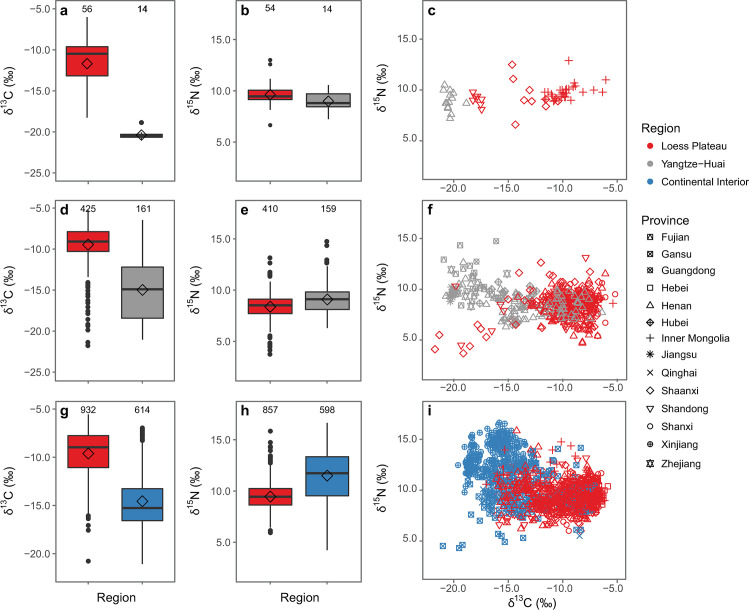
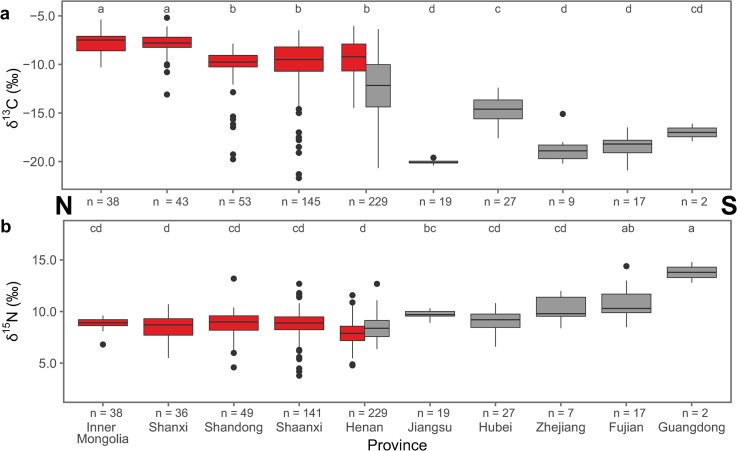
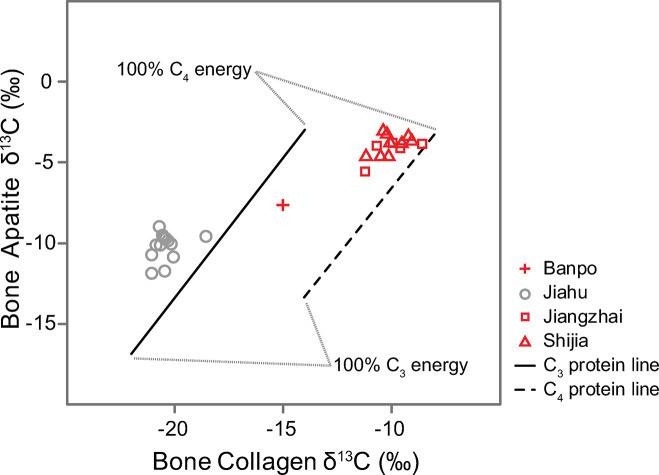
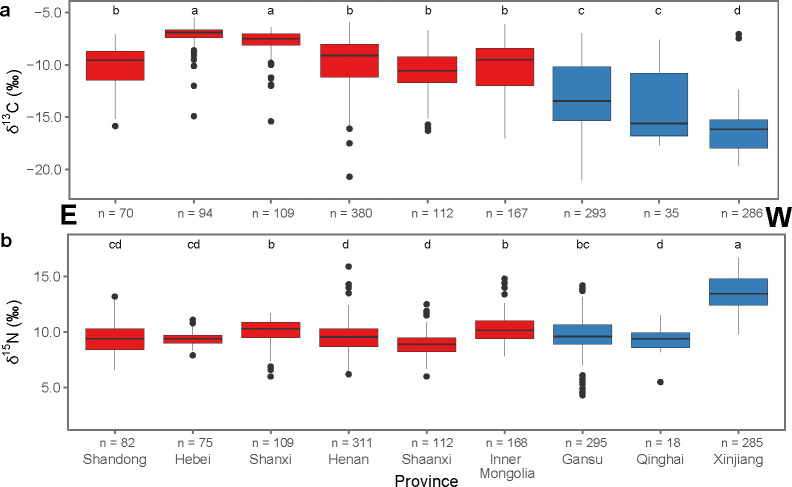
We conducted a meta-analysis of published carbon and nitrogen isotope data from archaeological human skeletal remains (n = 2448) from 128 sites cross China in order to investigate broad spatial and temporal patterns in the formation of staple cuisines. Between 6000-5000 cal BC we found evidence for an already distinct north versus south divide in the use of main crop staples (namely millet vs. a broad spectrum of C3 plant based diet including rice) that became more pronounced between 5000-2000 cal BC. We infer that this pattern can be understood as a difference in the spectrum of subsistence activities employed in the Loess Plateau and the Yangtze-Huai regions, which can be partly explained by differences in environmental conditions. We argue that regional differentiation in dietary tradition are not driven by differences in the conventional "stages" of shifting modes of subsistence (hunting-foraging-pastoralism-farming), but rather by myriad subsistence choices that combined and discarded modes in a number of innovative ways over thousands of years. The introduction of wheat and barley from southwestern Asia after 2000 cal BC resulted in the development of an additional east to west gradient in the degree of incorporation of the different staple products into human diets. Wheat and barley were rapidly adopted as staple foods in the Continental Interior contra the very gradual pace of adoption of these western crops in the Loess Plateau. While environmental and social factors likely contributed to their slow adoption, we explored local cooking practice as a third explanation; wheat and barley may have been more readily folded into grinding-and-baking cooking traditions than into steaming-and-boiling traditions. Changes in these culinary practices may have begun in the female sector of society.
我们对来自中国 128 个考古遗址的 2448 个人类骨骼遗骸的已发表碳氮同位素数据进行了荟萃分析,以研究主食形成的广泛时空模式。在公元前 6000-5000 年,我们发现了一个已经存在的南北差异的证据,即在主要作物主食的使用上(即小米与包括大米在内的广泛的 C3 植物性饮食),这一差异在公元前 5000-2000 年之间变得更加明显。我们推断,这种模式可以被理解为黄土高原和长江-淮河流域所采用的生存活动范围的差异,这部分可以用环境条件的差异来解释。我们认为,饮食传统的区域差异不是由传统的“生计模式转变阶段”(狩猎-采集-游牧-农业)的差异所驱动的,而是由数千年来以许多创新方式结合和抛弃模式的无数生存选择所驱动的。公元前 2000 年后,来自西南亚的小麦和大麦的引入导致不同主食产品在人类饮食中的融入程度形成了一个额外的从东到西的梯度。小麦和大麦在大陆内部迅速被采用为主食,而在黄土高原,这些西方作物的采用速度则非常缓慢。虽然环境和社会因素可能促成了它们的缓慢采用,但我们探讨了当地烹饪实践作为第三个解释;小麦和大麦可能更容易融入研磨和烘焙的烹饪传统,而不是蒸煮的传统。这些烹饪习惯的变化可能始于社会的女性群体。