Department of Archaeology, Simon Fraser University, Burnaby, B.C., Canada.
Department of Archaeology and Museology, College of History, Nankai University, Jinnan District, Tianjin City, People's Republic of China.
PLoS One. 2019 Jul 22;14(7):e0218943. doi: 10.1371/journal.pone.0218943. eCollection 2019.
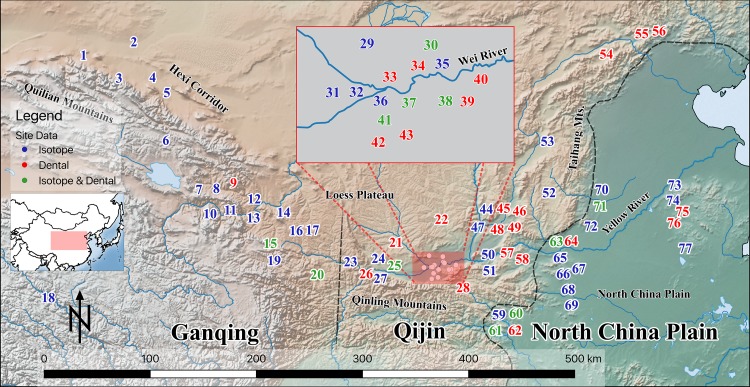
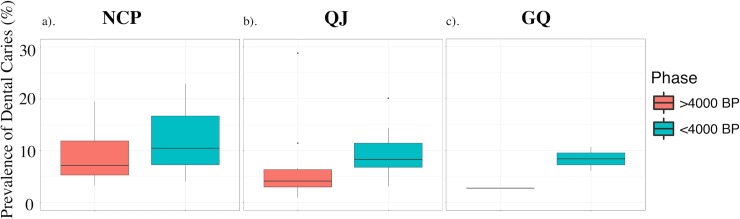
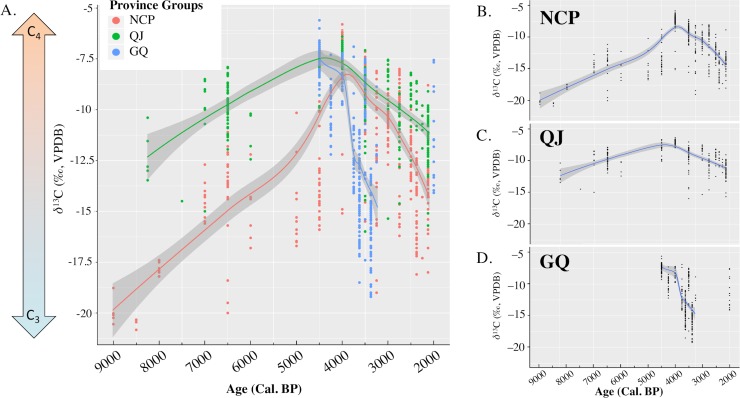
Prior to the introduction of wheat and barley from Central Asia during the Neolithic period, northern Chinese agricultural groups subsisted heavily on millet. Despite being the focus of many decades of intensive interest and research, the exact route(s), date(s), and mechanisms of the spread and adoption of wheat and barley into the existing well-established millet-based diet in northern China are still debated. As the majority of the important introduced crops are C3 plants, while the indigenous millet is C4, archaeologists can effectively identify the consumption of any introduced crops using stable carbon isotope analysis. Here we examine published stable isotope and dental caries data of human skeletal remains from 77 archaeological sites across northern and northwestern China. These sites date between 9000 to 1750 BP, encompassing the period from the beginning of agriculture to wheat's emergence as a staple crop in northern China. The aim of this study is to evaluate the implications of the spread and adoption of these crops in ancient China. Detailed analysis of human bone collagen δ13C values reveals an almost concurrent shift from a C4-based to a mixed C3/ C4- based subsistence economy across all regions at around 4500-4000 BP. This coincided with a global climatic event, Holocene Event 3 at 4200 BP, suggesting that the sudden change in subsistence economy across northern and northwestern China was likely related to climate change. Moreover, the substantially increased prevalence of dental caries from pre-to post-4000 BP indicates an increase in the consumption of cariogenic cereals during the later period. The results from this study have significant implications for understanding how the adoption of a staple crop can be indicative of large-scale environmental and socio-political changes in a region.
在新石器时代从中亚引入小麦和大麦之前,中国北方的农业群体主要依赖小米为生。尽管几十年来一直受到广泛关注和深入研究,但小麦和大麦传入中国北方已确立的小米为主的饮食中的确切途径、日期和机制仍存在争议。由于大多数重要的引入作物是 C3 植物,而本土的小米是 C4 植物,因此考古学家可以通过稳定碳同位素分析有效地识别任何引入作物的消耗情况。在这里,我们研究了来自中国北方和西北部 77 个考古遗址的人类骨骼遗骸的已发表的稳定同位素和龋齿数据。这些遗址的年代在公元前 9000 年至 1750 年之间,涵盖了农业起源到小麦在中国北方成为主食的时期。本研究的目的是评估这些作物在中国古代的传播和采用的影响。对人类骨骼胶原蛋白 δ13C 值的详细分析表明,大约在公元前 4500-4000 年,所有地区几乎同时从以 C4 为基础的经济向混合 C3/C4 为基础的经济转变。这与 4200 年前的全新世事件 3 这一全球气候事件相吻合,表明中国北方和西北部的生计经济突然发生变化可能与气候变化有关。此外,公元前 4000 年前后龋齿的患病率大幅增加,表明在后期对致龋谷物的消费增加。本研究的结果对理解主食的采用如何能够指示一个地区的大规模环境和社会政治变化具有重要意义。