Silva Ana P da, Gallardo Rodrigo A
Department of Population Health and Reproduction, School of Veterinary Medicine, University of California, Davis, CA 95616, USA.
Vaccines (Basel). 2020 Nov 2;8(4):637. doi: 10.3390/vaccines8040637.
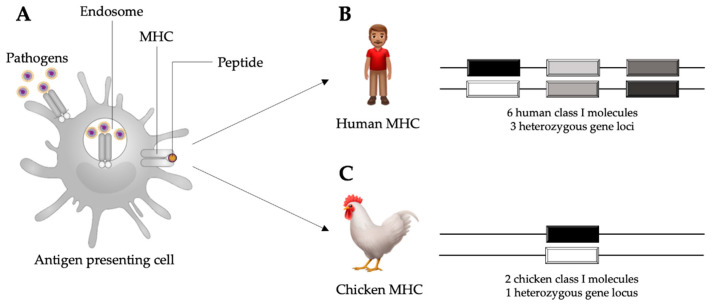
The chicken immune system has provided an immense contribution to basic immunology knowledge by establishing major landmarks and discoveries that defined concepts widely used today. One of many special features on chickens is the presence of a compact and simple major histocompatibility complex (MHC). Despite its simplicity, the chicken MHC maintains the essential counterpart genes of the mammalian MHC, allowing for a strong association to be detected between the MHC and resistance or susceptibility to infectious diseases. This association has been widely studied for several poultry infectious diseases, including infectious bronchitis. In addition to the MHC and its linked genes, other non-MHC loci may play a role in the mechanisms underlying such resistance. It has been reported that innate immune responses, such as macrophage function and inflammation, might be some of the factors driving resistance or susceptibility, consequently influencing the disease outcome in an individual or a population. Information about innate immunity and genetic resistance can be helpful in developing effective preventative measures for diseases such as infectious bronchitis, to which a systemic antibody response is often not associated with disease protection. In this review, we summarize the importance of the chicken MHC in poultry disease resistance, particularly to infectious bronchitis virus (IBV) infections and the role played by innate immunity and inflammation on disease outcome. We highlight how future studies focusing on the MHC and non-MHC genes can potentially bring clarity to observed resistance in some chicken B haplotype lines.
鸡的免疫系统通过确立当今广泛使用的概念的主要里程碑和发现,为基础免疫学知识做出了巨大贡献。鸡的众多特殊特征之一是存在紧凑且简单的主要组织相容性复合体(MHC)。尽管鸡的MHC很简单,但它保留了哺乳动物MHC的基本对应基因,使得能够检测到MHC与对传染病的抗性或易感性之间的强关联。这种关联已针对包括传染性支气管炎在内的几种家禽传染病进行了广泛研究。除了MHC及其连锁基因外,其他非MHC基因座可能在这种抗性的潜在机制中发挥作用。据报道,先天免疫反应,如巨噬细胞功能和炎症,可能是驱动抗性或易感性的一些因素,从而影响个体或群体的疾病结果。关于先天免疫和遗传抗性的信息有助于制定针对诸如传染性支气管炎等疾病的有效预防措施,对于这些疾病,全身性抗体反应通常与疾病保护无关。在本综述中,我们总结了鸡MHC在禽类抗病性中的重要性,特别是对传染性支气管炎病毒(IBV)感染的抗性,以及先天免疫和炎症对疾病结果的作用。我们强调,未来专注于MHC和非MHC基因的研究如何有可能为一些鸡B单倍型品系中观察到的抗性带来清晰的认识。