Section of Psychiatry and Neurochemistry, Institute of Neuroscience and Physiology, Sahlgrenska Academy, University of Gothenburg, Blå Stråket 15, 41345, Gothenburg, Sweden.
Psychosis Department, Region Västra Göraland; Sahlgrenska University Hospital, 41345, Gothenburg, Sweden.
BMC Psychiatry. 2020 Nov 4;20(1):523. doi: 10.1186/s12888-020-02871-y.
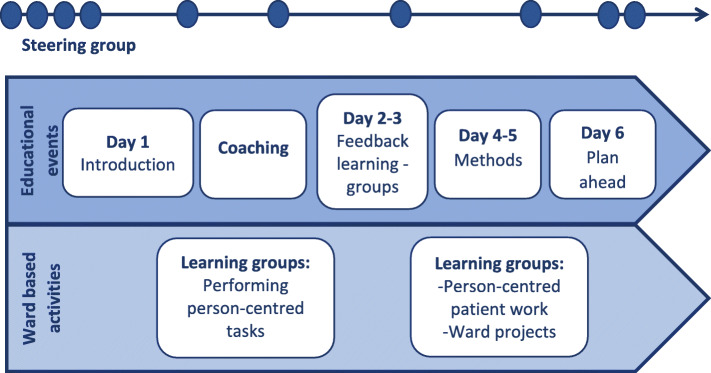
Reluctance on the part of mental health professionals constitutes an important barrier to patient participation in care. In order to stimulate person-centeredness in the inpatient care of persons with psychotic illness, we developed and tested an educational intervention for hospital staff (including psychiatrists) at all four wards at the Psychosis Clinic, Sahlgrenska University Hospital in Gothenburg, Sweden. The intervention was co-created by professionals, patients, and researchers using a participatory approach. In addition to lectures and workshops, staff created and implemented small projects to increase person-centeredness on their own wards. A primary focus was to establish a partnership between patient and staff by capturing and utilizing the patient's narrative to support active engagement in the care process. This included the development of a person-centered care plan. We hypothesized that the intervention would be associated with increased patient empowerment (primary outcome) and satisfaction with care (secondary outcome).
A before and after design was used to test group differences in patient empowerment (Empowerment Scale) and consumer satisfaction (UKU-ConSat Rating Scale). All patients receiving inpatient psychosis care during measuring periods were eligible if meeting inclusion criteria of schizophrenia spectrum disorder, age > 18, and ability to comprehend study information. Severe cognitive deficit and inadequate Swedish language skills were exclusion criteria. Data on possible confounding variables including overall health (EQ-5D), symptom burden (PANSS), and functional ability (GAF) were collected alongside outcome measures.
ANCOVAs with overall health as a confounding variable showed no group differences regarding empowerment before (n = 50) versus after (n = 49) intervention, sample mean = 2.87/2.99, p = .142, eta = .02, CI = -.27-.04. Consumer satisfaction (n = 50/50) was higher in the post-implementation group (4.46 versus 11.71, p = .041 eta = .04, CI = -14.17- -.31).
The hypothesis regarding the primary outcome, empowerment, was not supported. An increase in the secondary outcome, satisfaction, was observed, although the effect size was small, and results should be interpreted with caution. Findings from this staff educational intervention can inform the development of future studies aimed at improvement of inpatient care for persons with severe mental illness.
The trial was retrospectively registered at ClinicalTrials.gov June 9, 2017, identifier: NCT03182283.
心理健康专业人员的不情愿是阻碍患者参与护理的一个重要因素。为了在精神疾病患者的住院护理中激发以患者为中心的理念,我们为瑞典哥德堡萨赫勒格伦斯卡大学医院精神病诊所的所有四个病房的医院工作人员(包括精神科医生)开发并测试了一种教育干预措施。该干预措施是由专业人员、患者和研究人员使用参与式方法共同创建的。除了讲座和研讨会外,工作人员还创建并实施了小项目,以提高自己病房的以患者为中心程度。重点是通过捕捉和利用患者的叙述来建立患者和员工之间的伙伴关系,以支持他们积极参与护理过程。这包括制定以患者为中心的护理计划。我们假设该干预措施将与增加患者赋权(主要结果)和对护理的满意度(次要结果)相关。
使用前后设计来测试患者赋权(赋权量表)和消费者满意度(UKU-ConSat 评分量表)方面的组间差异。如果符合精神分裂症谱系障碍、年龄>18 岁和理解研究信息的能力等纳入标准,且无严重认知缺陷和瑞典语能力不足的排除标准,则所有接受住院精神病护理的患者均有资格参加测量期间的研究。收集了包括总体健康状况(EQ-5D)、症状负担(PANSS)和功能能力(GAF)在内的可能混杂变量的数据,以及结果测量值。
在考虑到总体健康状况作为混杂变量的情况下,干预前(n=50)和干预后(n=50)的赋权情况没有组间差异,样本均值为 2.87/2.99,p=0.142,eta=0.02,CI=-.27-.04。实施后的消费者满意度(n=50/50)更高(4.46 比 11.71,p=0.041,eta=0.04,CI= -14.17- -.31)。
关于主要结果(赋权)的假设未得到支持。观察到次要结果(满意度)的增加,尽管效果较小,因此结果应谨慎解释。这项工作人员教育干预措施的结果可以为旨在改善严重精神疾病患者住院护理的未来研究提供信息。
该试验于 2017 年 6 月 9 日在 ClinicalTrials.gov 上进行了回顾性注册,标识符为 NCT03182283。