Department of Molecular Biology, University of Wyoming, Laramie, WY, 82071, USA.
Cell Commun Signal. 2020 Nov 4;18(1):178. doi: 10.1186/s12964-020-00670-2.
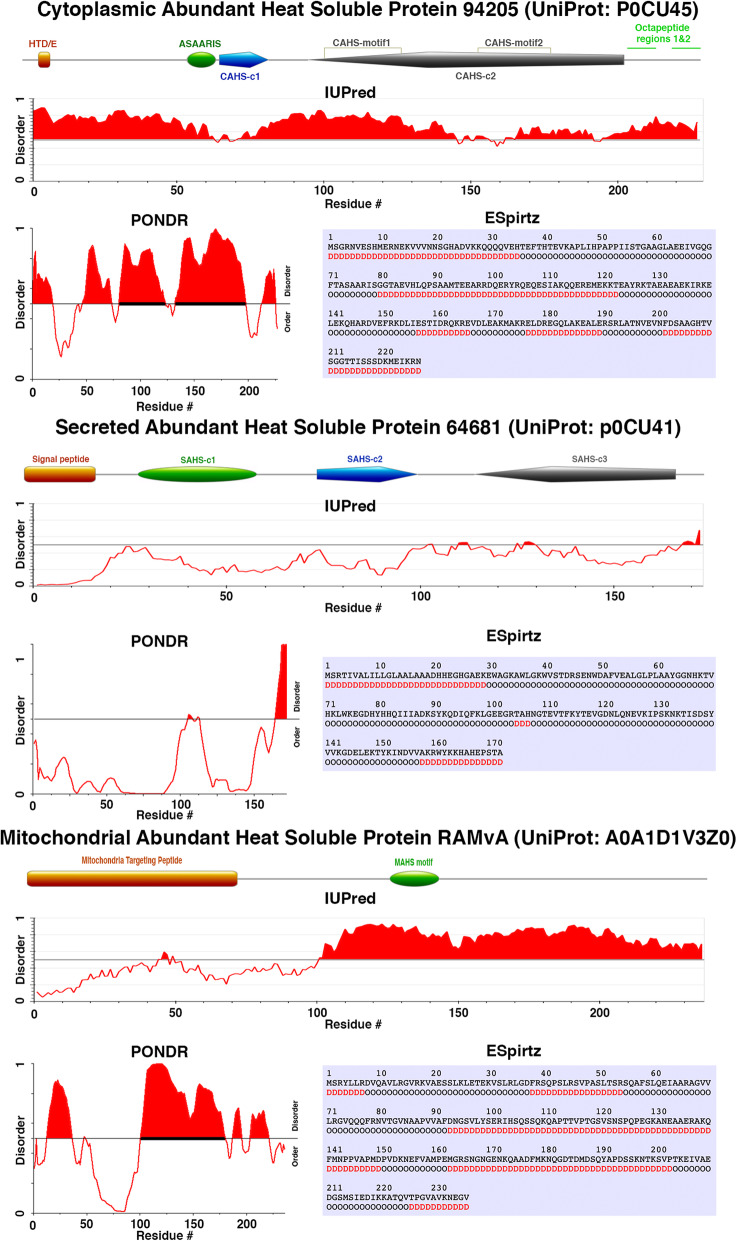
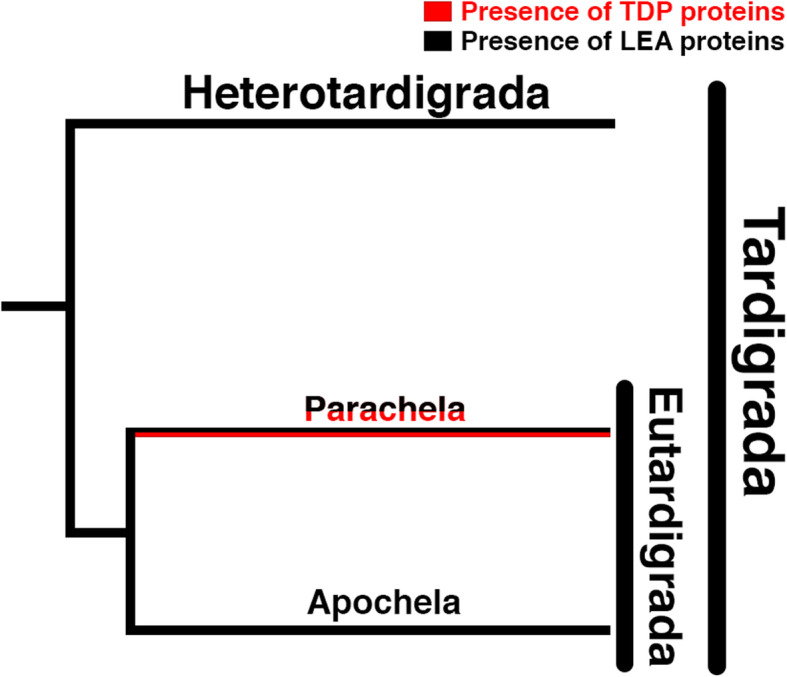
Disordered proteins have long been known to help mediate tolerance to different abiotic stresses including freezing, osmotic stress, high temperatures, and desiccation in a diverse set of organisms. Recently, three novel families of intrinsically disordered proteins were identified in tardigrades, microscopic animals capable of surviving a battery of environmental extremes. These three families include the Cytoplasmic-, Secreted-, and Mitochondrial- Abundant Heat Soluble (CAHS, SAHS, and MAHS) proteins, which are collectively termed Tardigrade Disordered Proteins (TDPs). At the level of sequence conservation TDPs are unique to tardigrades, and beyond their high degree of disorder the CAHS, SAHS, and MAHS families do not resemble one another. All three families are either highly expressed constitutively, or significantly enriched in response to desiccation. In vivo, ex vivo, and in vitro experiments indicate functional roles for members of each TDP family in mitigating cellular perturbations induced by various abiotic stresses. What is currently lacking is a comprehensive and holistic understanding of the fundamental mechanisms by which TDPs function, and the properties of TDPs that allow them to function via those mechanisms. A quantitative and systematic approach is needed to identify precisely what cellular damage TDPs work to prevent, what sequence features are important for these functions, and how those sequence features contribute to the underlying mechanisms of protection. Such an approach will inform us not only about these fascinating proteins, but will also provide insights into how the sequence of a disordered protein can dictate its functional, structural, and dynamic properties. Video Abstract.
长期以来,人们一直知道无序蛋白质有助于调节生物体对多种非生物胁迫的耐受能力,包括冷冻、渗透胁迫、高温和干燥。最近,在微观动物缓步动物中发现了三种新型的无序蛋白质家族,它们能够在一系列环境极端条件下生存。这三种家族包括细胞质丰富的热可溶性蛋白(CAHS)、分泌型丰富的热可溶性蛋白(SAHS)和线粒体丰富的热可溶性蛋白(MAHS),它们统称为缓步动物无序蛋白(TDP)。在序列保守性方面,TDP 是缓步动物特有的,除了高度无序外,CAHS、SAHS 和 MAHS 家族彼此之间并不相似。这三个家族要么高度组成型表达,要么在干燥响应中显著富集。体内、体外和体外实验表明,每个 TDP 家族的成员在减轻各种非生物胁迫引起的细胞扰动方面都具有功能作用。目前缺乏的是对 TDP 发挥作用的基本机制以及允许它们通过这些机制发挥作用的 TDP 特性的全面和整体理解。需要一种定量和系统的方法来准确确定 TDP 旨在预防的细胞损伤、这些功能的重要序列特征以及这些序列特征如何为保护的基础机制做出贡献。这种方法不仅将使我们了解这些迷人的蛋白质,还将深入了解无序蛋白质的序列如何决定其功能、结构和动态特性。视频摘要。