Nelson Kelly C, Brown Ashley E, Herrmann Amanda, Dorsey Chloe, Simon Julie M, Wilson Janice M, Savory Stephanie A, Haydu Lauren E
Department of Dermatology, The University of Texas MD Anderson Cancer Center, Houston, TX, USA.
McGovern Medical School, The University of Texas Health Science Center at Houston, Houston, TX, USA.
Dermatol Pract Concept. 2020 Oct 26;10(4):e2020088. doi: 10.5826/dpc.1004a88. eCollection 2020 Oct.
Accurate medical image interpretation is an essential proficiency for multiple medical specialties, including dermatologists and primary care providers. A dermatoscope, a ×10-×20 magnifying lens paired with a light source, enables enhanced visualization of skin cancer structures beyond standard visual inspection. Skilled interpretation of dermoscopic images improves diagnostic accuracy for skin cancer.
Design and validation of Cutaneous Neoplasm Diagnostic Self-Efficacy Instrument (CNDSEI)-a new tool to assess dermatology residents' confidence in dermoscopic diagnosis of skin tumors.
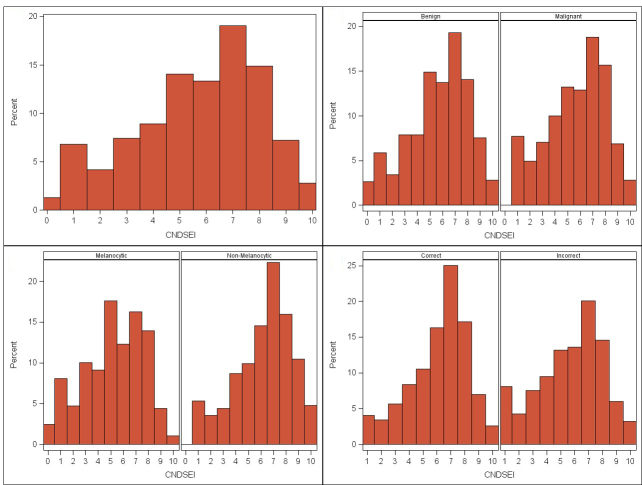
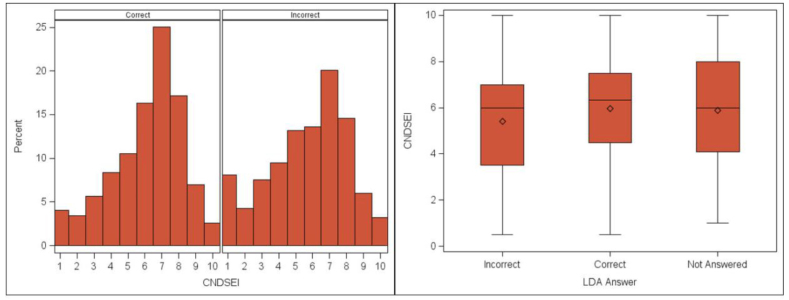
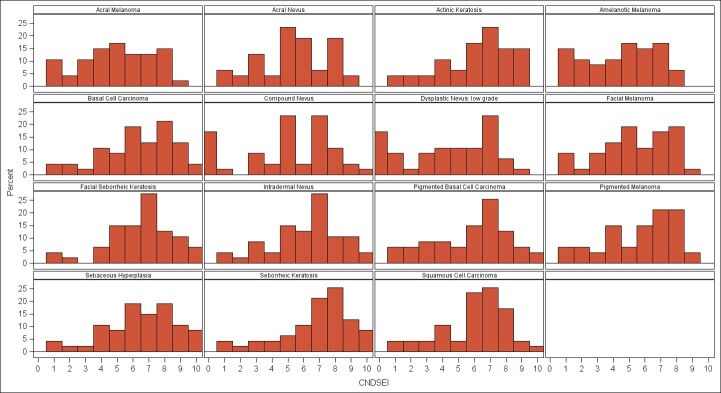
In the 2018-2019 academic year, the authors administered the CNDSEI and the Long Dermoscopy Assessment (LDA), to measure dermoscopic image interpretation accuracy, to residents in 9 dermatology residency programs prior to dermoscopy educational intervention exposure. The authors conducted CNDSEI item analysis with inspection of response distribution histograms, assessed internal reliability using Cronbach's coefficient alpha (α) and construct validity by comparing baseline CNDSEI and LDA results for corresponding lesions with one-way analysis of variance (ANOVA).
At baseline, residents respectively demonstrated significantly higher and lower CNDSEI scores for correctly and incorrectly diagnosed lesions on the LDA (P = 0.001). The internal consistency reliability of CNDSEI responses for the majority (13/15) of the lesion types was excellent (α ≥ 0.9) or good (0.8≥ α <0.9).
The CNDSEI pilot established that the tool reliably measures user dermoscopic image interpretation confidence and that self-efficacy correlates with diagnostic accuracy. Precise alignment of medical image diagnostic performance and the self-efficacy instrument content offers opportunity for construct validation of novel medical image interpretation self-efficacy instruments.
准确解读医学图像是包括皮肤科医生和初级保健提供者在内的多个医学专业的一项基本技能。皮肤镜是一种与光源配对的10倍至20倍放大镜,能够在标准目视检查之外增强对皮肤癌结构的可视化。熟练解读皮肤镜图像可提高皮肤癌的诊断准确性。
设计并验证皮肤肿瘤诊断自我效能量表(CNDSEI)——一种评估皮肤科住院医师对皮肤肿瘤进行皮肤镜诊断信心的新工具。
在2018 - 2019学年,作者在皮肤镜教育干预暴露之前,对9个皮肤科住院医师培训项目的住院医师进行了CNDSEI和长皮肤镜评估(LDA),以测量皮肤镜图像解读准确性。作者通过检查反应分布直方图进行CNDSEI项目分析,使用Cronbach's系数α(α)评估内部信度,并通过单向方差分析(ANOVA)比较相应病变的基线CNDSEI和LDA结果来构建效度。
在基线时,住院医师在LDA上对正确和错误诊断的病变分别表现出显著更高和更低的CNDSEI分数(P = 0.001)。大多数(13/15)病变类型的CNDSEI反应的内部一致性信度极佳(α≥0.9)或良好(0.8≥α<0.9)。
CNDSEI试点表明该工具能够可靠地测量用户对皮肤镜图像解读的信心,且自我效能与诊断准确性相关。医学图像诊断性能与自我效能量表内容的精确匹配为新型医学图像解读自我效能量表的构建效度提供了机会。