Friche Pauline, Moulis Lionel, Du Thanh Aurélie, Dereure Olivier, Duflos Claire, Carbonnel Francois
University Department of Family Medicine, University of Montpellier, Montpellier, France.
Clinical Research and Epidemiology Unit, Department of Public Health, Montpellier University Hospital, Montpellier, France.
JMIR Form Res. 2024 May 13;8:e56005. doi: 10.2196/56005.
Skin cancers are the most common group of cancers diagnosed worldwide. Aging and sun exposure increase their risk. The decline in the number of dermatologists is pushing the issue of dermatological screening back onto family doctors. Dermoscopy is an easy-to-use tool that increases the sensitivity of melanoma diagnosis by 60% to 90%, but its use is limited due to lack of training. The characteristics of "ideal" dermoscopy training have yet to be established. We created a Moodle (Moodle HQ)-based e-learning course to train family medicine residents in dermoscopy.
This study aimed to evaluate the evolution of dermoscopy knowledge among family doctors immediately and 1 and 3 months after e-learning training.
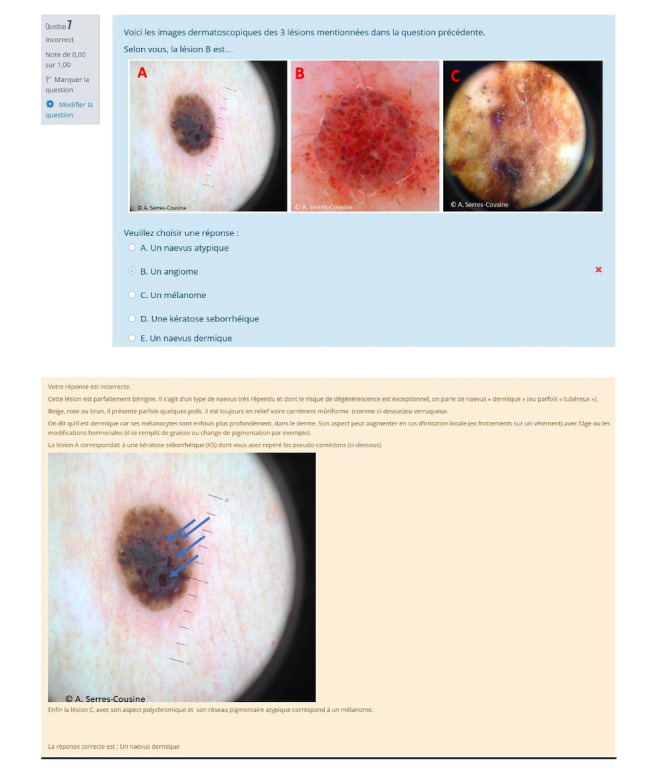
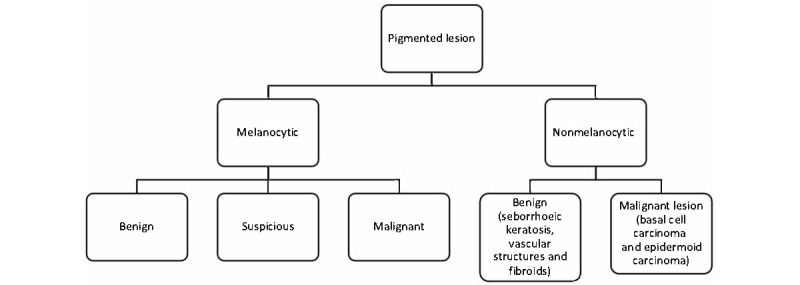
We conducted a prospective interventional study between April and November 2020 to evaluate an educational program intended for family medicine residents at the University of Montpellier-Nîmes, France. They were asked to complete an e-learning course consisting of 2 modules, with an assessment quiz repeated at 1 (M1) and 3 months (M3). The course was based on a 2-step algorithm, a method of dermoscopic analysis of pigmented skin lesions that is internationally accepted. The objectives of modules 1 and 2 were to differentiate melanocytic lesions from nonmelanocytic lesions and to precisely identify skin lesions by looking for dermoscopic morphological criteria specific to each lesion. Each module consisted of 15 questions with immediate feedback after each question.
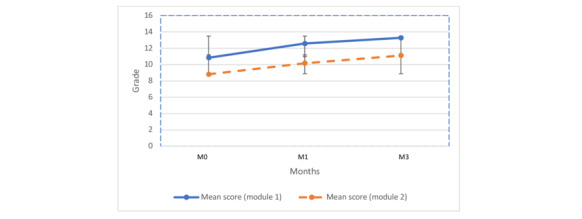
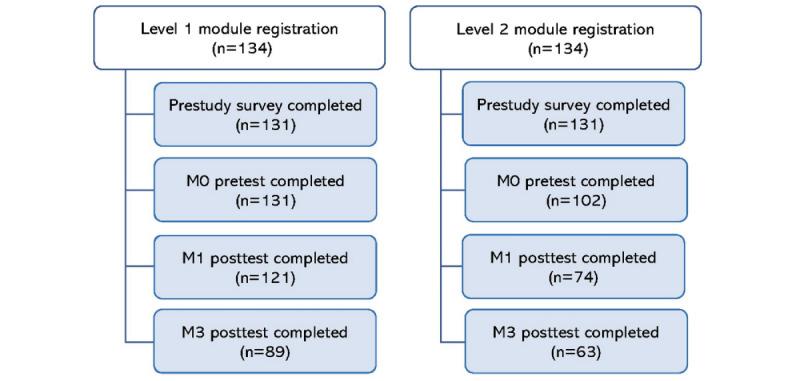
In total, 134 residents were included, and 66.4% (n=89) and 47% (n=63) of trainees fully participated in the evaluation of module 1 and module 2, respectively. This study showed a significant score improvement 3 months after the training course in 92.1% (n=82) of participants for module 1 and 87.3% (n=55) of participants for module 2 (P<.001). The majority of the participants expressed satisfaction (n=48, 90.6%) with the training course, and 96.3% (n=51) planned to use a dermatoscope in their future practice. Regarding final scores, the only variable that was statistically significant was the resident's initial scores (P=.003) for module 1. No measured variable was found to be associated with retention (midtraining or final evaluation) for module 2. Residents who had completed at least 1 dermatology rotation during medical school had significantly higher initial scores in module 1 at M0 (P=.03). Residents who reported having completed at least 1 dermatology rotation during their family medicine training had a statistically significant higher score at M1 for module 1 and M3 for module 2 (P=.01 and P=.001).
The integration of an e-learning training course in dermoscopy into the curriculum of FM residents results in a significant improvement in their diagnosis skills and meets their expectations. Developing a program combining an e-learning course and face-to-face training for residents is likely to result in more frequent and effective dermoscopy use by family doctors.
皮肤癌是全球诊断出的最常见癌症类型。衰老和日晒会增加患皮肤癌的风险。皮肤科医生数量的减少使得皮肤筛查问题重新落到家庭医生身上。皮肤镜检查是一种易于使用的工具,可将黑色素瘤诊断的敏感性提高60%至90%,但由于缺乏培训,其应用受到限制。“理想”的皮肤镜检查培训的特点尚未确定。我们创建了一个基于Moodle(Moodle总部)的电子学习课程,用于培训家庭医学住院医师进行皮肤镜检查。
本研究旨在评估家庭医生在电子学习培训后即刻、1个月和3个月时皮肤镜检查知识的进展情况。
2020年4月至11月,我们进行了一项前瞻性干预研究,以评估针对法国蒙彼利埃 - 尼姆大学家庭医学住院医师的教育项目。他们被要求完成一个由2个模块组成的电子学习课程,并在1个月(M1)和3个月(M3)时重复进行评估测验。该课程基于一种两步算法,这是一种国际认可的色素性皮肤病变的皮肤镜分析方法。模块1和模块2的目标是区分黑素细胞性病变和非黑素细胞性病变,并通过寻找每种病变特有的皮肤镜形态学标准来精确识别皮肤病变。每个模块由15个问题组成,每个问题后都有即时反馈。
总共纳入了134名住院医师,分别有66.4%(n = 89)和47%(n = 63)的学员充分参与了模块1和模块2的评估。本研究显示,培训课程3个月后,模块1的92.1%(n = 82)参与者和模块2的87.3%(n = 55)参与者的分数有显著提高(P <.001)。大多数参与者(n = 48,90.6%)对培训课程表示满意,96.3%(n = 51)计划在未来的实践中使用皮肤镜。关于最终分数,唯一具有统计学意义的变量是住院医师模块1的初始分数(P =.003)。未发现任何测量变量与模块2的留存率(培训中期或最终评估)相关。在医学院期间至少完成1次皮肤科轮转的住院医师在M0时模块1的初始分数显著更高(P =.03)。在家庭医学培训期间报告至少完成1次皮肤科轮转的住院医师在模块1的M1时和模块2的M3时分数有统计学意义的显著提高(P =.01和P =.001)。
将皮肤镜检查的电子学习培训课程纳入家庭医学住院医师的课程中,可显著提高他们的诊断技能并满足他们的期望。为住院医师开发一个结合电子学习课程和面对面培训的项目,可能会使家庭医生更频繁、有效地使用皮肤镜。