• 文献检索
  • 文档翻译
  • 深度研究
  • 学术资讯
  • Suppr Zotero 插件Zotero 插件
  • 邀请有礼
  • 套餐&价格
  • 历史记录
应用&插件
Suppr Zotero 插件Zotero 插件浏览器插件Mac 客户端Windows 客户端微信小程序
定价
高级版会员购买积分包购买API积分包
服务
文献检索文档翻译深度研究API 文档MCP 服务
关于我们
关于 Suppr公司介绍联系我们用户协议隐私条款
关注我们

Suppr 超能文献

核心技术专利:CN118964589B侵权必究
粤ICP备2023148730 号-1Suppr @ 2026

文献检索

告别复杂PubMed语法,用中文像聊天一样搜索,搜遍4000万医学文献。AI智能推荐,让科研检索更轻松。

立即免费搜索

文件翻译

保留排版,准确专业,支持PDF/Word/PPT等文件格式,支持 12+语言互译。

免费翻译文档

深度研究

AI帮你快速写综述,25分钟生成高质量综述,智能提取关键信息,辅助科研写作。

立即免费体验

将人工智能引入医学课程的重要性——评估从业者的观点。

The importance of introducing artificial intelligence to the medical curriculum - assessing practitioners' perspectives.

机构信息

Ivo Dumić-Čule, Children`s Hospital Srebrnjak, Srebrnjak 100, 10000 Zagreb, Croatia,

出版信息

Croat Med J. 2020 Oct 31;61(5):457-464. doi: 10.3325/cmj.2020.61.457.

DOI:10.3325/cmj.2020.61.457
PMID:33150764
原文链接:https://pmc.ncbi.nlm.nih.gov/articles/PMC7684542/
Abstract

AIM

To assess the attitude about the importance of introducing education on artificial intelligence (AI) in medical schools' curricula among physicians whose everyday job is significantly impacted by AI.

METHODS

An anonymous questionnaire was distributed at the national level in Croatia among radiologists and radiology residents practicing in primary, secondary, and tertiary health care institutions, both in the private and the public sectors. The overall response rate was 45% (144 of 321).

RESULTS

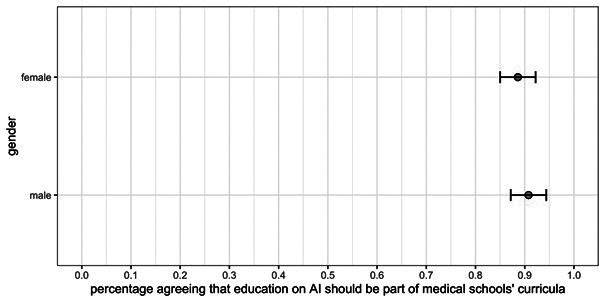
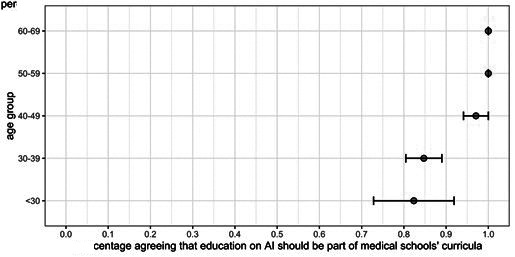
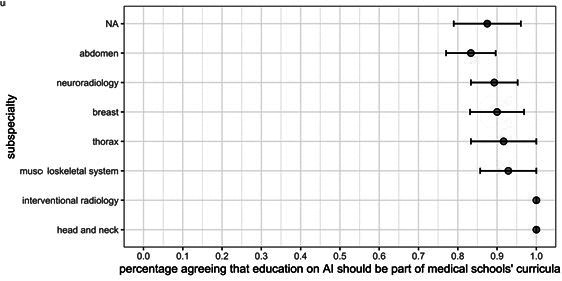
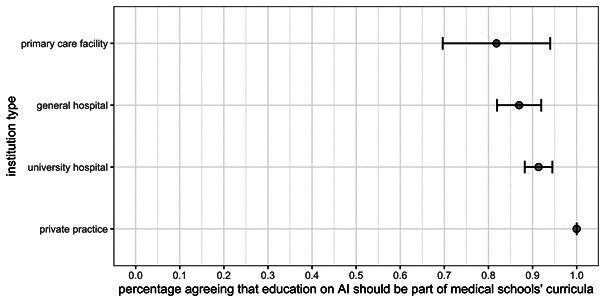
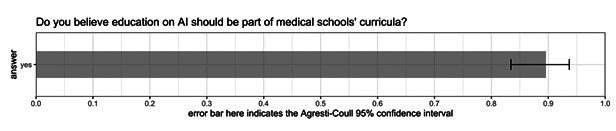
A large majority of participants - 89.6% (95% Agresti-Coull confidence interval 0.83-0.94) agreed on the need for education on AI to be included in medical curricula. Answers revealed a very high support across age groups and regardless of subspecialty area. A slightly higher support was present among physicians working in university hospitals compared with those in primary care centers, and among radiology residents compared with radiologists - but these estimated differences are uncertain, and the support levels were clearly high across the considered variables.

CONCLUSION

Since medical students have previously been shown to support introducing education on AI, a growing literature argues the same for reasons here reviewed, and physicians practicing a highly relevant area (radiology) overwhelmingly agree, we conclude that medical schools should indeed take steps to keep pace with technological progress in medicine by including education on AI in their curricula, be it as part of existing or new courses.

摘要

目的

评估在日常工作受到人工智能(AI)显著影响的医生中,对在医学院课程中引入 AI 教育的重要性的态度。

方法

在克罗地亚全国范围内,向在初级、二级和三级医疗机构(包括私营和公共部门)工作的放射科医生和放射科住院医师发放了一份匿名问卷。总体回复率为 45%(321 人中的 144 人)。

结果

绝大多数参与者(89.6%,95%Agresti-Coull 置信区间 0.83-0.94)同意需要在医学课程中纳入 AI 教育。答案表明,各年龄段和专业领域都非常支持。在大学医院工作的医生比在初级保健中心工作的医生以及放射科住院医师比放射科医生的支持率略高,但这些估计差异不确定,而且考虑到的变量的支持水平明显较高。

结论

由于医学生之前曾表示支持引入 AI 教育,越来越多的文献也从这里回顾的原因提出了同样的观点,并且在高度相关领域(放射科)工作的医生也压倒性地表示同意,因此我们得出结论,医学院应该通过在课程中纳入 AI 教育来跟上医学技术进步的步伐,无论是作为现有课程的一部分还是新的课程。
https://cdn.ncbi.nlm.nih.gov/pmc/blobs/d839/7684542/dce64811c475/CroatMedJ_61_0457-F5.jpg
https://cdn.ncbi.nlm.nih.gov/pmc/blobs/d839/7684542/69c97d5f722b/CroatMedJ_61_0457-F1.jpg
https://cdn.ncbi.nlm.nih.gov/pmc/blobs/d839/7684542/1d4e69b8463e/CroatMedJ_61_0457-F2.jpg
https://cdn.ncbi.nlm.nih.gov/pmc/blobs/d839/7684542/524090162b29/CroatMedJ_61_0457-F3.jpg
https://cdn.ncbi.nlm.nih.gov/pmc/blobs/d839/7684542/aacccdc967a9/CroatMedJ_61_0457-F4.jpg
https://cdn.ncbi.nlm.nih.gov/pmc/blobs/d839/7684542/dce64811c475/CroatMedJ_61_0457-F5.jpg
https://cdn.ncbi.nlm.nih.gov/pmc/blobs/d839/7684542/69c97d5f722b/CroatMedJ_61_0457-F1.jpg
https://cdn.ncbi.nlm.nih.gov/pmc/blobs/d839/7684542/1d4e69b8463e/CroatMedJ_61_0457-F2.jpg
https://cdn.ncbi.nlm.nih.gov/pmc/blobs/d839/7684542/524090162b29/CroatMedJ_61_0457-F3.jpg
https://cdn.ncbi.nlm.nih.gov/pmc/blobs/d839/7684542/aacccdc967a9/CroatMedJ_61_0457-F4.jpg
https://cdn.ncbi.nlm.nih.gov/pmc/blobs/d839/7684542/dce64811c475/CroatMedJ_61_0457-F5.jpg

相似文献

1
The importance of introducing artificial intelligence to the medical curriculum - assessing practitioners' perspectives.将人工智能引入医学课程的重要性——评估从业者的观点。
Croat Med J. 2020 Oct 31;61(5):457-464. doi: 10.3325/cmj.2020.61.457.
2
Knowledge, attitude, and perception of Arab medical students towards artificial intelligence in medicine and radiology: A multi-national cross-sectional study.阿拉伯医学专业学生对医学和放射学人工智能的知识、态度和看法:一项多国横断面研究。
Eur Radiol. 2024 Jul;34(7):1-14. doi: 10.1007/s00330-023-10509-2. Epub 2023 Dec 27.
3
Medical students' attitude towards artificial intelligence: a multicentre survey.医学生对人工智能的态度:一项多中心调查。
Eur Radiol. 2019 Apr;29(4):1640-1646. doi: 10.1007/s00330-018-5601-1. Epub 2018 Jul 6.
4
Influence of Artificial Intelligence on Canadian Medical Students' Preference for Radiology Specialty: ANational Survey Study.人工智能对加拿大医学生放射科专业偏好的影响:一项全国调查研究。
Acad Radiol. 2019 Apr;26(4):566-577. doi: 10.1016/j.acra.2018.10.007. Epub 2018 Nov 11.
5
A survey on the future of radiology among radiologists, medical students and surgeons: Students and surgeons tend to be more skeptical about artificial intelligence and radiologists may fear that other disciplines take over.一项针对放射科医生、医学生和外科医生的放射学未来的调查:学生和外科医生往往对人工智能持更怀疑的态度,而放射科医生可能担心其他学科会接管。
Eur J Radiol. 2019 Dec;121:108742. doi: 10.1016/j.ejrad.2019.108742. Epub 2019 Nov 9.
6
Artificial Intelligence/Machine Learning Education in Radiology: Multi-institutional Survey of Radiology Residents in the United States.人工智能/机器学习在放射学中的教育:美国放射科住院医师的多机构调查。
Acad Radiol. 2023 Jul;30(7):1481-1487. doi: 10.1016/j.acra.2023.01.005. Epub 2023 Jan 27.
7
Attitudes toward artificial intelligence in radiology with learner needs assessment within radiology residency programmes: a national multi-programme survey.医学影像学住培项目中基于学习者需求评估的学员对人工智能的态度:一项全国多项目调查。
Singapore Med J. 2021 Mar;62(3):126-134. doi: 10.11622/smedj.2019141. Epub 2019 Nov 4.
8
Systematic Review of Radiology Residency Artificial Intelligence Curricula: Preparing Future Radiologists for the Artificial Intelligence Era.系统评价放射科住院医师人工智能课程:为人工智能时代培养未来放射科医师。
J Am Coll Radiol. 2023 Jun;20(6):561-569. doi: 10.1016/j.jacr.2023.02.031. Epub 2023 Apr 29.
9
Artificial intelligence-based decision support system (AI-DSS) implementation in radiology residency: Introducing residents to AI in the clinical setting.基于人工智能的决策支持系统(AI-DSS)在放射科住院医师培训中的实施:在临床环境中向住院医师介绍人工智能。
Clin Imaging. 2022 Dec;92:32-37. doi: 10.1016/j.clinimag.2022.09.003. Epub 2022 Sep 26.
10
Impact of artificial intelligence on US medical students' choice of radiology.人工智能对美国医学生选择放射科的影响。
Clin Imaging. 2022 Jan;81:67-71. doi: 10.1016/j.clinimag.2021.09.018. Epub 2021 Oct 2.

引用本文的文献

1
Mechanisms of nurses' AI use intention formation in Sichuan, Yunnan, and Beijing, China: mediating effects of AI literacy via self-efficacy-to-attitude pathways.中国四川、云南和北京护士人工智能使用意图形成机制:通过自我效能感-态度路径的人工智能素养中介作用
Front Public Health. 2025 Jul 10;13:1622802. doi: 10.3389/fpubh.2025.1622802. eCollection 2025.
2
Artificial Intelligence in Health Education and Practice: A Systematic Review of Health Students' and Academics' Knowledge, Perceptions and Experiences.健康教育与实践中的人工智能:对健康专业学生和学者的知识、认知与经验的系统综述
Int Nurs Rev. 2025 Jun;72(2):e70045. doi: 10.1111/inr.70045.
3

本文引用的文献

1
Artificial Intelligence in Medicine: Today and Tomorrow.医学中的人工智能:现状与未来。
Front Med (Lausanne). 2020 Feb 5;7:27. doi: 10.3389/fmed.2020.00027. eCollection 2020.
2
Attitudes and perceptions of UK medical students towards artificial intelligence and radiology: a multicentre survey.英国医学生对人工智能与放射学的态度和认知:一项多中心调查
Insights Imaging. 2020 Feb 5;11(1):14. doi: 10.1186/s13244-019-0830-7.
3
Introducing Artificial Intelligence Training in Medical Education.医学教育中引入人工智能培训。
Patients' Perceptions of Artificial Intelligence Acceptance, Challenges, and Use in Medical Care: Qualitative Study.
患者对人工智能在医疗保健中的接受度、挑战及应用的认知:定性研究
J Med Internet Res. 2025 May 15;27:e70487. doi: 10.2196/70487.
4
Primary Care Provider Preferences Regarding Artificial Intelligence in Point-of-Care Cancer Screening.初级保健提供者对即时癌症筛查中人工智能的偏好
MDM Policy Pract. 2025 Apr 4;10(1):23814683251329007. doi: 10.1177/23814683251329007. eCollection 2025 Jan-Jun.
5
Medical Students' Perception Toward Using AI in Medical Education in the Kurdistan Region, Iraq: A Cross-Sectional Study.伊拉克库尔德地区医学生对医学教育中使用人工智能的认知:一项横断面研究。
Cureus. 2024 Sep 30;16(9):e70545. doi: 10.7759/cureus.70545. eCollection 2024 Sep.
6
Shaping future practices: German-speaking medical and dental students' perceptions of artificial intelligence in healthcare.塑造未来实践:德语国家医学生和牙科学学生对医疗保健中人工智能的看法。
BMC Med Educ. 2024 Aug 6;24(1):844. doi: 10.1186/s12909-024-05826-z.
7
Assessing AI Awareness and Identifying Essential Competencies: Insights From Key Stakeholders in Integrating AI Into Medical Education.评估人工智能意识和确定基本能力:将人工智能融入医学教育的主要利益相关者的见解。
JMIR Med Educ. 2024 Jun 12;10:e58355. doi: 10.2196/58355.
8
Knowledge, attitude, and perception of Arab medical students towards artificial intelligence in medicine and radiology: A multi-national cross-sectional study.阿拉伯医学专业学生对医学和放射学人工智能的知识、态度和看法:一项多国横断面研究。
Eur Radiol. 2024 Jul;34(7):1-14. doi: 10.1007/s00330-023-10509-2. Epub 2023 Dec 27.
9
Impact of Hair Transplantation on Quality of Life.毛发移植对生活质量的影响。
Aesthetic Plast Surg. 2024 May;48(9):1825-1830. doi: 10.1007/s00266-023-03781-6. Epub 2023 Dec 20.
10
A survey on practitioners' attitudes toward artificial intelligence in radiology.放射科从业者对人工智能态度的调查。
Croat Med J. 2023 Aug 31;64(4):289-291. doi: 10.3325/cmj.2023.64.289.
JMIR Med Educ. 2019 Dec 3;5(2):e16048. doi: 10.2196/16048.
4
Impact of artificial intelligence on radiology: a EuroAIM survey among members of the European Society of Radiology.人工智能对放射学的影响:欧洲放射学会成员的一项欧洲人工智能医学影像项目(EuroAIM)调查。
Insights Imaging. 2019 Oct 31;10(1):105. doi: 10.1186/s13244-019-0798-3.
5
Perception of Artificial Intelligence (AI) among radiologists.放射科医生对人工智能(AI)的认知
Acta Radiol Open. 2019 Sep 30;8(9):2058460119878662. doi: 10.1177/2058460119878662. eCollection 2019 Sep.
6
Potential Liability for Physicians Using Artificial Intelligence.医生使用人工智能的潜在责任。
JAMA. 2019 Nov 12;322(18):1765-1766. doi: 10.1001/jama.2019.15064.
7
Artificial intelligence in digital pathology - new tools for diagnosis and precision oncology.人工智能在数字病理学中的应用——诊断和精准肿瘤学的新工具。
Nat Rev Clin Oncol. 2019 Nov;16(11):703-715. doi: 10.1038/s41571-019-0252-y. Epub 2019 Aug 9.
8
Artificial intelligence and dermatology: opportunities, challenges, and future directions.人工智能与皮肤病学:机遇、挑战及未来方向。
Semin Cutan Med Surg. 2019 Mar 1;38(1):E31-37. doi: 10.12788/j.sder.2019..
9
Artificial intelligence in healthcare.人工智能在医疗保健领域的应用。
Nat Biomed Eng. 2018 Oct;2(10):719-731. doi: 10.1038/s41551-018-0305-z. Epub 2018 Oct 10.
10
High-performance medicine: the convergence of human and artificial intelligence.高性能医学:人机智能融合。
Nat Med. 2019 Jan;25(1):44-56. doi: 10.1038/s41591-018-0300-7. Epub 2019 Jan 7.