• 文献检索
  • 文档翻译
  • 深度研究
  • 学术资讯
  • Suppr Zotero 插件Zotero 插件
  • 邀请有礼
  • 套餐&价格
  • 历史记录
应用&插件
Suppr Zotero 插件Zotero 插件浏览器插件Mac 客户端Windows 客户端微信小程序
定价
高级版会员购买积分包购买API积分包
服务
文献检索文档翻译深度研究API 文档MCP 服务
关于我们
关于 Suppr公司介绍联系我们用户协议隐私条款
关注我们

Suppr 超能文献

核心技术专利:CN118964589B侵权必究
粤ICP备2023148730 号-1Suppr @ 2026

文献检索

告别复杂PubMed语法,用中文像聊天一样搜索,搜遍4000万医学文献。AI智能推荐,让科研检索更轻松。

立即免费搜索

文件翻译

保留排版,准确专业,支持PDF/Word/PPT等文件格式,支持 12+语言互译。

免费翻译文档

深度研究

AI帮你快速写综述,25分钟生成高质量综述,智能提取关键信息,辅助科研写作。

立即免费体验

健康教育与实践中的人工智能:对健康专业学生和学者的知识、认知与经验的系统综述

Artificial Intelligence in Health Education and Practice: A Systematic Review of Health Students' and Academics' Knowledge, Perceptions and Experiences.

作者信息

Shishehgar Sara, Murray-Parahi Pauline, Alsharaydeh Ethar, Mills Sarah, Liu Xianliang

机构信息

School of Nursing and Midwifery, Western Sydney University, Australia.

Faculty of Health, Charles Darwin University, Australia.

出版信息

Int Nurs Rev. 2025 Jun;72(2):e70045. doi: 10.1111/inr.70045.

DOI:10.1111/inr.70045
PMID:40545441
原文链接:https://pmc.ncbi.nlm.nih.gov/articles/PMC12183008/
Abstract

BACKGROUND/OBJECTIVE: Artificial intelligence (AI) is embedded in healthcare education and practice. Pre-service training on AI technologies allows health professionals to identify the best use of AI. This systematic review explores health students'/academics' perception of using AI in their practice. The authors aimed to identify any gaps in the health curriculum related to AI training that may need to be addressed.

METHODS

Medline (EBSCO), Web of Science, CINAHL (EBSCO), ERIC, Google Scholar, and Scopus were searched using key terms including health students, health academics, AI, and higher education. Quantitative and qualitative studies published in the last seven years were reviewed. JBI SUMARI was used to facilitate study selection, data extraction, and quality assessment of included articles. Thematic and descriptive data analyses were used to retrieve data. This systematic review has been registered in PROSPERO (CRD42023448005).

RESULTS

Twelve studies, including seven quantitative and five mixed-method studies, provided novel insights into health students' perceptions of using AI in health education or practice. Quantitative findings reported significant variations in attitudes and literacy levels regarding AI across different disciplines and demographics. Senior students and those with doctoral degrees exhibited more favourable outlooks compared with their less experienced counterparts (p < 0.001). Students intending to pursue careers in research demonstrated greater optimism towards AI adoption than those planning to work in clinical practice (p < 0.001). A review of qualitative data, particularly on nursing discipline, revealed four themes, including limited AI literacy, replacement of health specialties with AI vs. providing support, optimism vs. cautiousness about using AI in practice, and ethical concerns. Only one study explored health academics' experiences with AI in education, highlighting a gap in the current literature. This is while that students consistently agreed that universities are the best setting for learning about AI technologies in healthcare highlighting the need for embedding AI training into the health curricula to prepare future healthcare professionals.

CONCLUSION AND IMPLICATIONS FOR NURSING/HEALTH POLICY: This systematic review recommends embedding AI training in health curriculum, offering direction for health education providers and curriculum developers responsible for preparing next-generation healthcare professionals, particularly nurses. Ethical considerations and the future role of AI in healthcare practice remain central concerns to be addressed in both curriculum development and future research. Further research is required to address the implication and cost-effectiveness of embedding AI training into health curricula.
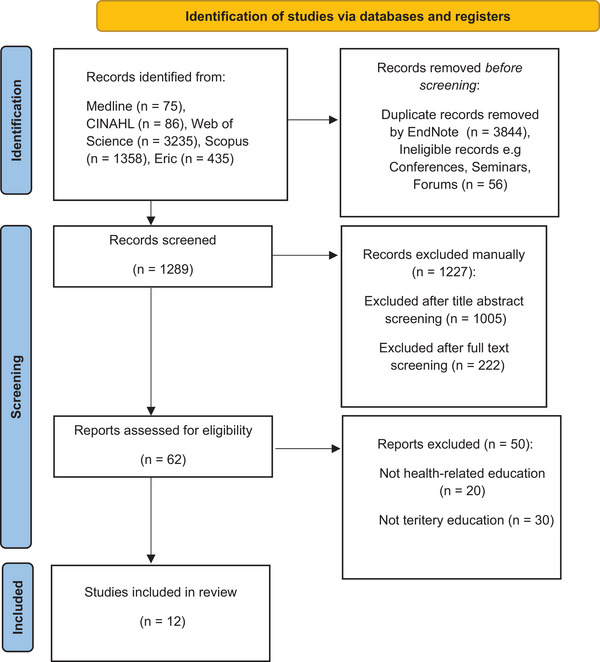
https://cdn.ncbi.nlm.nih.gov/pmc/blobs/dcdd/12183008/35084d978a1b/INR-72-0-g001.jpg
摘要

背景/目的:人工智能(AI)已融入医疗保健教育和实践之中。针对人工智能技术的职前培训能让卫生专业人员确定人工智能的最佳用途。本系统评价探讨了卫生专业学生/学者对在其实践中使用人工智能的看法。作者旨在找出健康课程中与人工智能培训相关的可能需要解决的差距。

方法

使用包括卫生专业学生、卫生专业学者、人工智能和高等教育等关键词,对医学期刊数据库(EBSCO)、科学引文索引、护理学与健康领域数据库(EBSCO)、教育资源信息中心、谷歌学术和Scopus进行检索。对过去七年发表的定量和定性研究进行了综述。使用循证卫生保健国际协作组织的循证卫生保健系统评价软件来促进纳入文章的研究选择、数据提取和质量评估。采用主题和描述性数据分析来检索数据。本系统评价已在国际前瞻性系统评价注册库(注册号:CRD42023448005)中登记。

结果

12项研究,包括7项定量研究和5项混合方法研究,为卫生专业学生对在健康教育或实践中使用人工智能的看法提供了新的见解。定量研究结果表明,不同学科和人口统计学特征的学生对人工智能的态度和知识水平存在显著差异。与经验较少的学生相比,高年级学生和拥有博士学位的学生表现出更积极的态度(p<0.001)。打算从事研究工作的学生对采用人工智能的态度比计划从事临床实践的学生更为乐观(p<0.001)。对定性数据的回顾,特别是关于护理学科的数据,揭示了四个主题,包括人工智能知识有限、人工智能取代卫生专业与提供支持、在实践中使用人工智能的乐观与谨慎态度以及伦理问题。只有一项研究探讨了卫生专业学者在教育中使用人工智能的经历,凸显了当前文献中的一个空白。与此同时,学生们一致认为大学是学习医疗保健领域人工智能技术的最佳场所,这突出表明需要将人工智能培训纳入健康课程,以培养未来的医疗保健专业人员。

结论及对护理/卫生政策的启示:本系统评价建议将人工智能培训纳入健康课程,为负责培养下一代医疗保健专业人员(尤其是护士)的健康教育提供者和课程开发者提供指导。伦理考量以及人工智能在医疗保健实践中的未来作用仍然是课程开发和未来研究中需要解决的核心问题。需要进一步研究以探讨将人工智能培训纳入健康课程的影响和成本效益。

相似文献

1
Artificial Intelligence in Health Education and Practice: A Systematic Review of Health Students' and Academics' Knowledge, Perceptions and Experiences.健康教育与实践中的人工智能:对健康专业学生和学者的知识、认知与经验的系统综述
Int Nurs Rev. 2025 Jun;72(2):e70045. doi: 10.1111/inr.70045.
2
Health professionals' experience of teamwork education in acute hospital settings: a systematic review of qualitative literature.医疗专业人员在急症医院环境中团队合作教育的经验:对定性文献的系统综述
JBI Database System Rev Implement Rep. 2016 Apr;14(4):96-137. doi: 10.11124/JBISRIR-2016-1843.
3
Pharmacy students' perceptions of artificial intelligence integration in pharmacy practice: Ethical challenges in multiple countries of the MENA region.药学专业学生对人工智能融入药学实践的看法:中东和北非地区多个国家的伦理挑战
Curr Pharm Teach Learn. 2025 Jun 5;17(9):102397. doi: 10.1016/j.cptl.2025.102397.
4
The educational effects of portfolios on undergraduate student learning: a Best Evidence Medical Education (BEME) systematic review. BEME Guide No. 11.档案袋对本科学生学习的教育效果:最佳证据医学教育(BEME)系统评价。BEME指南第11号。
Med Teach. 2009 Apr;31(4):282-98. doi: 10.1080/01421590902889897.
5
Multi-stakeholder preferences for the use of artificial intelligence in healthcare: A systematic review and thematic analysis.多利益相关方对人工智能在医疗保健中的应用的偏好:系统评价和主题分析。
Soc Sci Med. 2023 Dec;338:116357. doi: 10.1016/j.socscimed.2023.116357. Epub 2023 Nov 4.
6
Faculty development initiatives designed to promote leadership in medical education. A BEME systematic review: BEME Guide No. 19.旨在促进医学教育领导力的教师发展计划。BEME 系统评价:BEME 指南第 19 号。
Med Teach. 2012;34(6):483-503. doi: 10.3109/0142159X.2012.680937.
7
The measurement of collaboration within healthcare settings: a systematic review of measurement properties of instruments.医疗机构内协作的测量:对测量工具属性的系统评价
JBI Database System Rev Implement Rep. 2016 Apr;14(4):138-97. doi: 10.11124/JBISRIR-2016-2159.
8
Factors that impact on the use of mechanical ventilation weaning protocols in critically ill adults and children: a qualitative evidence-synthesis.影响重症成人和儿童机械通气撤机方案使用的因素:一项定性证据综合分析
Cochrane Database Syst Rev. 2016 Oct 4;10(10):CD011812. doi: 10.1002/14651858.CD011812.pub2.
9
Experiences of pre-licensure or pre-registration health professional students and their educators in working with intra-professional teams: a qualitative systematic review.执照前或注册前卫生专业学生及其教育工作者在跨专业团队合作中的经历:一项定性系统评价
JBI Database System Rev Implement Rep. 2017 Apr;15(4):1011-1056. doi: 10.11124/JBISRIR-2016-003009.
10
Experiences of registered nurses as managers and leaders in residential aged care facilities: a systematic review.注册护士在养老院的管理和领导经验:系统评价。
Int J Evid Based Healthc. 2011 Dec;9(4):388-402. doi: 10.1111/j.1744-1609.2011.00239.x.

本文引用的文献

1
A systematic review of the impact of artificial intelligence on educational outcomes in health professions education.人工智能对卫生专业教育中教育成果影响的系统评价。
BMC Med Educ. 2025 Jan 27;25(1):129. doi: 10.1186/s12909-025-06719-5.
2
AI as an intervention: improving clinical outcomes relies on a causal approach to AI development and validation.作为一种干预手段的人工智能:改善临床结果依赖于对人工智能开发和验证采用因果方法。
J Am Med Inform Assoc. 2025 Mar 1;32(3):589-594. doi: 10.1093/jamia/ocae301.
3
Artificial intelligence in medical education - perception among medical students.
人工智能在医学教育中的应用——医学生的认知。
BMC Med Educ. 2024 Jul 27;24(1):804. doi: 10.1186/s12909-024-05760-0.
4
Relationship Between Individual Innovativeness Levels and Attitudes Toward Artificial Intelligence Among Nursing and Midwifery Students.护理和助产学专业学生个体创新水平与对人工智能态度的关系。
Comput Inform Nurs. 2024 Nov 1;42(11):802-808. doi: 10.1097/CIN.0000000000001170.
5
Artificial Intelligence Readiness, Perceptions, and Educational Needs Among Dental Students: A Cross-Sectional Study.人工智能准备情况、认知与牙科学子的教育需求:一项横断面研究。
Clin Exp Dent Res. 2024 Aug;10(4):e925. doi: 10.1002/cre2.925.
6
The Cooperation Between Nurses and a New Digital Colleague "AI-Driven Lifestyle Monitoring" in Long-Term Care for Older Adults: Viewpoint.护士与新数字同事"AI 驱动的生活方式监测"在老年人长期护理中的合作:观点。
JMIR Nurs. 2024 May 23;7:e56474. doi: 10.2196/56474.
7
Digital proficiency: assessing knowledge, attitudes, and skills in digital transformation, health literacy, and artificial intelligence among university nursing students.数字化素养:评估大学生护理学生在数字化转型、健康素养和人工智能方面的知识、态度和技能。
BMC Med Educ. 2024 May 7;24(1):508. doi: 10.1186/s12909-024-05482-3.
8
Medical education and physician training in the era of artificial intelligence.人工智能时代的医学教育和医师培训。
Singapore Med J. 2024 Mar 1;65(3):159-166. doi: 10.4103/singaporemedj.SMJ-2023-203. Epub 2024 Mar 26.
9
Awareness and level of digital literacy among students receiving health-based education.接受健康教育的学生的数字素养意识和水平。
BMC Med Educ. 2024 Jan 8;24(1):38. doi: 10.1186/s12909-024-05025-w.
10
Artificial Intelligence in Medicine: Cross-Sectional Study Among Medical Students on Application, Education, and Ethical Aspects.人工智能在医学中的应用:医学生对应用、教育和伦理方面的横断面研究。
JMIR Med Educ. 2024 Jan 5;10:e51247. doi: 10.2196/51247.