University College London, Department of Medical Physics and Biomedical Engineering, London, United Kingdom.
J Biomed Opt. 2020 Nov;25(11). doi: 10.1117/1.JBO.25.11.110501.
The application of near-infrared spectroscopy (NIRS) to determine the concentrations of tissue chromophores has typically relied on three alternative technological approaches: continuous-wave, frequency-domain, and time-domain. It is often the case that uncertain and variable coupling of light into and out of the skin surface renders absolute measurements unreliable, and NIRS methods are mostly used to measure changes of chromophore concentrations and of physiological parameters such as blood volume and oxygenation.
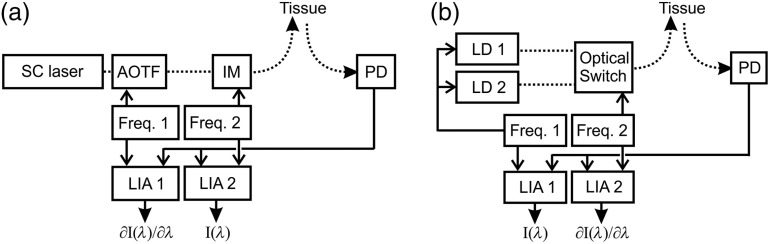
The aim has been to investigate whether an approach based on a wavelength-modulated source may enable measurements to be acquired, which are independent of surface coupling and may facilitate derivation of absolute values of tissue parameters.
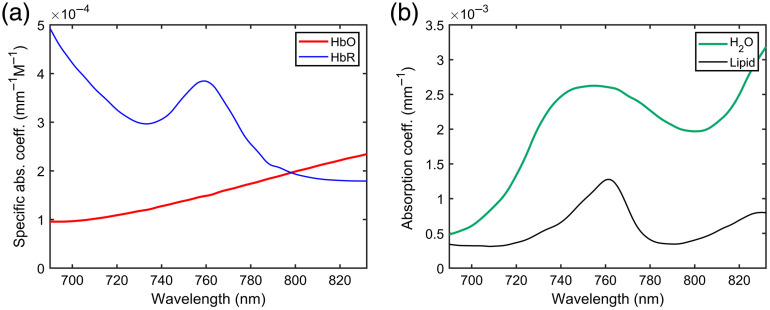
An analysis is performed using the modified Beer-Lambert law.
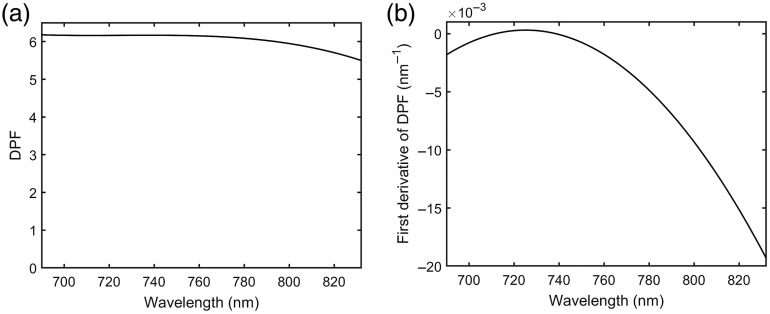
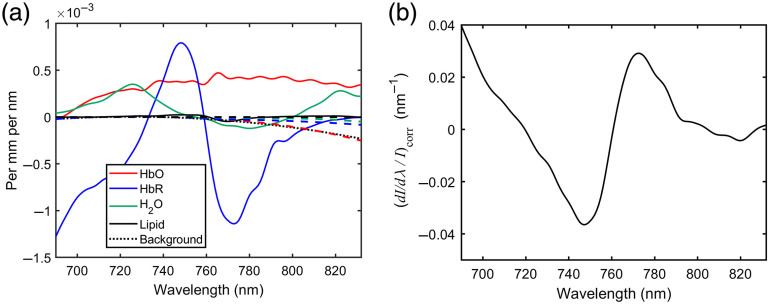
It is shown that the relative modulation in detected intensity resulting from a wavelength-modulated source could be used to estimate absolute concentrations of chromophores if unknown surface coupling losses and geometrical factors are insensitive to small changes in wavelength.
Wavelength modulated NIRS could be an effective tool for quantitative in vivo analysis of tissues, although it may be technically challenging.
近红外光谱(NIRS)在确定组织色团浓度方面的应用通常依赖于三种替代技术方法:连续波、频域和时域。通常情况下,光在皮肤表面的耦合不确定且可变,这使得绝对测量不可靠,NIRS 方法主要用于测量色团浓度和生理参数(如血容量和氧合)的变化。
本研究旨在探讨基于波长调制源的方法是否可以进行测量,这种方法不依赖于表面耦合,并可能有助于推导组织参数的绝对值。
使用修正的 Beer-Lambert 定律进行分析。
结果表明,如果未知的表面耦合损耗和几何因子对波长的微小变化不敏感,则可以使用波长调制源产生的检测强度的相对调制来估计色团的绝对浓度。
波长调制 NIRS 可能是组织定量活体分析的有效工具,尽管它可能具有技术挑战性。