Su Chengyong, Xie Tingting, Wang Yunliang, Si Chengcai, Li Luyan, Ma Junye, Li Chunxiang, Sun Xiaoyan, Hao Jiasheng, Yang Qun
College of Life Sciences, Anhui Normal University, Wuhu 241000, China.
State Key Laboratory of Palaeobiology and Stratigraphy, Center for Excellence in Life and Palaeoenvironment, Nanjing Institute of Geology and Paleontology, Chinese Academy of Sciences, Nanjing 210008, China.
Insects. 2020 Nov 3;11(11):754. doi: 10.3390/insects11110754.
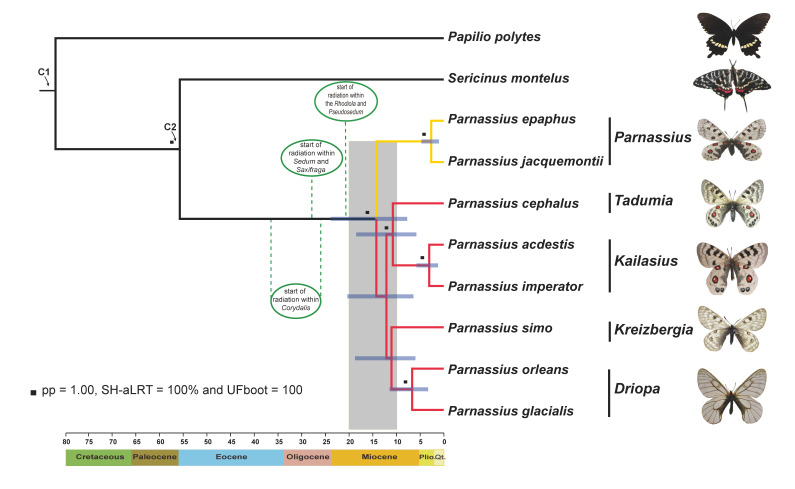
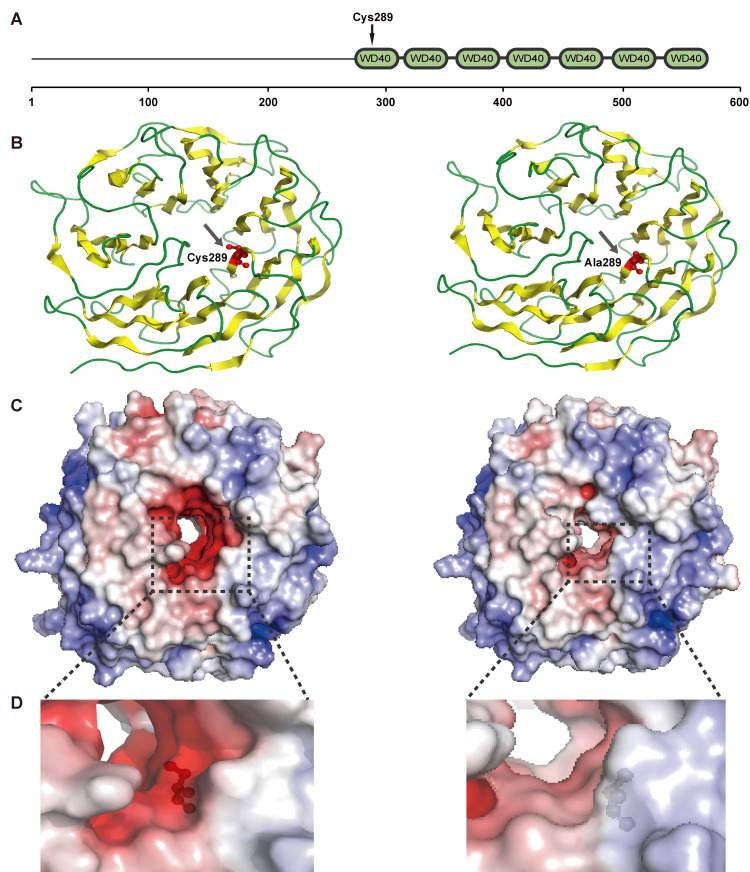
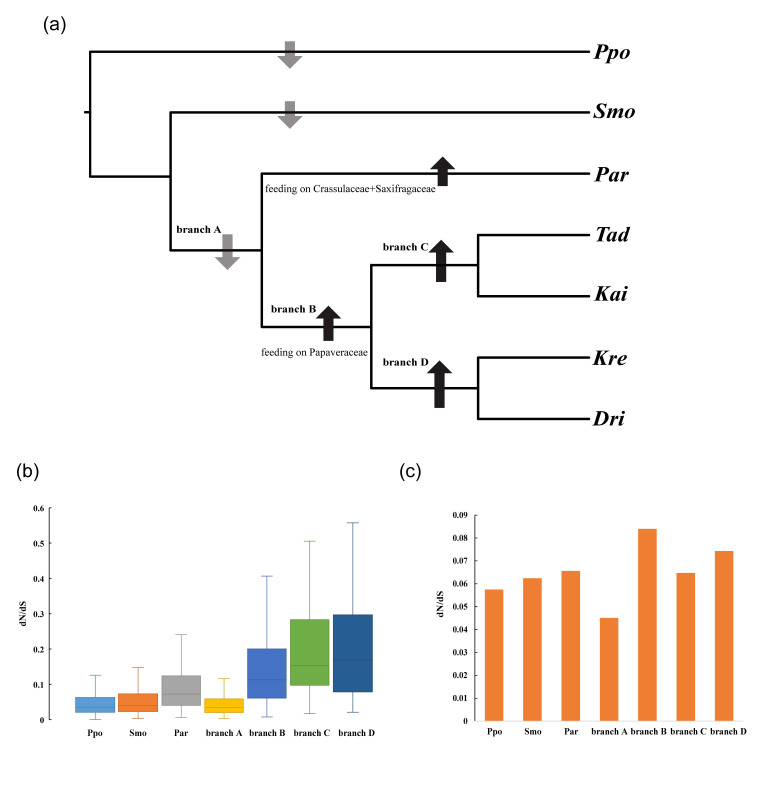
The early evolutionary pattern and molecular adaptation mechanism of alpine butterflies to high altitudes in Qinghai-Tibet Plateau are poorly understood up to now, due to difficulties in sampling, limited sequence data, and time calibration issues. Here, we present large-scale transcriptomic datasets of eight representative species to reveal the phylogenetic timescale and potential genetic basis for high-altitude adaptation with multiple analytic strategies using 476 orthologous genes. Our phylogenetic results strongly supported that the subgenus formed a well-resolved basal clade, and the subgenera and were closely related in the phylogenetic trees. In addition, molecular dating analyses showed that the began to diverge at about 13.0 to 14.3 million years ago (middle Miocene), correlated with their hostplant's spatiotemporal distributions, as well as geological and palaeoenvironmental changes of the Qinghai-Tibet Plateau. Moreover, the accelerated evolutionary rate, candidate positively selected genes and their potentially functional changes were detected, probably contributed to the high-altitude adaptation of species. Overall, our study provided some new insights into the spatiotemporally evolutionary pattern and high altitude adaptation of butterflies from the extrinsic and intrinsic view, which will help to address evolution, biodiversity, and conservation questions concerning and other butterfly species.
由于采样困难、序列数据有限以及时间校准问题,迄今为止,人们对青藏高原高山蝴蝶早期的进化模式和对高海拔的分子适应机制了解甚少。在此,我们展示了八个代表性物种的大规模转录组数据集,以利用476个直系同源基因,通过多种分析策略揭示系统发育时间尺度和高海拔适应的潜在遗传基础。我们的系统发育结果有力地支持了该亚属形成了一个解析良好的基部类群,并且该亚属和在系统发育树中密切相关。此外,分子年代分析表明,大约在1300万至1430万年前(中新世中期)开始分化,这与它们寄主植物的时空分布以及青藏高原的地质和古环境变化相关。此外,还检测到加速的进化速率、候选的正选择基因及其潜在的功能变化,这可能有助于该物种的高海拔适应。总体而言,我们的研究从外在和内在视角为蝴蝶的时空进化模式和高海拔适应提供了一些新见解,这将有助于解决有关蝴蝶及其他蝴蝶物种的进化、生物多样性和保护问题。