Department of Biochemistry, College of Medicine and Health Sciences, United Arab Emirates University, Al Ain, Abu Dhabi, UAE.
Department of Anatomy, College of Medicine and Health Sciences, United Arab Emirates University, Al Ain, Abu Dhabi, UAE; Zayed Center for Health Sciences, United Arab Emirates University, Al Ain, Abu Dhabi, UAE.
J Biol Chem. 2021 Jan-Jun;296:100035. doi: 10.1074/jbc.REV120.014915. Epub 2020 Dec 1.
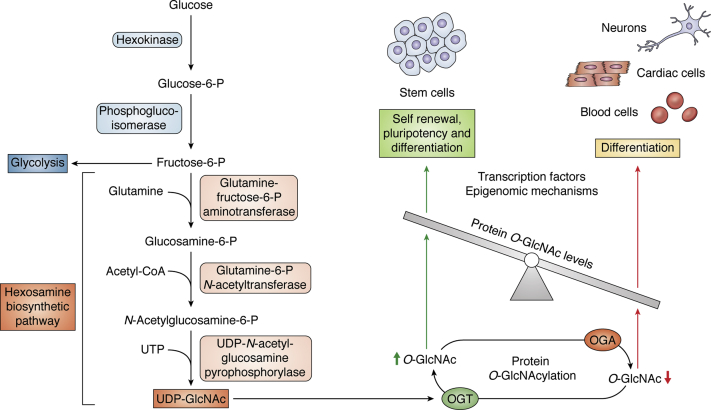
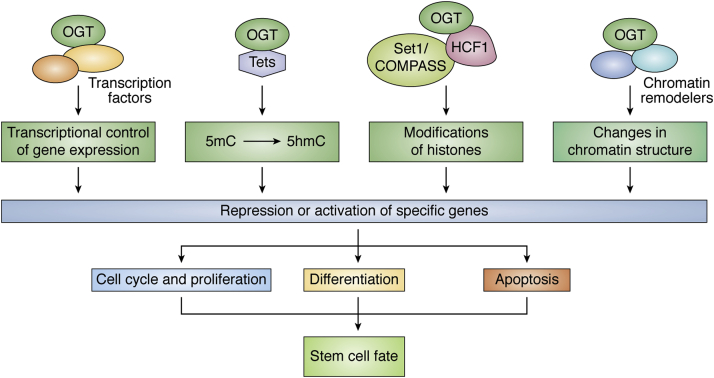
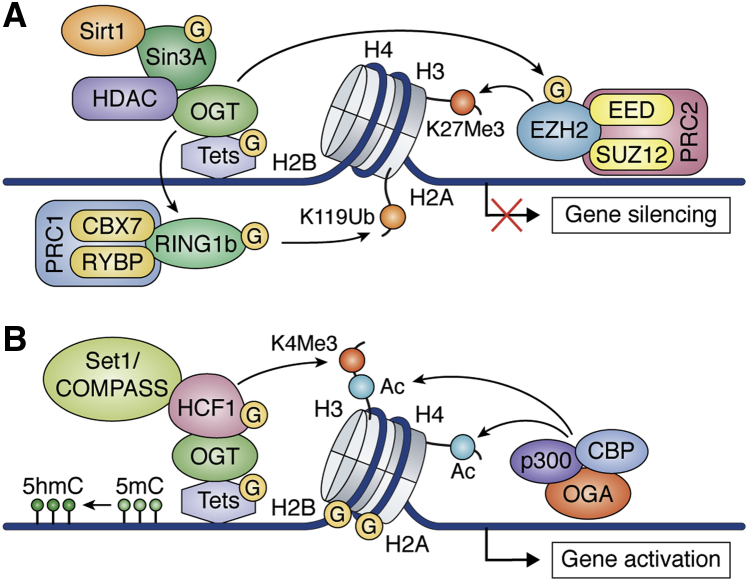
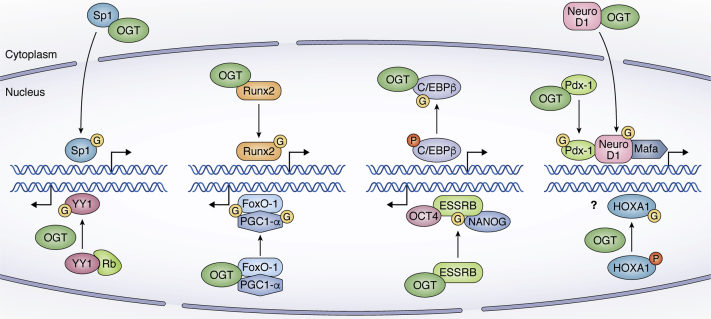
Embryonic and adult stem cells possess the capability of self-renewal and lineage-specific differentiation. The intricate balance between self-renewal and differentiation is governed by developmental signals and cell-type-specific gene regulatory mechanisms. A perturbed intra/extracellular environment during lineage specification could affect stem cell fate decisions resulting in pathology. Growing evidence demonstrates that metabolic pathways govern epigenetic regulation of gene expression during stem cell fate commitment through the utilization of metabolic intermediates or end products of metabolic pathways as substrates for enzymatic histone/DNA modifications. UDP-GlcNAc is one such metabolite that acts as a substrate for enzymatic mono-glycosylation of various nuclear, cytosolic, and mitochondrial proteins on serine/threonine amino acid residues, a process termed protein O-GlcNAcylation. The levels of GlcNAc inside the cells depend on the nutrient availability, especially glucose. Thus, this metabolic sensor could modulate gene expression through O-GlcNAc modification of histones or other proteins in response to metabolic fluctuations. Herein, we review evidence demonstrating how stem cells couple metabolic inputs to gene regulatory pathways through O-GlcNAc-mediated epigenetic/transcriptional regulatory mechanisms to govern self-renewal and lineage-specific differentiation programs. This review will serve as a primer for researchers seeking to better understand how O-GlcNAc influences stemness and may catalyze the discovery of new stem-cell-based therapeutic approaches.
胚胎和成体干细胞具有自我更新和谱系特异性分化的能力。自我更新和分化之间的精细平衡受发育信号和细胞类型特异性基因调控机制的控制。谱系特化过程中细胞内/外环境的紊乱可能会影响干细胞命运决策,导致病理发生。越来越多的证据表明,代谢途径通过将代谢中间产物或代谢途径的终产物用作酶促组蛋白/DNA 修饰的底物,来调控干细胞命运决定过程中的表观遗传基因表达。UDP-GlcNAc 就是这样一种代谢物,它可以作为各种核、胞质和线粒体蛋白丝氨酸/苏氨酸残基上酶促单糖基化的底物,这个过程称为蛋白质 O-GlcNAc 糖基化。细胞内的 GlcNAc 水平取决于营养物质的可用性,特别是葡萄糖。因此,这种代谢传感器可以通过 O-GlcNAc 修饰组蛋白或其他蛋白质来调节基因表达,以响应代谢波动。本文综述了证据,证明干细胞如何通过 O-GlcNAc 介导的表观遗传/转录调控机制将代谢输入与基因调控途径偶联,从而调控自我更新和谱系特异性分化程序。本文综述将为寻求更好地理解 O-GlcNAc 如何影响干细胞特性并可能促进基于干细胞的新治疗方法发现的研究人员提供一个基础。