Wisconsin National Primate Research Center, University of Wisconsin-Madison, Madison, WI, USA.
Department of Comparative Biosciences, University of Wisconsin-Madison, Madison, WI, USA.
Sci Rep. 2020 Nov 5;10(1):19159. doi: 10.1038/s41598-020-76313-w.
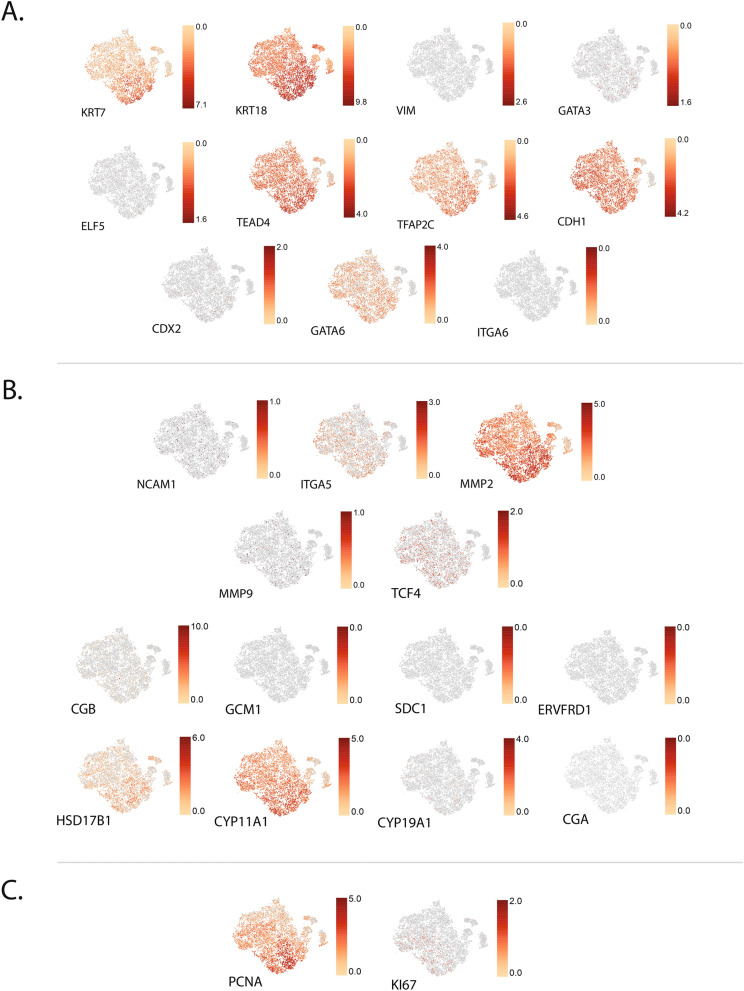
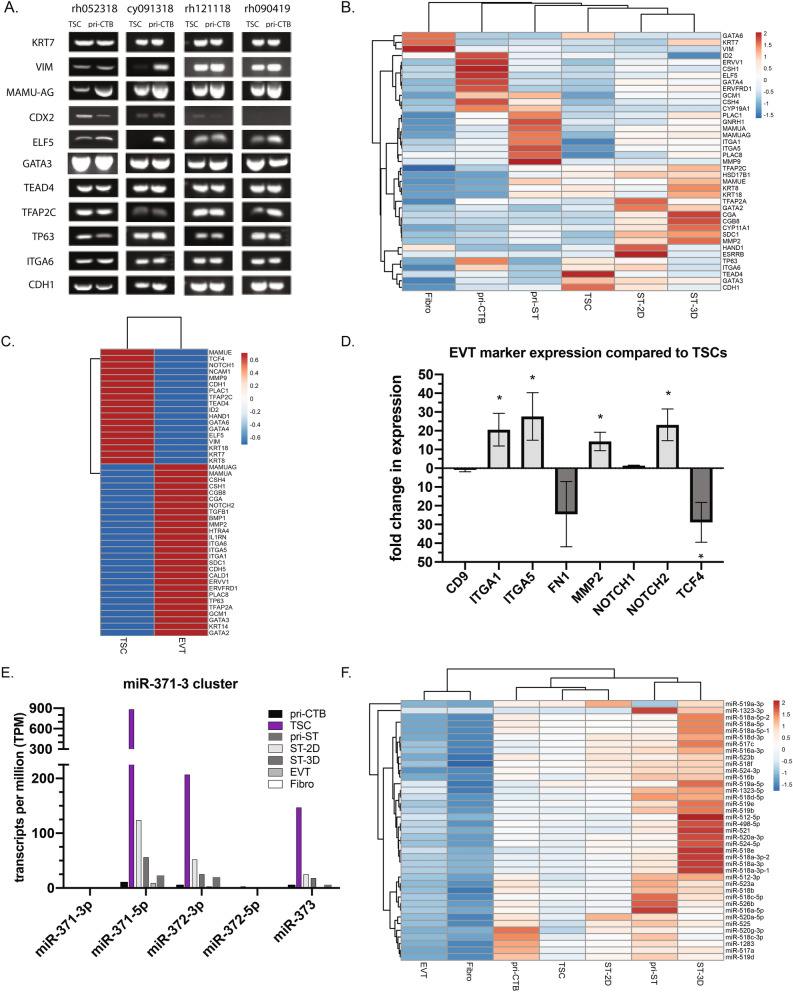
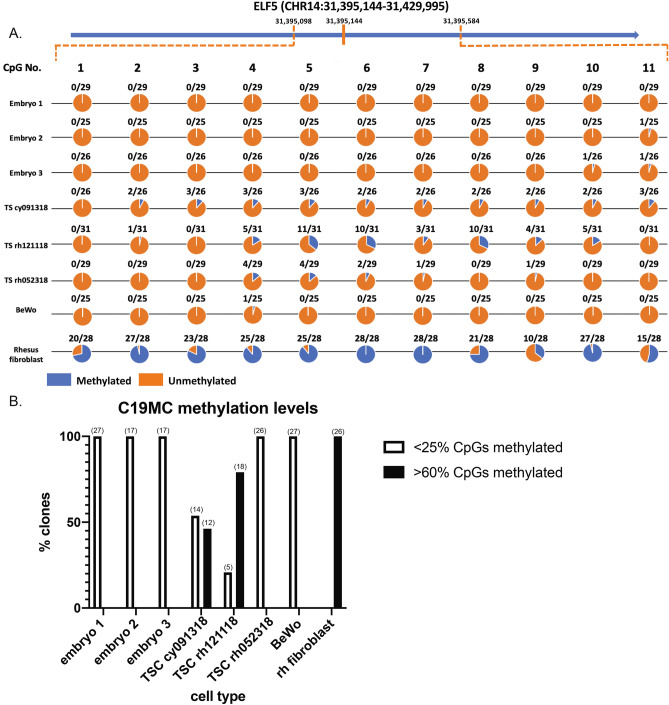
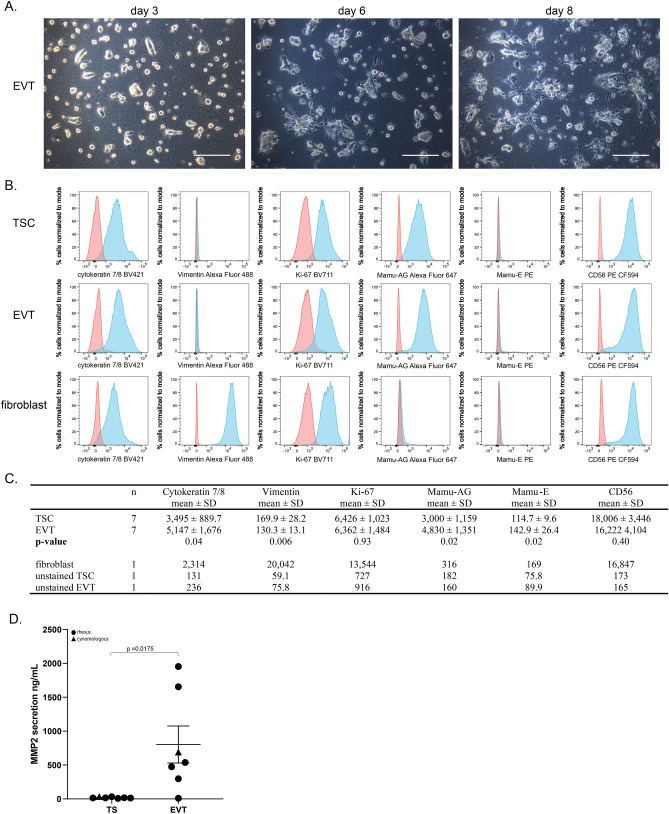
Nonhuman primates are excellent models for studying human placentation as experimental manipulations in vitro can be translated to in vivo pregnancy. Our objective was to develop macaque trophoblast stem cells (TSCs) as an in vitro platform for future assessment of primate trophoblast development and function. Macaque TSC lines were generated by isolating first and second trimester placental villous cytotrophoblasts followed by culture in TSC medium to maintain cellular proliferation. TSCs grew as mononuclear colonies, whereas upon induction of syncytiotrophoblast (ST) differentiation multinuclear structures appeared, indicative of syncytium formation. Chorionic gonadotropin secretion was > 4000-fold higher in ST culture media compared to TSC media. The secretion of chorionic gonadotropin by TSC-derived ST reflects a reprogramming of macaque TSCs to an earlier pregnancy phenotype. Characteristic trophoblast hallmarks were defined in TSCs and ST including expression of C19MC miRNAs and the macaque placental nonclassical MHC class I molecule, Mamu-AG. Extravillous trophoblasts (EVTs) were derived that express macaque EVT markers Mamu-AG and CD56, and also secrete high levels of MMP2. Our analyses of macaque TSCs suggests that these cells represent a proliferative, self-renewing population capable of differentiating to STs and EVTs in vitro thereby establishing an experimental model of primate placentation.
非人类灵长类动物是研究人类胎盘形成的优秀模型,因为体外的实验操作可以转化为体内妊娠。我们的目的是开发猕猴滋养层干细胞(TSC)作为体外平台,用于未来评估灵长类动物滋养层的发育和功能。通过分离第一和第二孕期胎盘绒毛细胞滋养层,然后在 TSC 培养基中培养以维持细胞增殖,从而生成猕猴 TSC 系。TSC 以单核细胞集落生长,而在诱导合胞滋养层(ST)分化时,出现多核结构,表明合胞体形成。与 TSC 培养基相比,ST 培养基中绒毛膜促性腺激素的分泌高 > 4000 倍。TSC 衍生的 ST 分泌的绒毛膜促性腺激素反映了猕猴 TSC 向更早的妊娠表型的重编程。在 TSCs 和 ST 中定义了特征性滋养层标志,包括 C19MC miRNAs 和猕猴胎盘非经典 MHC 类 I 分子 Mamu-AG 的表达。衍生出的绒毛外滋养层(EVT)表达猕猴 EVT 标志物 Mamu-AG 和 CD56,并且还分泌高水平的 MMP2。我们对猕猴 TSC 的分析表明,这些细胞代表增殖、自我更新的群体,能够在体外分化为 ST 和 EVT,从而建立灵长类动物胎盘形成的实验模型。