Department of Psychology, University of Warwick, University Road, Coventry, CV4 7AL, UK.
Department of Communication Sciences and Disorders, Louisiana State University, Baton Rouge, USA.
J Autism Dev Disord. 2021 Sep;51(9):3109-3125. doi: 10.1007/s10803-020-04772-1. Epub 2020 Nov 6.
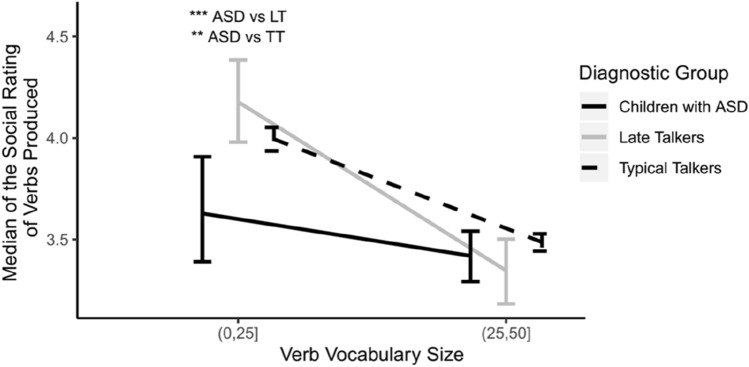
This study compares the lexical composition of 118 children with autism spectrum disorder (ASD) aged 12 to 84 months with 4626 vocabulary-matched typically developing toddlers with and without language delay, aged 8 to 30 months. Children with ASD and late talkers showed a weaker noun bias. Additionally, differences were identified in the proportion of nouns and verbs, and in the semantic categories of animals, toys, household items and vehicles. Most differences appear to reflect the extent of the age differences between the groups. However, children with ASD produced fewer high-social verbs than typical talkers and late talkers, a difference that might be associated with ASD features. In sum, our findings identified areas of overlap and distinction across the developing lexical profiles.
本研究比较了 118 名 12 至 84 个月大的自闭症谱系障碍(ASD)儿童与 4626 名词汇匹配的、无语言延迟的典型发育幼儿(8 至 30 个月大)的词汇组成。ASD 儿童和晚说话者的名词偏向较弱。此外,在名词和动词的比例以及动物、玩具、家居用品和车辆的语义类别方面也存在差异。大多数差异似乎反映了两组之间年龄差异的程度。然而,与典型说话者和晚说话者相比,ASD 儿童使用的高社交动词较少,这一差异可能与 ASD 特征有关。总之,我们的研究结果确定了发展词汇特征的重叠和区别区域。