Department of Public Health, Brody School of Medicine, East Carolina University and North Carolina Agromedicine Institute, Greenville, NC.
Department of Surgery, Brody School of Medicine, East Carolina University, Greenville, NC.
Am J Infect Control. 2021 Jan;49(1):1-7. doi: 10.1016/j.ajic.2020.11.005. Epub 2020 Nov 6.
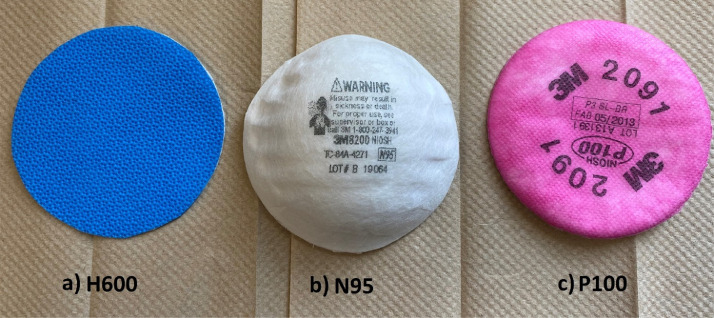
Due to COVID-19 and high demand for respirators, some healthcare professionals have been using the Halyard H600 fabric as an alternative to N95 respirators without testing the filtration efficiency of the fabric with established scientific methods. The purpose of this study was to assess the efficiency of the Halyard H600 as a respirator filtering material as compared to the NIOSH-certified N95 and P100 filters, and determine if H600 is a good alternative for respiratory protection for healthcare professionals during the COVID-19 pandemic.
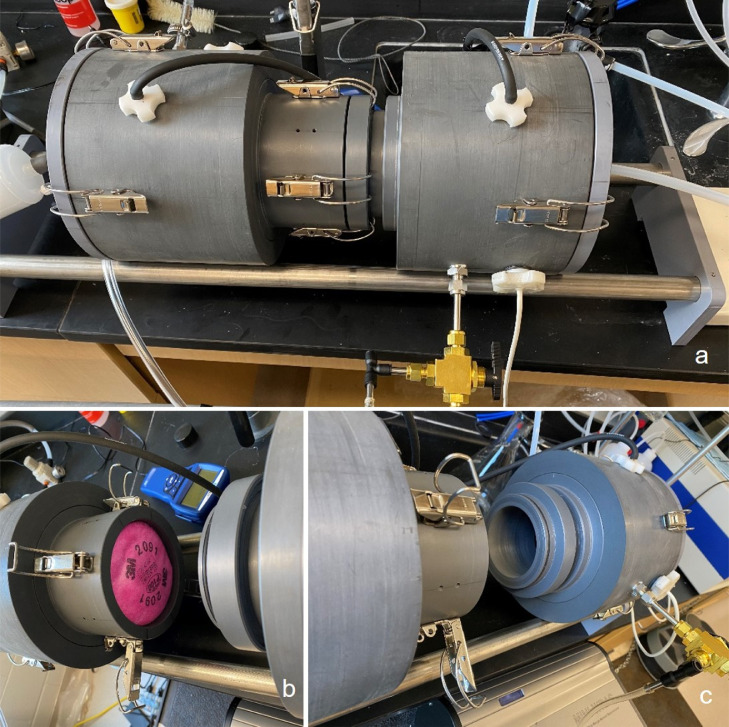
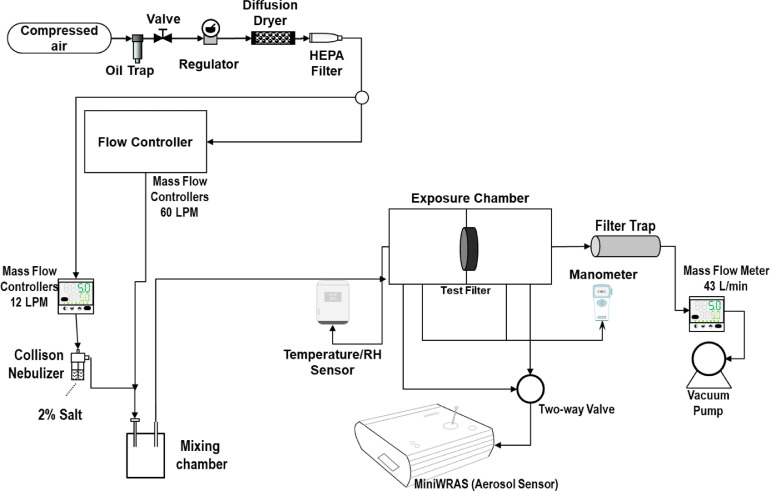
Three filter types (Halyard H600, N95, and P100) were challenged with salt particles inside an exposure chamber at a flow rate of 43 LPM and relative humidity of 40 ± 2%. N95 and P100 respirator filters were tested initially to establish the validity of the chamber, followed by the Halyard H600 fabric. Particle penetration was measured using an aerosol spectrometer. The filtration efficiency was calculated for different particle sizes by measuring the particle number concentration upstream and downstream of the filter. The pressure drop across the filter materials was measured using a manometer.
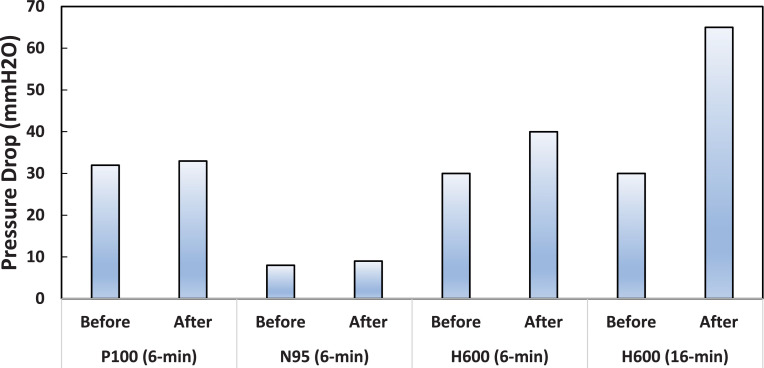
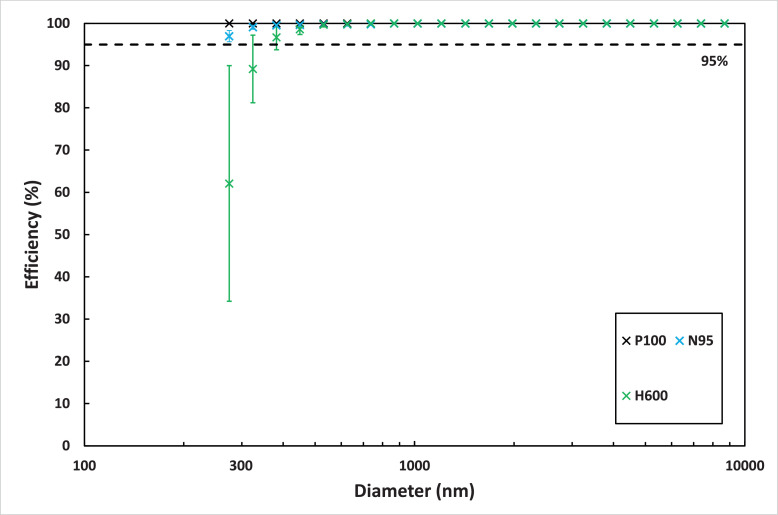
The efficiency of the P100 for particles ≥250 nm was 100%. The N95 efficiency was 97 ± 1% at 275 nm, 99 ± 0% at 324 nm, and 100% for larger particles. The Halyard H600 fabric had a variable efficiency with an average of 62 ± 28% at 275 nm, 89 ± 8% at 324 nm, and 100% efficiency for particles >450 nm. The pressure drop values for P100 and N95 were 32 and 8 mmHO, respectively. The Halyard H600 fabric resistance increased dramatically from 30 mmHO at the start of the exposure to 65 mmHO after 16-minutes of exposure.
The high variability in filter efficiency for particles ≤324 nm and the increased fabric breathing resistance demonstrate that the Halyard H600 has an inferior performance and is not a good substitute for N95 and P100. Thus, the use of the Halyard H600 fabric for respiratory protection is not recommended.
由于 COVID-19 和对呼吸器的高需求,一些医护人员一直在使用 Halyard H600 织物作为 N95 呼吸器的替代品,而没有用既定的科学方法测试织物的过滤效率。本研究的目的是评估 Halyard H600 作为过滤材料的效率与 NIOSH 认证的 N95 和 P100 过滤器相比,以及确定在 COVID-19 大流行期间,H600 是否是医护人员呼吸保护的良好替代品。
在流量为 43 LPM 且相对湿度为 40 ± 2%的暴露室内,用盐颗粒对三种过滤类型(Halyard H600、N95 和 P100)进行了挑战。首先对 N95 和 P100 呼吸器过滤器进行测试,以验证室的有效性,然后对 Halyard H600 织物进行测试。使用气溶胶光谱仪测量颗粒穿透率。通过测量过滤器上下游的颗粒数浓度,计算不同粒径的过滤效率。使用压力计测量过滤材料的压降。
P100 对≥250nm 的颗粒的效率为 100%。N95 在 275nm 时的效率为 97 ± 1%,在 324nm 时为 99 ± 0%,对于较大的颗粒则为 100%。Halyard H600 织物的效率具有变异性,在 275nm 时平均为 62 ± 28%,在 324nm 时为 89 ± 8%,对于>450nm 的颗粒则为 100%。P100 和 N95 的压降值分别为 32 和 8mmHO。暴露开始时,Halyard H600 织物的阻力为 30mmHO,16 分钟后增加到 65mmHO。
对于≤324nm 的颗粒,过滤效率的高度变化以及织物呼吸阻力的增加表明,Halyard H600 的性能较差,不能替代 N95 和 P100。因此,不建议使用 Halyard H600 织物进行呼吸保护。