Department of Environmental Science, Policy, and Management, University of California, Berkeley, CA 94720;
Department of Civil and Environmental Engineering, Politecnico di Milano, 20133 Milano, Italy.
Proc Natl Acad Sci U S A. 2020 Nov 24;117(47):29526-29534. doi: 10.1073/pnas.2017796117. Epub 2020 Nov 9.
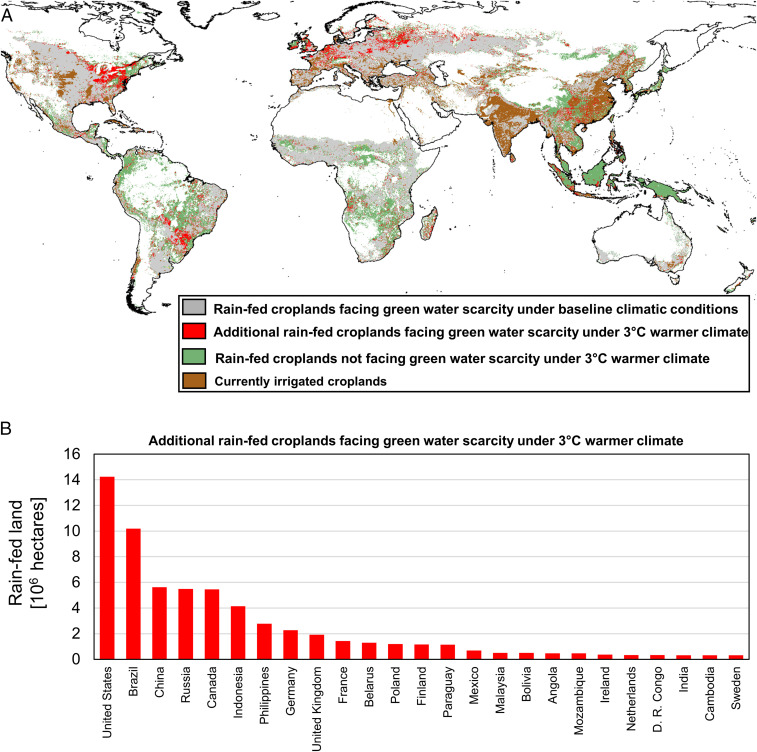
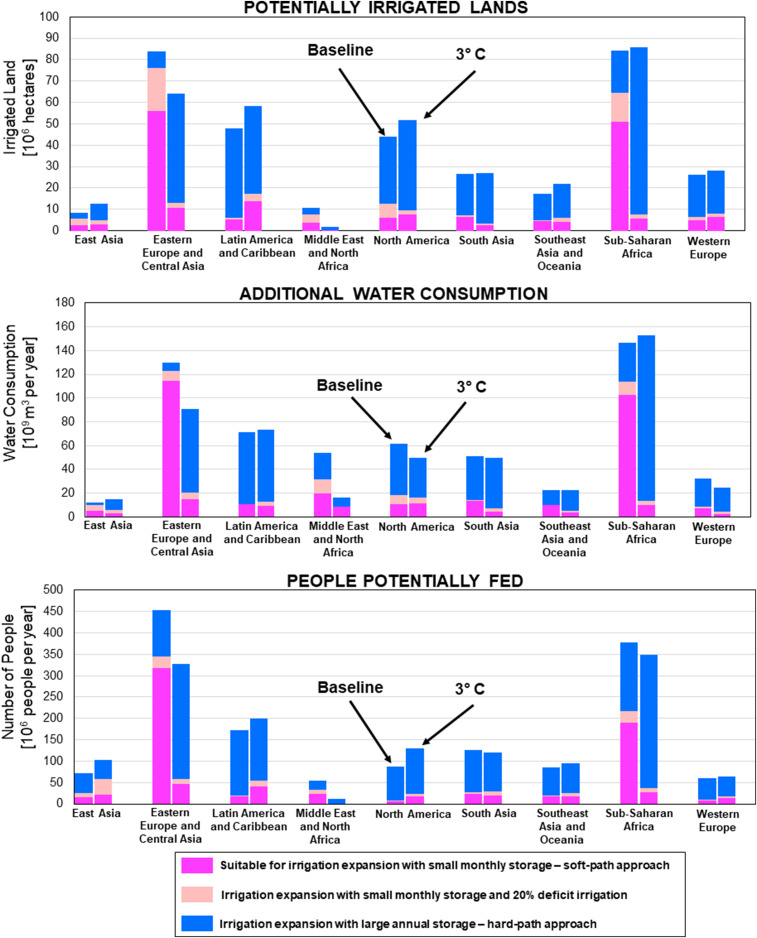
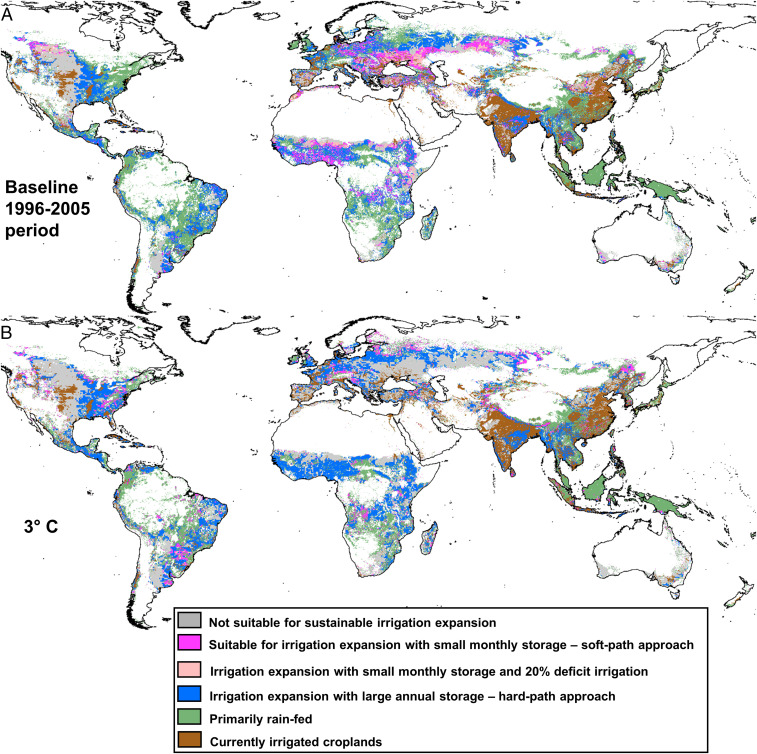
Climate change is expected to affect crop production worldwide, particularly in rain-fed agricultural regions. It is still unknown how irrigation water needs will change in a warmer planet and where freshwater will be locally available to expand irrigation without depleting freshwater resources. Here, we identify the rain-fed cropping systems that hold the greatest potential for investment in irrigation expansion because water will likely be available to suffice irrigation water demand. Using projections of renewable water availability and irrigation water demand under warming scenarios, we identify target regions where irrigation expansion may sustain crop production under climate change. Our results also show that global rain-fed croplands hold significant potential for sustainable irrigation expansion and that different irrigation strategies have different irrigation expansion potentials. Under a 3 °C warming, we find that a soft-path irrigation expansion with small monthly water storage and deficit irrigation has the potential to expand irrigated land by 70 million hectares and feed 300 million more people globally. We also find that a hard-path irrigation expansion with large annual water storage can sustainably expand irrigation up to 350 million hectares, while producing food for 1.4 billion more people globally. By identifying where irrigation can be expanded under a warmer climate, this work may serve as a starting point for investigating socioeconomic factors of irrigation expansion and may guide future research and resources toward those agricultural communities and water management institutions that will most need to adapt to climate change.
预计气候变化将影响全球的作物生产,特别是在雨养农业区。目前尚不清楚在一个更温暖的星球上,灌溉用水需求将如何变化,以及在不耗尽淡水资源的情况下,哪里有淡水可以用于扩大灌溉。在这里,我们确定了在雨养种植系统中,有最大的潜力进行灌溉投资,因为水可能会充足灌溉用水需求。利用变暖情景下可再生水资源和灌溉用水需求的预测,我们确定了目标区域,在这些区域,灌溉扩展可能会在气候变化下维持作物生产。我们的研究结果还表明,全球雨养耕地具有可持续灌溉扩展的巨大潜力,不同的灌溉策略具有不同的灌溉扩展潜力。在升温 3°C 的情况下,我们发现,每月水存储量较小且存在亏缺灌溉的软路径灌溉扩展,有可能将灌溉土地扩大 7000 万公顷,并在全球范围内养活 3 亿多人。我们还发现,每年水存储量大的硬路径灌溉扩展可以可持续地扩大灌溉面积,达到 3.5 亿公顷,同时为全球增加 14 亿人的食物供应。通过确定在更温暖的气候下可以扩大灌溉的地区,这项工作可以作为调查灌溉扩展的社会经济因素的起点,并为未来的研究和资源提供方向,以帮助那些最需要适应气候变化的农业社区和水管理机构。