Cancer Cell Biology and Drug Discovery Group, Department of Life Sciences and Medicine, University of Luxembourg, Esch-sur-Alzette 4362, Luxembourg.
Department of Integrative Biology and Pharmacology, McGovern Medical School, University of Texas Health Science Center at Houston, 6431 Fannin St., Houston, TX 77030, USA.
Biomolecules. 2020 Nov 6;10(11):1522. doi: 10.3390/biom10111522.
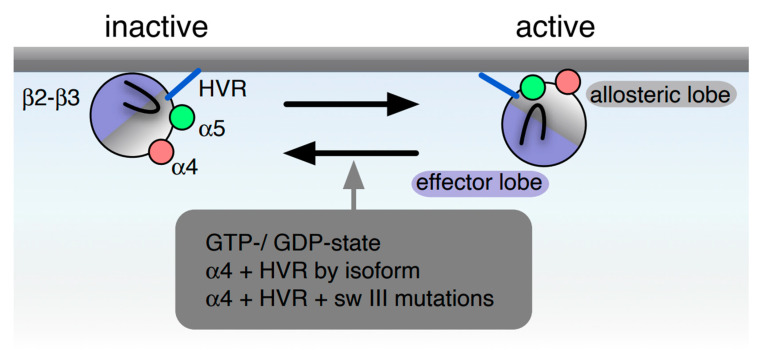
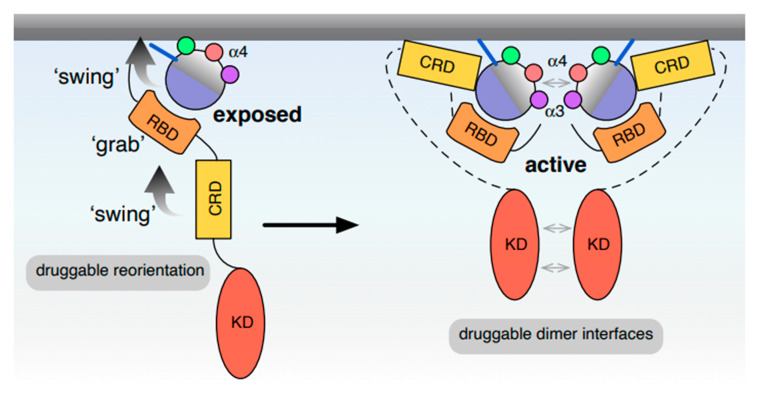
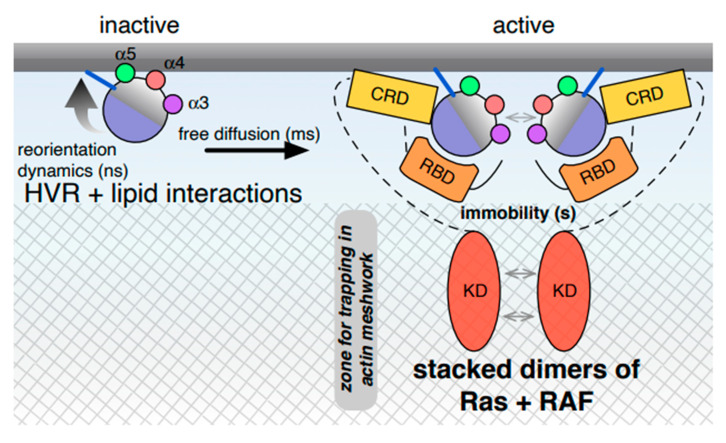
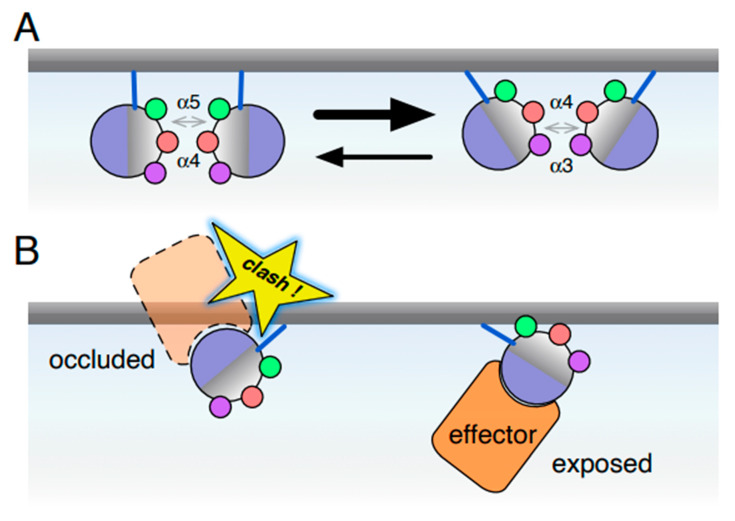
Ras is the most frequently mutated oncogene and recent drug development efforts have spurred significant new research interest. Here we review progress toward understanding how Ras functions in nanoscale, proteo-lipid signaling complexes on the plasma membrane, called nanoclusters. We discuss how G-domain reorientation is plausibly linked to Ras-nanoclustering and -dimerization. We then look at how these mechanistic features could cooperate in the engagement and activation of RAF by Ras. Moreover, we show how this structural information can be integrated with microscopy data that provide nanoscale resolution in cell biological experiments. Synthesizing the available data, we propose to distinguish between two types of Ras nanoclusters, an active, immobile RAF-dependent type and an inactive/neutral membrane anchor-dependent. We conclude that it is possible that Ras reorientation enables dynamic Ras dimerization while the whole Ras/RAF complex transits into an active state. These transient di/oligomer interfaces of Ras may be amenable to pharmacological intervention. We close by highlighting a number of open questions including whether all effectors form active nanoclusters and whether there is an isoform specific composition of Ras nanocluster.
Ras 是最常发生突变的致癌基因,最近的药物研发工作激发了人们对 Ras 功能的新研究兴趣。本文我们将综述 Ras 在质膜上的纳米级、蛋白脂质信号复合物(称为纳米簇)中的功能的研究进展。我们讨论了 G 结构域重排与 Ras-纳米簇形成和二聚化之间的关系。然后,我们研究了这些机械特征如何在 Ras 与 RAF 的结合和激活中协同作用。此外,我们还展示了如何将这些结构信息与提供细胞生物学实验中纳米级分辨率的显微镜数据整合。综合现有数据,我们提出区分两种 Ras 纳米簇,一种是 RAF 依赖性的、活跃的、不可移动的 Ras 纳米簇,另一种是不活跃/中性的膜锚依赖性的 Ras 纳米簇。我们得出的结论是,Ras 重新定向可能使 Ras 二聚化具有动态性,同时整个 Ras/RAF 复合物进入激活状态。Ras 的这些瞬时二聚体/寡聚体界面可能适合药物干预。最后,我们强调了一些悬而未决的问题,包括所有效应物是否都形成活性纳米簇,以及 Ras 纳米簇是否具有特定的异构体组成。