Department of Brain Sciences, Imperial College London, London, UK.
UK DRI Centre for Care Research and Technology, London, UK.
BMJ Open. 2020 Nov 10;10(11):e042093. doi: 10.1136/bmjopen-2020-042093.
Traumatic brain injury (TBI) often results in persistent disability, due particularly to cognitive impairments. Outcomes remain difficult to predict but appear to relate to axonal injury. Several new approaches involving fluid and neuroimaging biomarkers show promise to sensitively quantify axonal injury. By assessing these longitudinally in a large cohort, we aim both to improve our understanding of the pathophysiology of TBI, and provide better tools to predict clinical outcome.
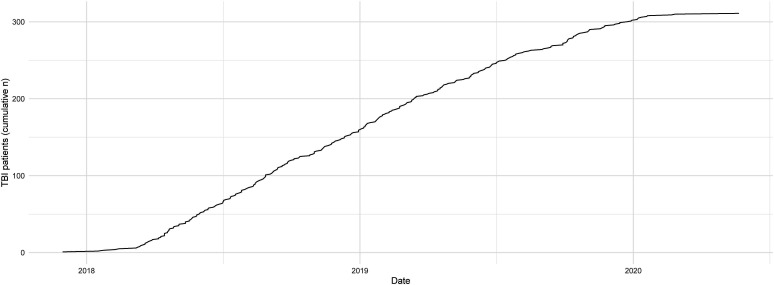
BIOmarkers of AXonal injury after TBI is a prospective longitudinal study of fluid and neuroimaging biomarkers of axonal injury after moderate-to-severe TBI, currently being conducted across multiple European centres. We will provide a detailed characterisation of axonal injury after TBI, using fluid (such as plasma/microdialysate neurofilament light) and neuroimaging biomarkers (including diffusion tensor MRI), which will then be related to detailed clinical, cognitive and functional outcome measures. We aim to recruit at least 250 patients, including 40 with cerebral microdialysis performed, with serial assessments performed twice in the first 10 days after injury, subacutely at 10 days to 6 weeks, at 6 and 12 months after injury.
The relevant ethical approvals have been granted by the following ethics committees: in London, by the Camberwell St Giles Research Ethics Committee; in Policlinico (Milan), by the Comitato Etico Milano Area 2; in Niguarda (Milan), by the Comitato Etico Milano Area 3; in Careggi (Florence), by the Comitato Etico Regionale per la Sperimentazione Clinica della Regione Toscana, Sezione area vasta centro; in Trento, by the Trento Comitato Etico per le Sperimentazioni Cliniche, Azienda Provinciale per i Servizi Sanitari della Provincia autonoma di Trento; in Lausanne, by the Commission cantonale d'éthique de la recherche sur l'être humain; in Ljubljana, by the National Medical Ethics Committee at the Ministry of Health of the Republic of Slovenia. The study findings will be disseminated to patients, healthcare professionals, academics and policy-makers including through presentation at conferences and peer-reviewed publications. Data will be shared with approved researchers to provide further insights for patient benefit.
NCT03534154.
创伤性脑损伤(TBI)常导致持续性残疾,特别是认知障碍。目前,对其预后仍难以预测,但似乎与轴索损伤有关。一些新的涉及液体和神经影像学生物标志物的方法显示出了灵敏地定量轴索损伤的潜力。通过对大量患者进行纵向评估,我们旨在进一步了解 TBI 的病理生理学,并提供更好的工具来预测临床结局。
BIOmarkers of AXonal injury after TBI 是一项正在欧洲多个中心进行的前瞻性纵向研究,旨在研究中重度 TBI 后液体和神经影像学生物标志物的轴索损伤。我们将使用液体(如血浆/微透析液神经丝轻链)和神经影像学生物标志物(包括弥散张量 MRI)对 TBI 后的轴索损伤进行详细描述,然后将其与详细的临床、认知和功能结局测量相关联。我们的目标是招募至少 250 名患者,其中包括 40 名接受脑微透析的患者,在损伤后 10 天内进行两次连续评估,亚急性在 10 天至 6 周,在 6 个月和 12 个月后进行评估。
以下伦理委员会已批准相关伦理许可:在伦敦,由坎伯韦尔圣吉尔斯研究伦理委员会批准;在米兰的 Policlinico,由米兰第 2 区伦理委员会批准;在米兰的 Niguarda,由米兰第 3 区伦理委员会批准;在佛罗伦萨的 Careggi,由托斯卡纳地区临床试验伦理委员会区域性中心批准;在特伦托,由特伦托临床试验伦理委员会,特伦托省卫生局批准;在洛桑,由瑞士法语区伦理委员会批准;在卢布尔雅那,由斯洛文尼亚共和国卫生部国家医学伦理委员会批准。研究结果将通过会议和同行评议出版物等方式向患者、医疗保健专业人员、学者和政策制定者传播。将与经批准的研究人员共享数据,以为患者获益提供进一步的见解。
NCT03534154。