UMR CNRS 7057, Laboratoire Matière Et Systèmes Complexes, Université de Paris, Paris, France.
Institute for Food, Nutrition and Health, D-HEST, ETH Zürich, Zürich, Switzerland.
Sci Rep. 2020 Nov 10;10(1):19436. doi: 10.1038/s41598-020-76332-7.
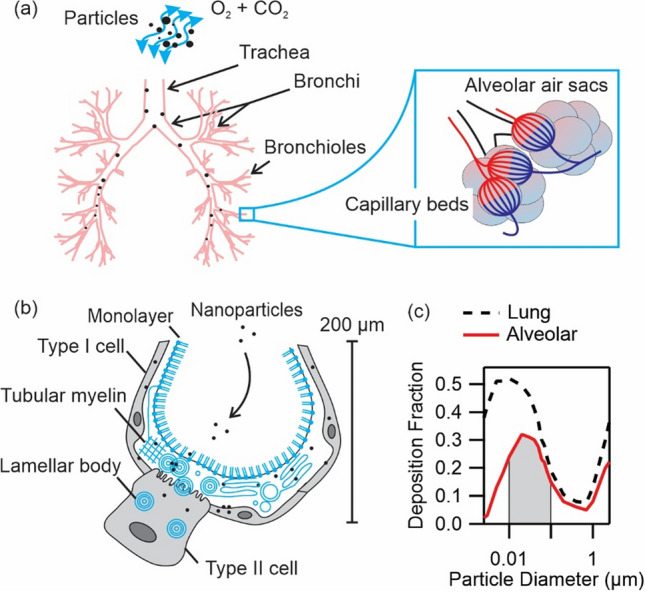
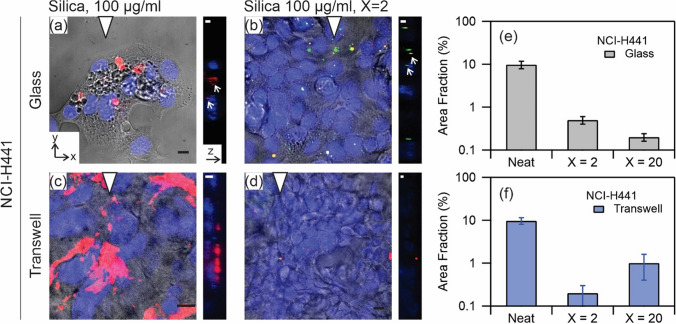
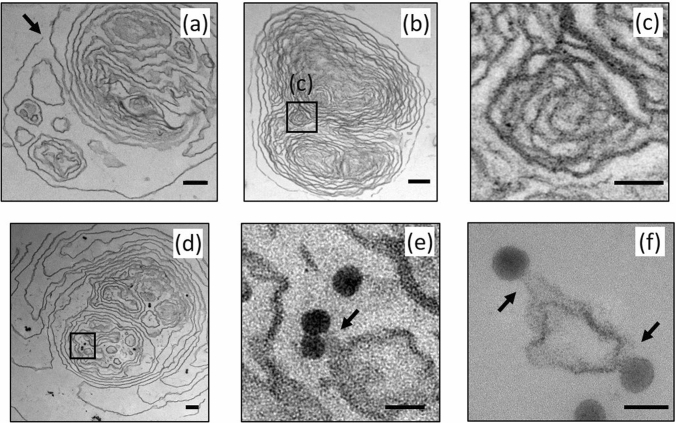
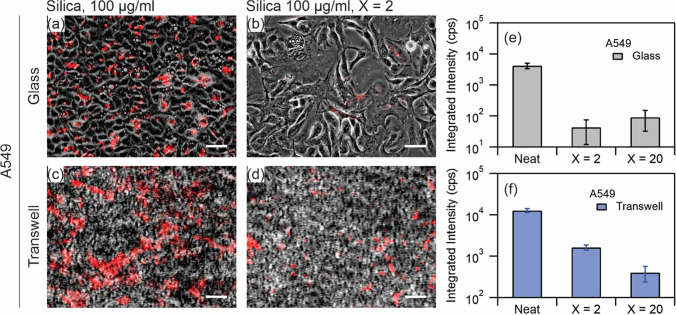
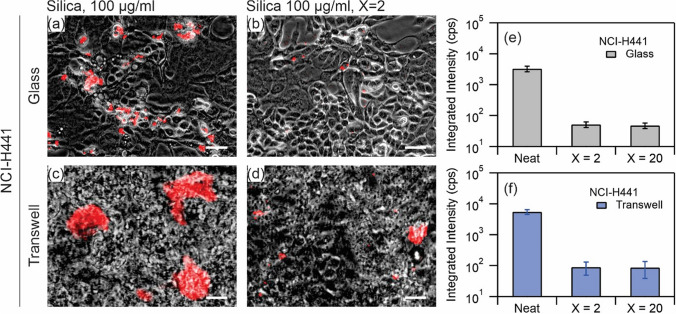
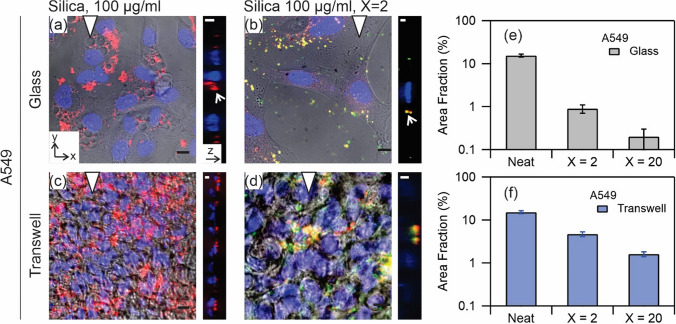
Pulmonary surfactant forms a sub-micrometer thick fluid layer that covers the surface of alveolar lumen and inhaled nanoparticles therefore come in to contact with surfactant prior to any interaction with epithelial cells. We investigate the role of the surfactant as a protective physical barrier by modeling the interactions using silica-Curosurf-alveolar epithelial cell system in vitro. Electron microscopy displays that the vesicles are preserved in the presence of nanoparticles while nanoparticle-lipid interaction leads to formation of mixed aggregates. Fluorescence microscopy reveals that the surfactant decreases the uptake of nanoparticles by up to two orders of magnitude in two models of alveolar epithelial cells, A549 and NCI-H441, irrespective of immersed culture on glass or air-liquid interface culture on transwell. Confocal microscopy corroborates the results by showing nanoparticle-lipid colocalization interacting with the cells. Our work thus supports the idea that pulmonary surfactant plays a protective role against inhaled nanoparticles. The effect of surfactant should therefore be considered in predictive assessment of nanoparticle toxicity or drug nanocarrier uptake. Models based on the one presented in this work may be used for preclinical tests with engineered nanoparticles.
肺表面活性剂形成亚微米厚的液膜覆盖在肺泡腔的表面,因此吸入的纳米颗粒在与上皮细胞相互作用之前会与表面活性剂接触。我们通过使用体外硅石-Curosurf-肺泡上皮细胞系统来模拟相互作用,研究了表面活性剂作为一种保护性物理屏障的作用。电子显微镜显示,在纳米颗粒存在的情况下,囊泡得以保留,而纳米颗粒-脂质相互作用导致混合聚集体的形成。荧光显微镜显示,肺表面活性剂可将两种肺泡上皮细胞模型(A549 和 NCI-H441)中纳米颗粒的摄取量降低两个数量级,无论在玻璃上浸入培养还是在 Transwell 上气液界面培养。共聚焦显微镜通过显示与细胞相互作用的纳米颗粒-脂质共定位证实了这一结果。因此,我们的工作支持了肺表面活性剂在对抗吸入纳米颗粒方面发挥保护作用的观点。因此,在预测纳米颗粒毒性或药物纳米载体摄取时,应考虑表面活性剂的作用。基于本工作中提出的模型可以用于工程纳米颗粒的临床前测试。