Liu Jing, Xu Xiaopei, Zhu Chunqing, Luo Liyuan, Wang Qi, Xiao Binbin, Feng Bin, Hu Lingtao, Liu Lanying
Department of Psychiatry, Tongde Hospital of Zhejiang Province, Hangzhou, China.
Department of Radiology, The Second Affiliated Hospital of Zhejiang University School of Medicine, Hangzhou, China.
Front Psychiatry. 2020 Sep 23;11:565890. doi: 10.3389/fpsyt.2020.565890. eCollection 2020.
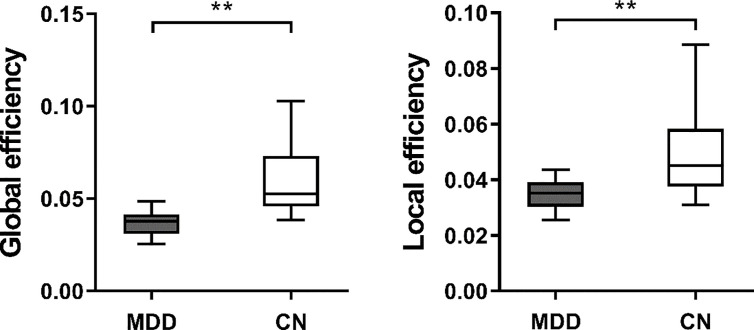
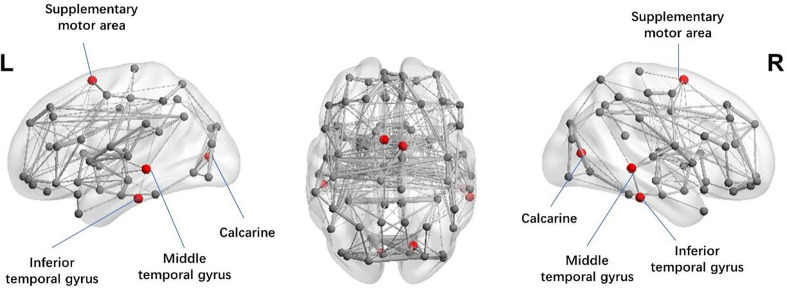
Major depressive disorder (MDD) is a severe and devastating condition. However, the anatomical basis behind the affective symptoms, cognitive symptoms, and somatic-vegetative symptoms of MDD is still unknown. To explore the mechanism behind the depressive symptoms in MDD, we used diffusion tensor imaging (DTI)-based structural brain connectivity analysis to investigate the network difference between MDD patients and healthy controls (CN), and to explore the association between network metrics and patients' clinical symptoms. Twenty-six patients with MDD and 25 CN were included. A baseline 24-item Hamilton rating scale for depression (HAMD-24) score ≥ 21 and seven factors (anxiety/somatization, weight loss, cognitive disturbance, diurnal variation, retardation, sleep disturbance, hopelessness) scores were assessed. When compared with healthy subjects, significantly higher characteristic path length and clustering coefficient as well as significantly lower network efficiencies were observed in patients with MDD. Furthermore, MDD patients demonstrated significantly lower nodal degree and nodal efficiency in multiple brain regions including superior frontal gyrus (SFG), supplementary motor area (SMA), calcarine fissure, middle temporal gyrus (MTG), and inferior temporal gyrus (ITG). We also found that the characteristic path length of MDD patients was associated with weight loss. Moreover, significantly lower global efficiency of MDD patients was correlated with higher total HAMD score, anxiety somatization, and cognitive disturbance. The nodal degree in SFG was also found to be negatively associated with disease duration. In conclusion, our results demonstrated that MDD patients had impaired structural network features compared to CN, and disruption of optimal network architecture might be the mechanism behind the depressive symptoms and emotion disturbance in MDD patients.
重度抑郁症(MDD)是一种严重且具有破坏性的疾病。然而,MDD的情感症状、认知症状和躯体 - 植物神经症状背后的解剖学基础仍不清楚。为了探究MDD抑郁症状背后的机制,我们使用基于扩散张量成像(DTI)的脑结构连接性分析来研究MDD患者与健康对照(CN)之间的网络差异,并探索网络指标与患者临床症状之间的关联。纳入了26例MDD患者和25名CN。评估了基线24项汉密尔顿抑郁量表(HAMD - 24)评分≥21以及七个因子(焦虑/躯体化、体重减轻、认知障碍、昼夜变化、迟缓、睡眠障碍、绝望)的评分。与健康受试者相比,MDD患者观察到显著更高的特征路径长度和聚类系数以及显著更低的网络效率。此外,MDD患者在包括额上回(SFG)、辅助运动区(SMA)、距状裂、颞中回(MTG)和颞下回(ITG)在内的多个脑区表现出显著更低的节点度和节点效率。我们还发现MDD患者的特征路径长度与体重减轻有关。此外,MDD患者显著更低的全局效率与更高的HAMD总分、焦虑躯体化和认知障碍相关。还发现SFG中的节点度与病程呈负相关。总之,我们的结果表明,与CN相比,MDD患者的结构网络特征受损,最佳网络架构的破坏可能是MDD患者抑郁症状和情绪障碍背后的机制。