Latvian State Forest Research Institute "Silava", Rigas 111, Salaspils, LV-2169, Latvia.
Institute of Parasitology, Slovak Academy of Sciences, Hlinkova 3, 040 01, Kosice, Slovakia.
Parasitol Res. 2021 Jan;120(1):365-371. doi: 10.1007/s00436-020-06957-0. Epub 2020 Nov 10.
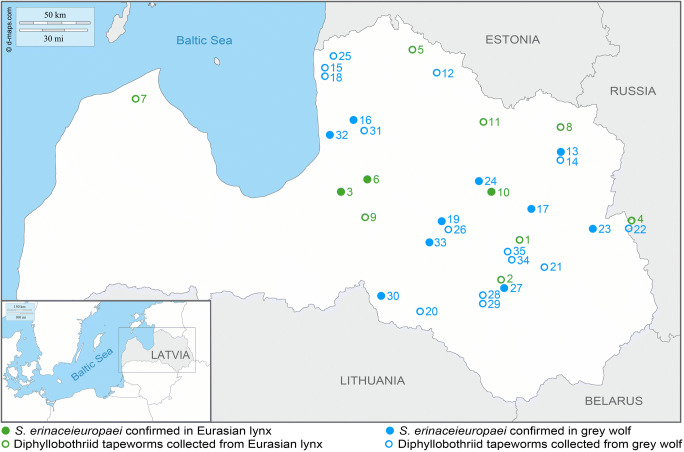
Diphyllobothriid tapeworms of the genus Spirometra are causative agents of sparganosis, food-borne zoonotic parasitic disease. They have been recorded in broad spectrum of hosts, including humans, in all continents except Antarctica. Spirometra tapeworms have been intensively studied in several Asian countries; however, they have been rather neglected in Europe. The aim of this study was to provide a pilot screening of Spirometra spp. in Latvia, where data on sparganosis are not available. Tapeworms morphologically identified as diphyllobothriid species were isolated from grey wolves Canis lupus and Eurasian lynxes Lynx lynx from Latvia during the hunting periods 2013-2019. The parasites were subjected to molecular genotyping using sequences of the partial large (LSU rDNA; 615 bp) and small (SSU rDNA; 720 bp) subunits of the nuclear ribosomal RNA gene and complete (1566 bp) cytochrome c oxidase subunit I gene of the mitochondrial DNA (cox1 mtDNA). Analyses of both ribosomal subunits of 13 tapeworms revealed no intraspecific variation within the respective rDNA subunits. On the other hand, sequence analysis of mitochondrial cox1 revealed intraspecific polymorphism displayed by 12 cox1 haplotypes. Comparison of the current data with sequences of the corresponding DNA regions deposited in the GenBank revealed 99.3-99.5% (LSU rDNA), 99.2% (SSU rDNA) and 99.6-100% (cox1 mtDNA) identity of studied tapeworms with Spirometra erinaceieuropaei, which provided the first confirmation of this diphyllobothriid tapeworm in Latvia. Since S. erinaceieuropaei is probably prevalent in Latvian wildlife and may also occur in other potential host species, further studies are needed in order to acquire complex data on its geographic distribution and transmission in the natural environment of Latvia, as well as on the spectrum of its intermediate, paratenic, and definitive hosts.
裂头绦虫属的双腔吸虫是食源性人畜共患寄生虫病裂头蚴的病原体。它们已在除南极洲以外的各大洲的广泛宿主中被记录,包括人类。裂头蚴在几个亚洲国家得到了深入研究;然而,在欧洲却被忽视了。本研究旨在对拉脱维亚进行裂头蚴属的初步筛查,因为拉脱维亚没有裂头蚴病的数据。在 2013 年至 2019 年的狩猎期间,从拉脱维亚的灰狼(Canis lupus)和欧亚猞猁(Lynx lynx)中分离出形态上鉴定为双腔吸虫的绦虫。寄生虫采用部分核核糖体 RNA 基因的大亚基(LSU rDNA;615bp)和小亚基(SSU rDNA;720bp)以及线粒体 DNA(cox1 mtDNA)的完整(1566bp)细胞色素 c 氧化酶亚基 I 基因的分子基因分型。对 13 条绦虫的两个核糖体亚基的分析显示,各自 rDNA 亚基内没有种内变异。另一方面,线粒体 cox1 的序列分析显示 12 个 cox1 单倍型显示出种内多态性。将当前数据与 GenBank 中相应 DNA 区域的序列进行比较,发现研究的绦虫与欧洲棘球蚴(Spirometra erinaceieuropaei)的 LSU rDNA 为 99.3-99.5%、SSU rDNA 为 99.2%、cox1 mtDNA 为 99.6-100%,这首次证实了这种双腔吸虫在拉脱维亚的存在。由于 S. erinaceieuropaei 可能在拉脱维亚野生动物中普遍存在,并且也可能存在于其他潜在的宿主物种中,因此需要进一步研究,以获取其在拉脱维亚自然环境中的地理分布和传播以及中间宿主、副宿主和最终宿主的谱的复杂数据。