Zhang Nan, Cheng Pan, Jia Wei, Dung Chung-Hin, Liu Li, Chen Wenzhao, Lei Hao, Kan Changcheng, Han Xiaoyan, Su Boni, Xiao Shenglan, Qian Hua, Lin Borong, Li Yuguo
Department of Mechanical Engineering, The University of Hong Kong, Hong Kong SAR, China.
Zhejiang Institute of Research and Innovation, The University of Hong Kong, Lin An, Zhejiang, China.
Build Environ. 2020 Aug;180:107106. doi: 10.1016/j.buildenv.2020.107106. Epub 2020 Jul 2.
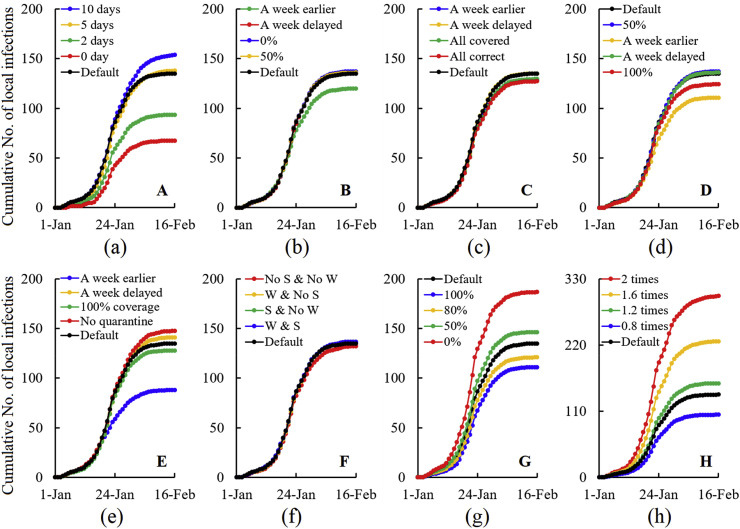
By March 31, 2020, COVID-19 had spread to more than 200 countries. Over 750,000 confirmed cases were reported, leading to more than 36,000 deaths. In this study, we analysed the efficiency of various intervention strategies to prevent infection by the virus, SARS-CoV-2, using an agent-based SEIIR model, in the fully urbanised city of Shenzhen, Guangdong Province, China. Shortening the duration from symptom onset to hospital admission, quarantining recent arrivals from Hubei Province, and letting symptomatic individuals stay at home were found to be the three most important interventions to reduce the risk of infection in Shenzhen. The ideal time window for a mandatory quarantine of arrivals from Hubei Province was between 10 January and January 17, 2020, while the ideal time window for local intervention strategies was between 15 and 22 January. The risk of infection could have been reduced by 50% if all symptomatic individuals had immediately gone to hospital for isolation, and by 35% if a 14-day quarantine for arrivals from Hubei Province had been introduced one week earlier. Intervention strategies implemented in Shenzhen were effective, and the spread of infection would be controlled even if the initial basic reproduction number had doubled. Our results may be useful for other cities when choosing their intervention strategies to prevent outbreaks of COVID-19.
截至2020年3月31日,新型冠状病毒肺炎已传播至200多个国家。报告确诊病例超过75万例,导致3.6万多人死亡。在本研究中,我们在中国广东省完全城市化的深圳市,使用基于主体的SEIIR模型分析了各种干预策略预防严重急性呼吸综合征冠状病毒2(SARS-CoV-2)感染的效果。研究发现,缩短症状出现到入院的时间、对近期来自湖北省的人员进行隔离以及让有症状的人员居家隔离是深圳降低感染风险的三项最重要干预措施。对来自湖北省的人员进行强制隔离的理想时间窗口是2020年1月10日至1月17日,而本地干预策略的理想时间窗口是1月15日至22日。如果所有有症状的人员立即前往医院隔离,感染风险可降低50%;如果对来自湖北省的人员提前一周实施14天隔离,感染风险可降低35%。深圳实施的干预策略是有效的,即使初始基本再生数翻倍,感染传播也将得到控制。我们的结果可能对其他城市选择预防新型冠状病毒肺炎爆发的干预策略有用。