Institute of Health and Care Sciences, Sahlgrenska Academy, Gothenburg, Sweden.
Department of Obstetrics and Gynecology, Region Vastra Gotaland , NU-Hospital Group, Trollhättan, Sweden.
Acta Obstet Gynecol Scand. 2021 May;100(5):971-978. doi: 10.1111/aogs.14042. Epub 2021 Jan 28.
The aim of this study was to compare childbirth experiences and experience of labor pain in primiparous women who had received high- vs low-dose oxytocin for augmentation of delayed labor.
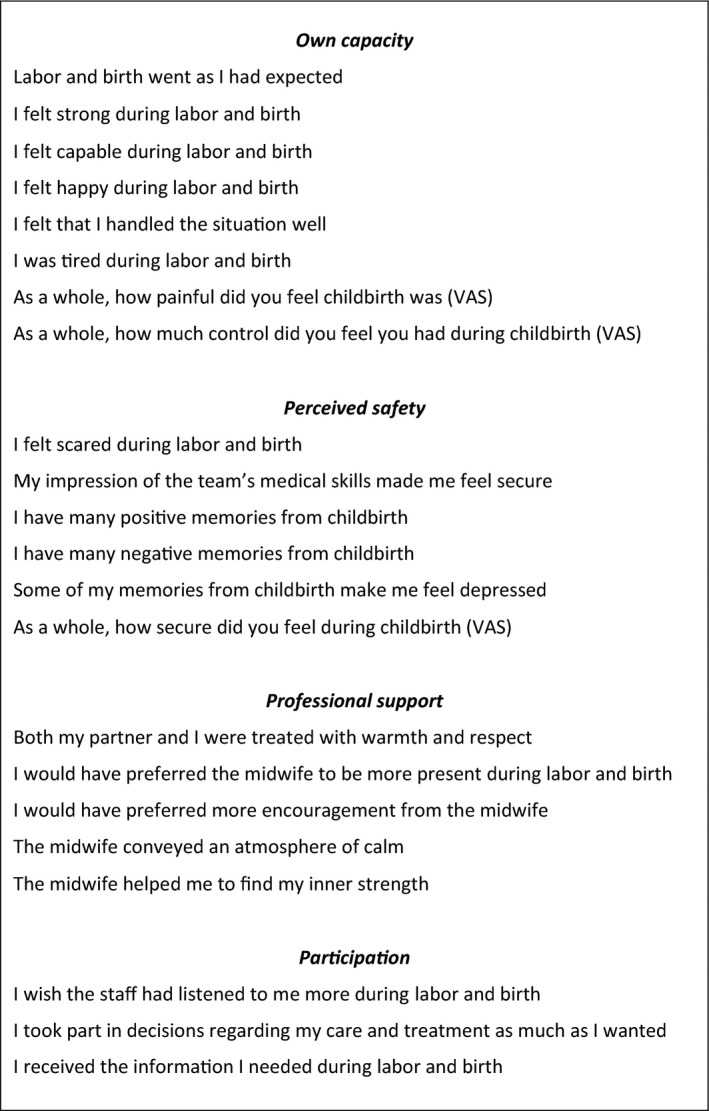
A multicenter, parallel, double-blind randomized controlled trial took place in six Swedish labor wards. Inclusion criteria were healthy primiparous women at term with uncomplicated singleton pregnancies, cephalic fetal presentation, spontaneous onset of labor, confirmed delayed labor progress and ruptured membranes. The randomized controlled trial compared high- vs low-dose oxytocin used for augmentation of a delayed labor progress. The Childbirth Experience Questionnaire version 2 (CEQ2) was sent to the women 1 month after birth. The CEQ2 consists of 22 items in four domains: Own capacity, Perceived safety, Professional support and Participation. In addition, labor pain was reported with a visual analog scale (VAS) 2 hours postpartum and 1 month after birth. The main outcome was the childbirth experience measured with the four domains of the CEQ2. The clinical trial number is NCT01587625.
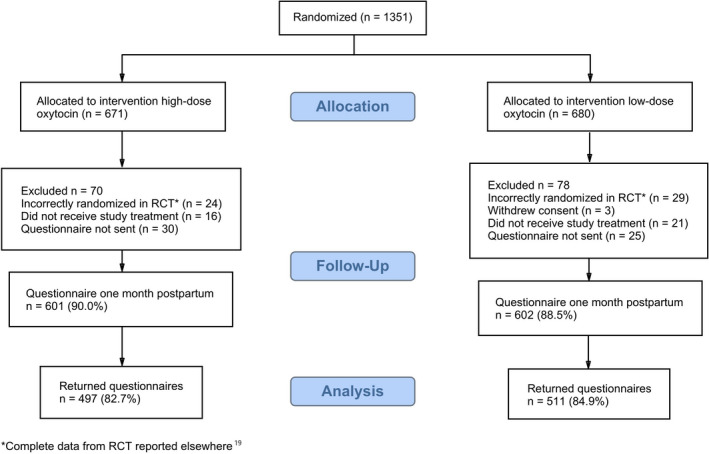
The CEQ2 was sent to 1203 women, and a total of 1008 women (83.8%) answered the questionnaire. The four domains of childbirth experience were scored similarly in the high- and low-dose oxytocin groups of women: Own capacity (P = .36), Perceived safety (P = .44), Professional support (P = .84), Participation (P = .49). VAS scores of labor pain were reported as similar in both oxytocin dosage groups. Labor pain was scored higher 1 month after birth compared with 2 hours postpartum. There was an association between childbirth experiences and mode of birth in both the high- and low-dose oxytocin groups.
Different dosage of oxytocin for augmentation of delayed labor did not affect women's childbirth experiences assessed through CEQ2 1 month after birth, or pain assessment 2 hours or 1 month after birth.
本研究旨在比较接受高剂量和低剂量催产素进行引产的初产妇的分娩经历和分娩疼痛体验。
一项多中心、平行、双盲随机对照试验在瑞典的 6 个产房进行。纳入标准为健康的初产妇,足月,单胎妊娠,头位,自发性临产,确诊产程延长,胎膜破裂。随机对照试验比较了高剂量和低剂量催产素用于引产。分娩体验问卷第 2 版(CEQ2)在产后 1 个月寄给产妇。CEQ2 由 4 个领域的 22 个项目组成:自身能力、感知安全、专业支持和参与。此外,产后 2 小时和 1 个月用视觉模拟评分法(VAS)报告分娩疼痛。主要结局是用 CEQ2 的 4 个领域测量的分娩体验。临床试验编号为 NCT01587625。
共向 1203 名妇女寄出了 CEQ2,共有 1008 名妇女(83.8%)回答了问卷。高剂量和低剂量催产素组妇女的分娩体验四个领域得分相似:自身能力(P=0.36)、感知安全(P=0.44)、专业支持(P=0.84)、参与(P=0.49)。催产素剂量组的 VAS 评分相似。产后 1 个月的分娩疼痛评分高于产后 2 小时。高剂量和低剂量催产素组的分娩经历与分娩方式均相关。
不同剂量的催产素用于引产不会影响产后 1 个月时用 CEQ2 评估的分娩经历,也不会影响产后 2 小时或 1 个月时的疼痛评估。