Department of Women's and Children's Health, Uppsala University, Akademiska Sjukhuset, 75185, Uppsala, Sweden.
Centre for Clinical Research Dalarna, Nissers Väg 3, 79182, Falun, Sweden.
BMC Pregnancy Childbirth. 2023 Mar 14;23(1):176. doi: 10.1186/s12884-023-05498-5.
In clinical settings and research studies, childbirth experience is often measured using a single-item question about overall experience. Little is known about what women include in this rating, which complicates the design of adequate follow-up, as well as the interpretation of research findings based on ratings of overall childbirth experience. The aim of this study was to examine which known dimensions of childbirth experience women include in the rating on a single-item measure.
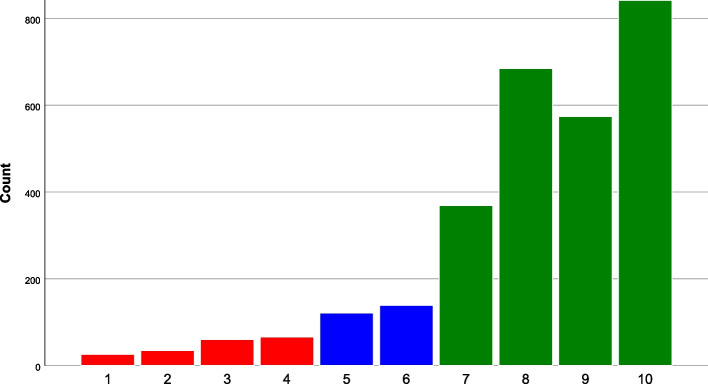
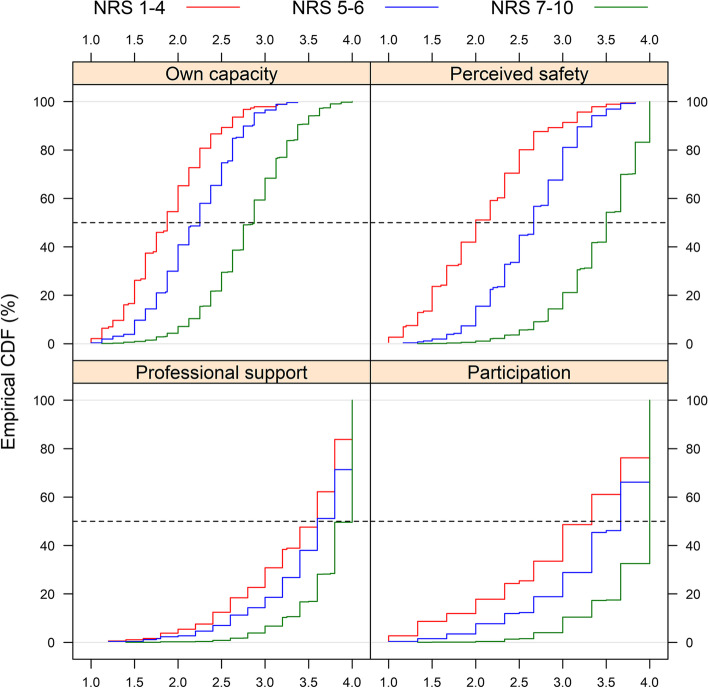
Ratings of overall childbirth experience on a 10-point numeric rating scale (NRS) from 2953 women with spontaneous or induced onset of labour at two Swedish hospitals were evaluated against the validated Childbirth Experience Questionnaire 2 (CEQ2), completed on one of the first days postpartum. The CEQ2 measures four childbirth experience domains: own capacity, perceived safety, professional support and participation. Internal consistency for CEQ2 was evaluated by calculating Cronbach's alpha. NRS ratings were explored in relation to CEQ2 using empirical cumulative distribution function graphs, where childbirth experience was defined as negative (NRS ratings 1-4), mixed (NRS ratings 5-6) or positive (NRS ratings 7-10). A multiple linear regression analysis, presented as beta coefficients (B) and 95% confidence intervals (CI), was also performed to explore the relationship between the four domains of the CEQ2 and overall childbirth experience.
The prevalence of negative childbirth experience was 6.3%. All CEQ2-subscales reached high or acceptable reliability (Cronbach's alpha = 0.78; 0.81; 0.69 and 0.66, respectively). Regardless of overall childbirth experience, the majority of respondents scored high on the CEQ2 subscale representing professional support. Overall childbirth experience was mainly explained by perceived safety (B = 1.60, CI 1.48-1.73), followed by own capacity (B = 0.65, CI 0.53-0.77) and participation (B = 0.43, CI 0.29-0.56).
In conclusion, overall childbirth experience rated by a single-item measurement appears to mainly capture experiences of perceived safety, and to a lesser extent own capacity and participation, but appears not to reflect professional support. CEQ2 shows good psychometric properties for use shortly after childbirth, and among women with induced onset of labour, which increases the usability of the instrument.
在临床环境和研究中,分娩体验通常使用一个关于整体体验的单项问题进行衡量。关于女性在这个评分中包含哪些内容,知之甚少,这使得后续工作的设计变得复杂,也使得基于整体分娩体验评分的研究结果的解释变得复杂。本研究旨在探讨女性在单项测量中对分娩体验的整体评分中包含哪些已知维度。
对来自瑞典两家医院的 2953 名自发性或诱导性分娩的女性在 10 点数字评分量表(NRS)上对分娩体验的整体评分进行评估,并与产后第一天完成的经过验证的分娩体验问卷 2(CEQ2)进行对比。CEQ2 衡量四个分娩体验领域:自身能力、感知安全性、专业支持和参与。通过计算克朗巴赫的 alpha 来评估 CEQ2 的内部一致性。使用经验累积分布函数图探索 NRS 评分与 CEQ2 的关系,其中分娩体验定义为负面(NRS 评分 1-4)、混合(NRS 评分 5-6)或正面(NRS 评分 7-10)。还进行了多元线性回归分析,以β系数(B)和 95%置信区间(CI)表示,以探讨 CEQ2 的四个领域与整体分娩体验之间的关系。
负面分娩体验的患病率为 6.3%。所有 CEQ2 子量表的信度均较高或可接受(克朗巴赫的 alpha 分别为 0.78、0.81、0.69 和 0.66)。无论整体分娩体验如何,大多数受访者在代表专业支持的 CEQ2 子量表上的得分都很高。整体分娩体验主要由感知安全性(B=1.60,CI 1.48-1.73)决定,其次是自身能力(B=0.65,CI 0.53-0.77)和参与度(B=0.43,CI 0.29-0.56)。
总之,单项测量评定的整体分娩体验似乎主要反映感知安全性体验,在较小程度上反映自身能力和参与度,但似乎不反映专业支持。CEQ2 在产后不久即可用于测量,并且在诱导性分娩的女性中具有良好的心理测量学特性,这增加了该工具的可用性。