Leibniz Institute for Farm Animal Biology (FBN), Institute of Genome Biology, Wilhelm-Stahl-Allee 2, 18196, Dummerstorf, Germany.
Department of Pathology, University of Veterinary Medicine, Hannover, Germany.
Genet Sel Evol. 2020 Nov 11;52(1):68. doi: 10.1186/s12711-020-00586-y.
Tetradysmelia is a rare genetic disorder that is characterized by an extremely severe reduction of all limb parts distal of the scapula and pelvic girdle. We studied a Holstein Friesian backcross family with 24 offspring, among which six calves displayed autosomal recessive tetradysmelia. In order to identify the genetic basis of the disorder, we genotyped three affected calves, five dams and nine unaffected siblings using a Bovine Illumina 50 k BeadChip and sequenced the whole genome of the sire.
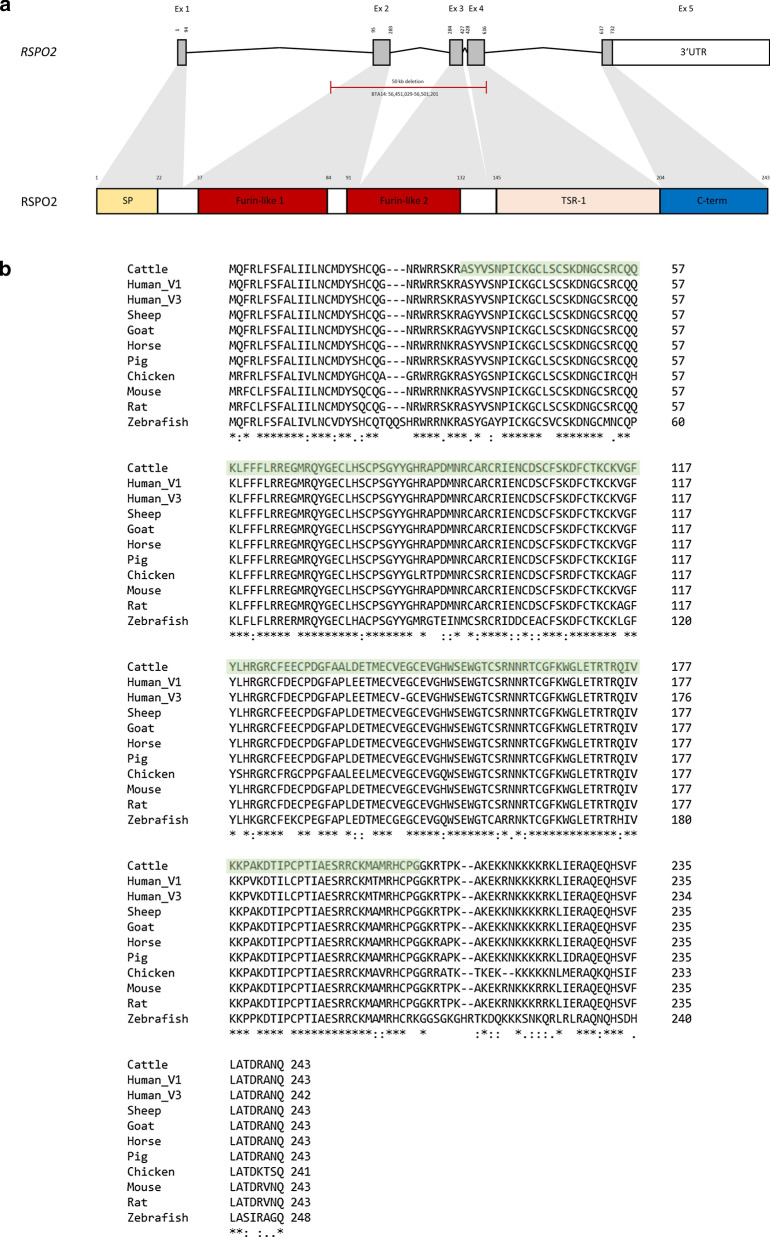
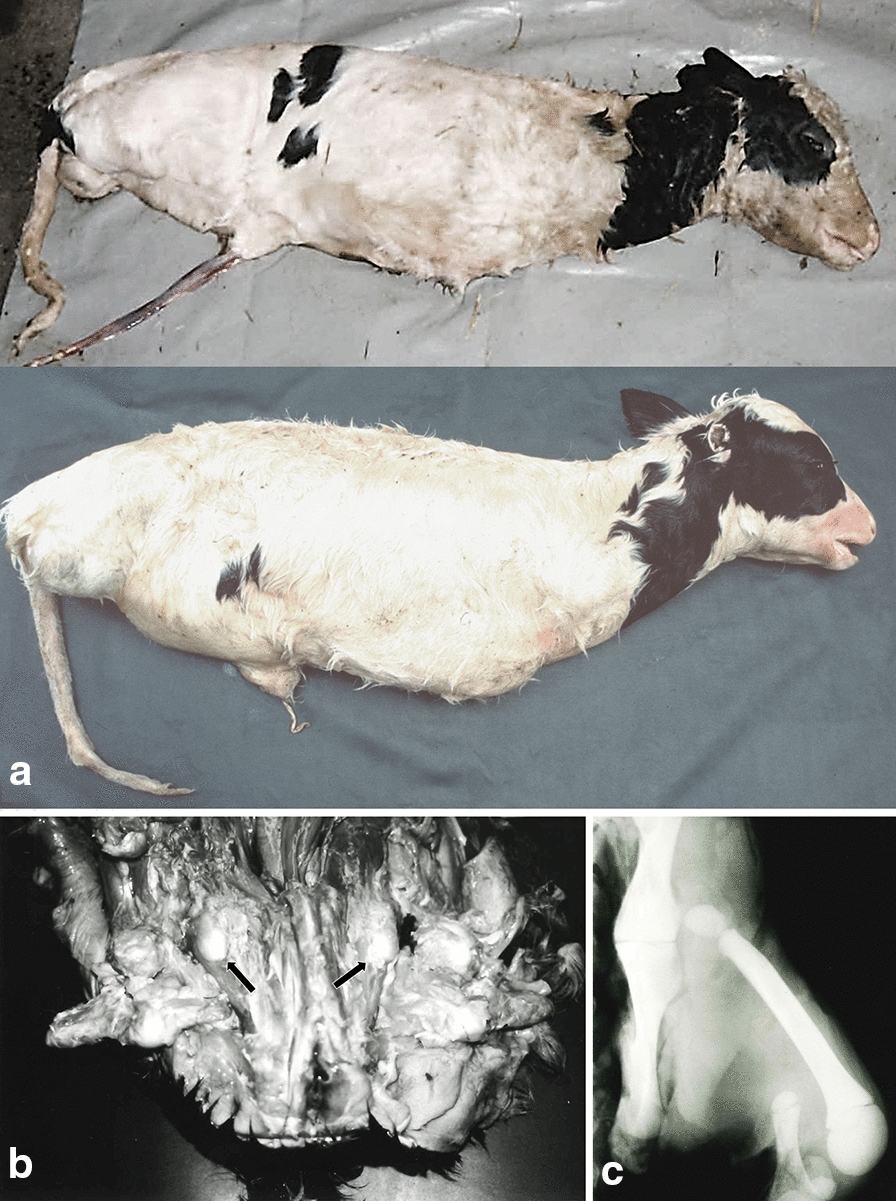
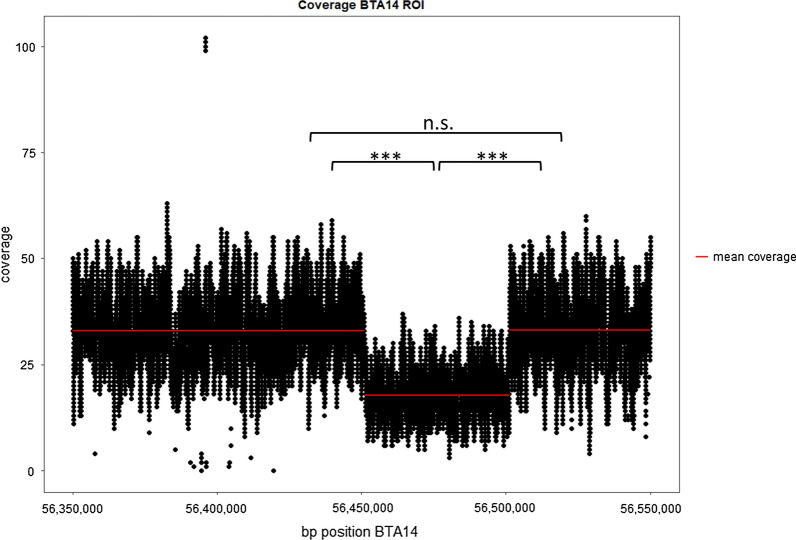
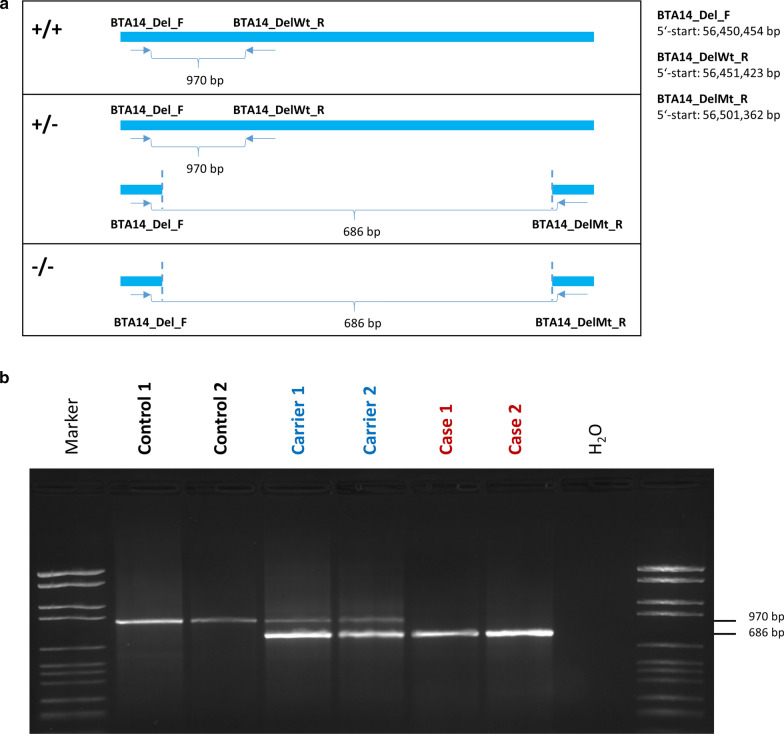
Pathological examination of four tetradysmelia cases revealed a uniform and severe dysmelia of all limbs. Applying a homozygosity mapping approach, we identified a homozygous region of 10.54 Mb on chromosome 14 (Bos taurus BTA14). Only calves that were diagnosed with tetradysmelia shared a distinct homozygous haplotype for this region. We sequenced the whole genome of the cases' sire and searched for heterozygous single nucleotide polymorphisms (SNPs) and small variants on BTA14 that were uniquely present in the sire and absent from 3102 control whole-genome sequences of the 1000 Bull Genomes Project, but none were identified in the 10.54-Mb candidate region on BTA14. Therefore, we subsequently performed a more comprehensive analysis by also considering structural variants and detected a 50-kb deletion in the targeted chromosomal region that was in the heterozygous state in the cases' sire. Using PCR, we confirmed that this detected deletion segregated perfectly within the family with tetradysmelia. The deletion spanned three exons of the bovine R-spondin 2 (RSPO2) gene, which encode three domains of the respective protein. R-spondin 2 is a secreted ligand of leucine-rich repeats containing G protein-coupled receptors that enhance Wnt signalling and is involved in a broad range of developmental processes during embryogenesis.
We identified a 50-kb deletion on BTA14 that disrupts the coding sequence of the RSPO2 gene and is associated with bovine tetradysmelia. To our knowledge, this is the first reported candidate causal mutation for tetradysmelia in a large animal model. Since signalling pathways involved in limb development are conserved across species, the observed inherited defect may serve as a model to further elucidate fundamental pathways of limb development.
四联体畸形是一种罕见的遗传疾病,其特征是肩胛骨和骨盆带远端所有肢体部分严重减少。我们研究了一个荷斯坦弗里森牛的回交家系,其中有 24 个后代,其中 6 头小牛表现出常染色体隐性四联体畸形。为了确定该疾病的遗传基础,我们使用 Bovine Illumina 50 k BeadChip 对 3 头受影响的小牛、5 头母牛和 9 头未受影响的同胞进行了基因分型,并对父本进行了全基因组测序。
对 4 例四联体畸形病例的病理检查显示所有四肢均存在均匀而严重的畸形。应用纯合子作图方法,我们在 14 号染色体(Bos taurus BTA14)上鉴定出一个 10.54 Mb 的纯合区域。只有被诊断为四联体畸形的小牛共享该区域的一个独特的纯合单倍型。我们对病例的父本进行了全基因组测序,并在 BTA14 上搜索了唯存在于父本而不存在于 1000 个公牛基因组计划的 3102 个全基因组对照序列中的杂合单核苷酸多态性(SNP)和小变体,但在 BTA14 的 10.54 Mb 候选区域未发现。因此,我们随后通过同时考虑结构变异进行了更全面的分析,并在目标染色体区域检测到 50 kb 的缺失,该缺失在病例的父本中呈杂合状态。使用 PCR,我们证实该检测到的缺失在四联体畸形家系中完全分离。该缺失跨越牛 R 分泌蛋白 2(RSPO2)基因的三个外显子,该基因编码相应蛋白的三个结构域。RSPO2 是富含亮氨酸重复的 G 蛋白偶联受体的分泌配体,可增强 Wnt 信号通路,并参与胚胎发生过程中的广泛发育过程。
我们在 BTA14 上发现了一个 50 kb 的缺失,破坏了 RSPO2 基因的编码序列,并与牛的四联体畸形有关。据我们所知,这是首次在大型动物模型中报道四联体畸形的候选致病突变。由于参与肢体发育的信号通路在物种间是保守的,因此观察到的遗传性缺陷可以作为进一步阐明肢体发育基本途径的模型。