Seglem K B, Ørstavik R, Torvik F A, Røysamb E, Vollrath M
Department of Mental Disorders, Norwegian Institute of Public Health, P. O. Box 222, Skøyen, 0213, Oslo, Norway.
Department of Mental Health and Suicide, Norwegian Institute of Public Health, P. O. Box 222, Skøyen, 0213, Oslo, Norway.
BMC Public Health. 2020 Nov 11;20(1):1689. doi: 10.1186/s12889-020-09741-y.
Long-term sickness absences burden the economy in many industrialized countries. Both educational attainment and health behaviors are well-known predictors of sickness absence. It remains, however, unclear whether these associations are causal or due to confounding factors. The co-twin control method allows examining causal hypotheses by controlling for familial confounding (shared genes and environment). In this study, we applied this design to study the role of education and health behaviors in sickness absence, taking sex and cohort differences into account.
Participants were two cohorts of in total 8806 Norwegian twins born 1948 to 1960 (older cohort, mean age at questionnaire = 40.3, 55.8% women), and 1967 to 1979 (younger cohort, mean age at questionnaire = 25.6, 58.9% women). Both cohorts had reported their health behaviors (smoking, physical activity and body mass index (BMI)) through a questionnaire during the 1990s. Data on the twins' educational attainment and long-term sickness absences between 2000 and 2014 were retrieved from Norwegian national registries. Random (individual-level) and fixed (within-twin pair) effects regression models were used to measure the associations between educational attainment, health behaviours and sickness absence and to test the effects of possible familial confounding.
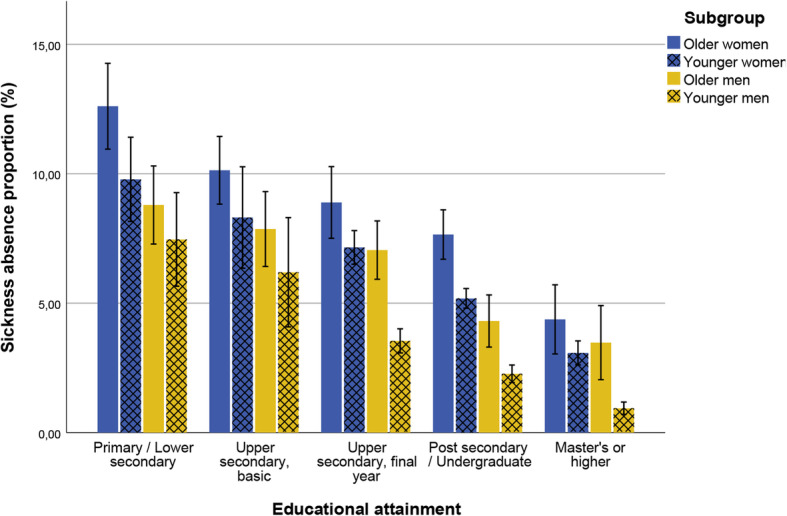
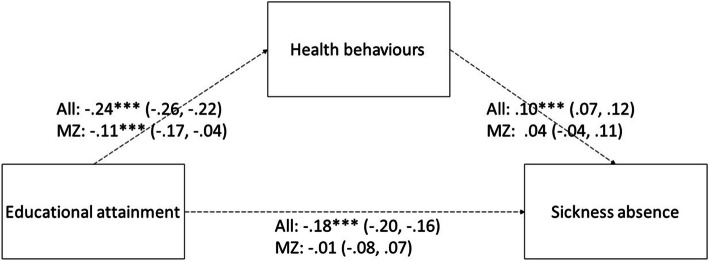
Low education and poor health behaviors were associated with a higher proportion of sickness absence at the individual level. There were stronger effects of health behaviors on sickness absence in women, and in the older cohort, whereas the effect of educational attainment was similar across sex and cohorts. After adjustment for unobserved familial factors (genetic and environmental factors shared by twin pairs), the associations were strongly attenuated and non-significant, with the exception of health behaviors and sickness absence among men in the older cohort.
The associations between educational attainment, health behaviors, and sickness absence seem to be confounded by unobserved familial factors shared by co-twins. However, the association between health behaviors and sickness absence was consistent with a causal effect among men in the older cohort. Future studies should consider familial confounding, as well as sex and age/cohort differences, when assessing associations between education, health behaviors and sickness absence.
在许多工业化国家,长期病假给经济带来负担。教育程度和健康行为都是众所周知的病假预测因素。然而,尚不清楚这些关联是因果关系还是由混杂因素导致。同卵双胞胎对照方法可以通过控制家族性混杂因素(共享基因和环境)来检验因果假设。在本研究中,我们采用这种设计来研究教育和健康行为在病假中的作用,并考虑了性别和队列差异。
参与者为两组共8806名挪威双胞胎,一组出生于1948年至1960年(年龄较大的队列,问卷调查时的平均年龄为40.3岁,女性占55.8%),另一组出生于1967年至1979年(年龄较小的队列,问卷调查时的平均年龄为25.6岁,女性占58.9%)。两组在20世纪90年代都通过问卷报告了他们的健康行为(吸烟、体育活动和体重指数(BMI))。2000年至2014年期间双胞胎的教育程度和长期病假数据来自挪威国家登记处。采用随机(个体水平)和固定(双胞胎对内部)效应回归模型来衡量教育程度、健康行为与病假之间的关联,并检验可能的家族性混杂因素的影响。
在个体水平上,低教育程度和不良健康行为与较高比例的病假相关。健康行为对女性和年龄较大队列的病假影响更强,而教育程度的影响在性别和队列中相似。在调整未观察到的家族因素(双胞胎对共享的基因和环境因素)后,除年龄较大队列中的男性健康行为与病假之间的关联外,这些关联均大幅减弱且无统计学意义。
教育程度、健康行为与病假之间的关联似乎被同卵双胞胎共享的未观察到的家族因素所混杂。然而,健康行为与病假之间的关联在年龄较大队列的男性中与因果效应一致。未来研究在评估教育、健康行为与病假之间的关联时应考虑家族性混杂因素以及性别和年龄/队列差异。