PATH, PO Box 900922, Seattle, WA, 98109, USA.
Centre for Health Economics Research & Modelling Infectious Diseases (CHERMID), Vaccine & Infectious Disease Institute, Campus Drie Eiken, Universiteitsplein 1 - 2610, Wilrijk, Belgium.
Vaccine. 2020 Jul 14;38(33):5139-5147. doi: 10.1016/j.vaccine.2020.06.036. Epub 2020 Jun 22.
Interventions to protect young infants against respiratory syncytial virus (RSV) are in advanced phases of development and are expected to be available in the foreseeable future. Gavi, the Vaccine Alliance, included maternal vaccines and infant monoclonal antibodies for RSV as part of the 2018 vaccine investment strategy (VIS) and decided to support these products subject to licensure, World Health Organization prequalification, Strategic Advisory Group of Experts recommendation, and meeting the financial assumptions used as the basis of the investment case. Impact estimates reported in this manuscript were used to inform the Gavi VIS.
We compared two independent vaccine impact models to evaluate a potential maternal RSV vaccine's impact on infant health in 73 Gavi-supported countries. Key inputs were harmonized across both models. We analyzed various scenarios to evaluate the effect of uncertain model parameters such as vaccine efficacy, duration of infant protection, and infant disease burden. Estimates of averted cases, severe cases, hospitalizations, deaths, and disability-adjusted life years (DALYs) were calculated over the 2023-2035 horizon.
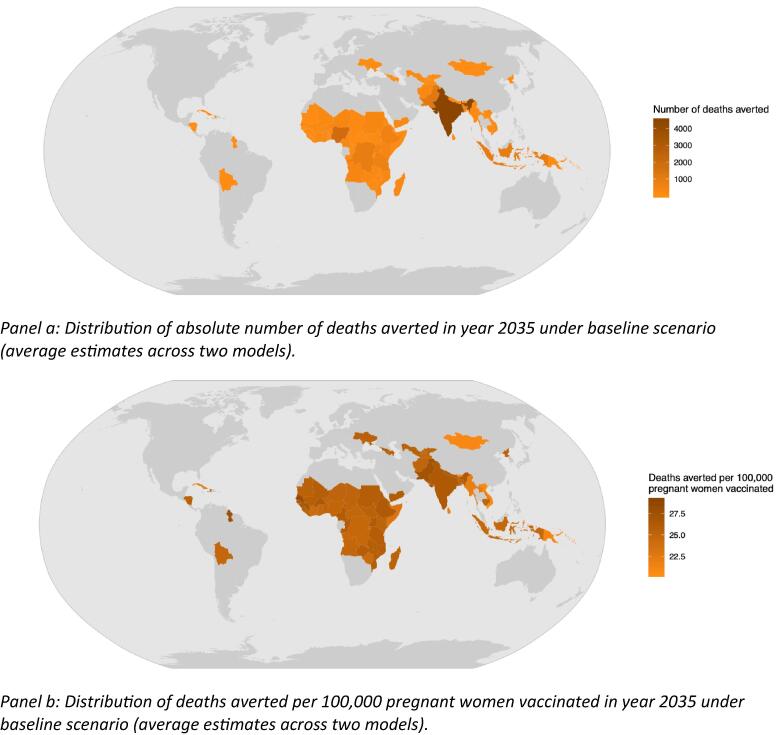
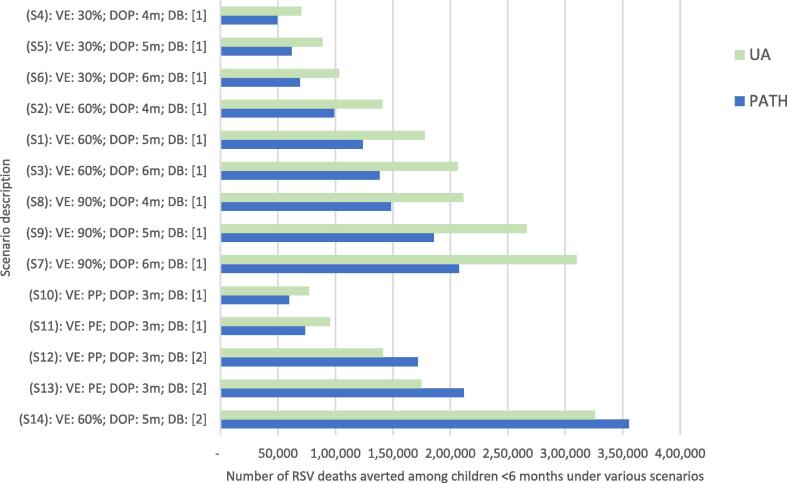
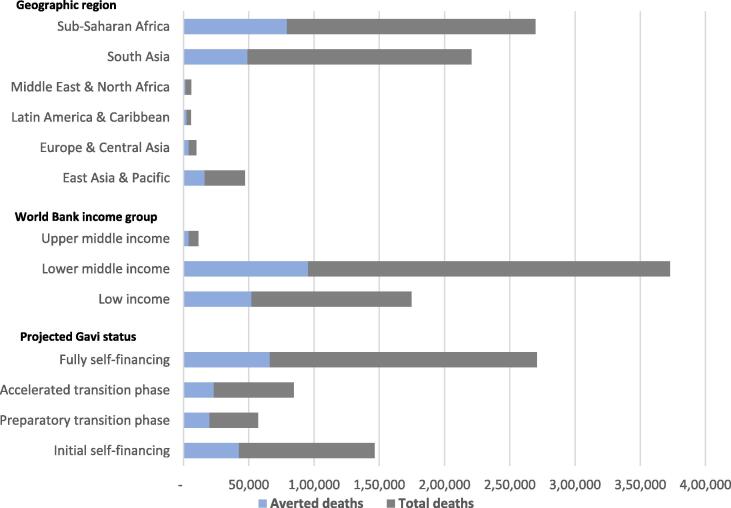
A maternal RSV vaccine with 60% efficacy offering 5 months of infant protection implemented across 73 low- and middle-income countries could avert 10.1-12.5 million cases, 2.8-4.0 million hospitalizations, 123.7-177.7 thousand deaths, and 8.5-11.9 million DALYs among infants under 6 months of age for the duration of analysis (2023-2035). Maternal RSV vaccination was projected to avert up to 42% of estimated RSV deaths among infants under 6 months in year 2035. Alternative scenario analyses with higher disease burden assumptions showed that a maternal vaccine could avert as many as 325-355 thousand deaths among infants under 6 months.
RSV maternal immunization is projected to substantially reduce mortality and morbidity among young infants if introduced across Gavi-supported countries.
This work was supported by Bill & Melinda Gates Foundation, Seattle, WA, and Respiratory Syncytial Virus Consortium in Europe. The findings and conclusions contained within are those of the authors and do not necessarily reflect positions or policies of the Bill & Melinda Gates Foundation or of the Respiratory Syncytial Virus Consortium. LW is supported by Research Foundation-Flanders (1234620 N).
预防呼吸道合胞病毒(RSV)的干预措施目前已进入后期开发阶段,预计在可预见的未来将会问世。疫苗联盟 Gavi 将针对 RSV 的母亲疫苗和婴儿单克隆抗体纳入 2018 年疫苗投资策略(VIS),并决定在获得许可、世界卫生组织资格预审、专家战略咨询小组建议以及满足作为投资案例基础的财务假设的前提下,支持这些产品。本文报告的影响估计数用于为 Gavi VIS 提供信息。
我们比较了两种独立的疫苗影响模型,以评估在 73 个 Gavi 支持的国家中,一种潜在的母亲 RSV 疫苗对婴儿健康的影响。两个模型都对关键投入进行了协调。我们分析了各种情况,以评估疫苗效力、婴儿保护期和婴儿疾病负担等不确定模型参数的影响。在 2023-2035 年期间,计算了可预防病例、严重病例、住院治疗、死亡和残疾调整生命年(DALY)的估计数。
在 73 个低收入和中等收入国家中,使用效力为 60%、能为婴儿提供 5 个月保护的 RSV 母亲疫苗,可预防 6 个月以下婴儿在分析期间(2023-2035 年)发生 1010 万至 1250 万例病例、280 万至 400 万例住院治疗、12.37 万至 17.77 千例死亡以及 850 万至 1190 万残疾调整生命年。预计 RSV 母亲疫苗接种可预防 2035 年 6 个月以下婴儿中高达 42%的 RSV 死亡。采用更高疾病负担假设的替代情景分析表明,母亲疫苗接种可预防多达 6 个月以下婴儿 32.5 万至 35.5 万例死亡。
如果在 Gavi 支持的国家中推出 RSV 母亲免疫接种,预计将大大降低幼儿的死亡率和发病率。
这项工作得到了比尔及梅琳达·盖茨基金会(西雅图,华盛顿)和欧洲呼吸道合胞病毒联盟的支持。本文包含的研究结果和结论仅反映作者的观点,不一定反映比尔及梅琳达·盖茨基金会或呼吸道合胞病毒联盟的立场或政策。LW 得到了佛兰德斯研究基金会(1234620N)的支持。