Maclot François, Candresse Thierry, Filloux Denis, Malmstrom Carolyn M, Roumagnac Philippe, van der Vlugt René, Massart Sébastien
Plant Pathology Laboratory, Terra-Gembloux Agro-Bio Tech, Liège University, Gembloux, Belgium.
Univ. Bordeaux, INRAE, UMR BFP, Villenave d'Ornon, France.
Front Microbiol. 2020 Oct 16;11:578064. doi: 10.3389/fmicb.2020.578064. eCollection 2020.
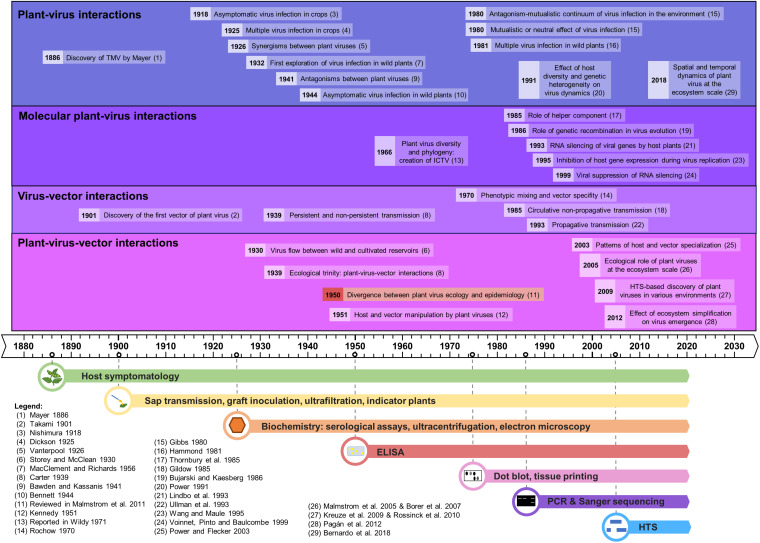
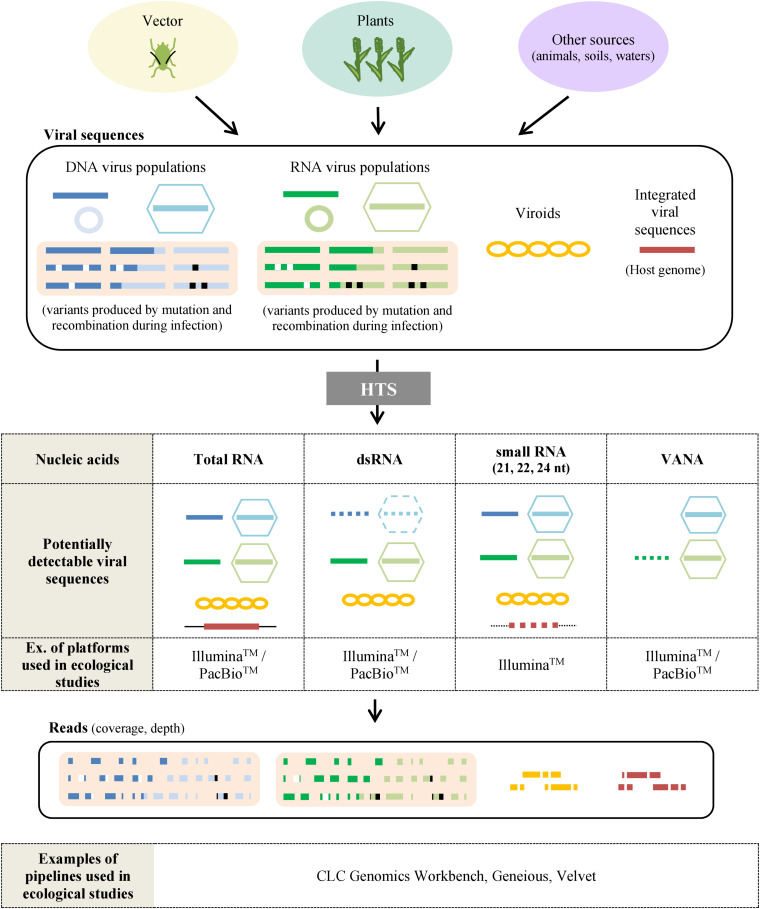
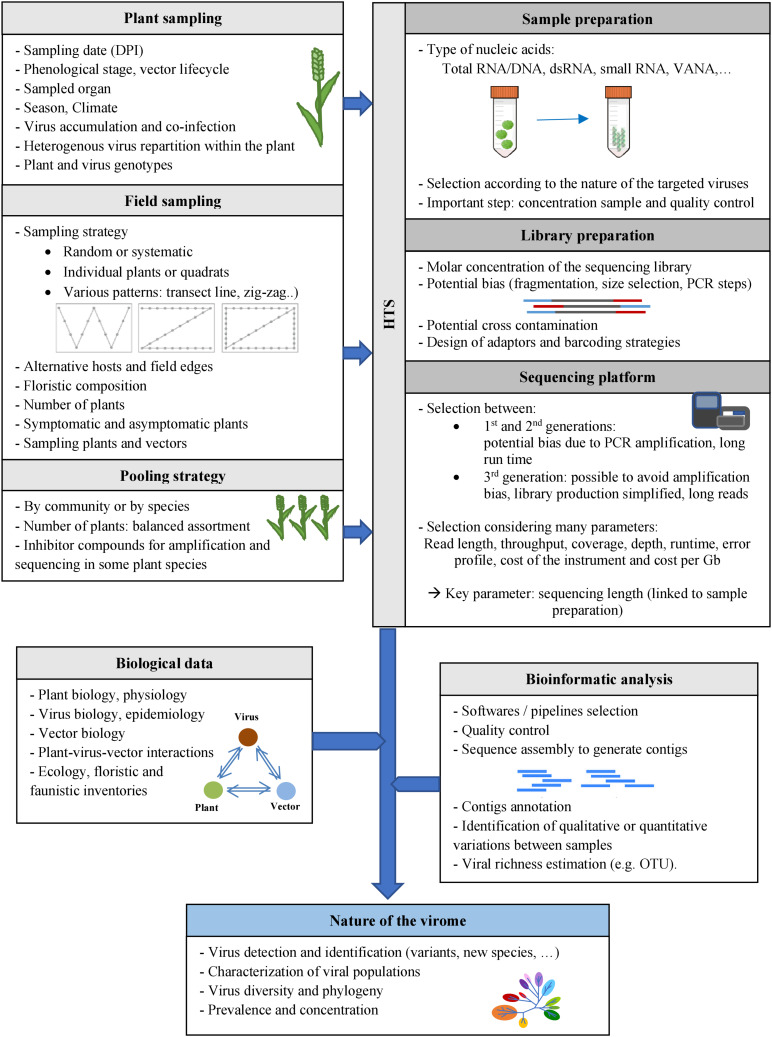
The ecology of plant viruses began to be explored at the end of the 19th century. Since then, major advances have revealed mechanisms of virus-host-vector interactions in various environments. These advances have been accelerated by new technlogies for virus detection and characterization, most recently including high throughput sequencing (HTS). HTS allows investigators, for the first time, to characterize all or nearly all viruses in a sample without information about which viruses might be present. This powerful approach has spurred new investigation of the viral metagenome (virome). The rich virome datasets accumulated illuminate important ecological phenomena such as virus spread among host reservoirs (wild and domestic), effects of ecosystem simplification caused by human activities (and agriculture) on the biodiversity and the emergence of new viruses in crops. To be effective, however, HTS-based virome studies must successfully navigate challenges and pitfalls at each procedural step, from plant sampling to library preparation and bioinformatic analyses. This review summarizes major advances in plant virus ecology associated with technological developments, and then presents important considerations and best practices for HTS use in virome studies.
植物病毒生态学在19世纪末开始得到探索。从那时起,重大进展揭示了病毒在各种环境中与宿主-载体相互作用的机制。病毒检测和表征的新技术加速了这些进展,最近包括高通量测序(HTS)。HTS首次使研究人员能够在不了解样本中可能存在哪些病毒的情况下,对样本中的所有或几乎所有病毒进行表征。这种强大的方法推动了对病毒宏基因组(病毒组)的新研究。积累的丰富病毒组数据集揭示了重要的生态现象,如病毒在宿主库(野生和家养)之间的传播、人类活动(和农业)导致的生态系统简化对生物多样性的影响以及作物中新病毒的出现。然而,要想有效,基于HTS的病毒组研究必须在从植物采样到文库制备和生物信息学分析的每个程序步骤中成功应对挑战和陷阱。本综述总结了与技术发展相关的植物病毒生态学的主要进展,然后介绍了在病毒组研究中使用HTS的重要注意事项和最佳实践。