Burdeyron Perrine, Giraud Sébastien, Hauet Thierry, Steichen Clara
INSERM U1082 IRTOMIT, CHU de Poitiers, Poitiers 86021, France.
World J Stem Cells. 2020 Oct 26;12(10):1080-1096. doi: 10.4252/wjsc.v12.i10.1080.
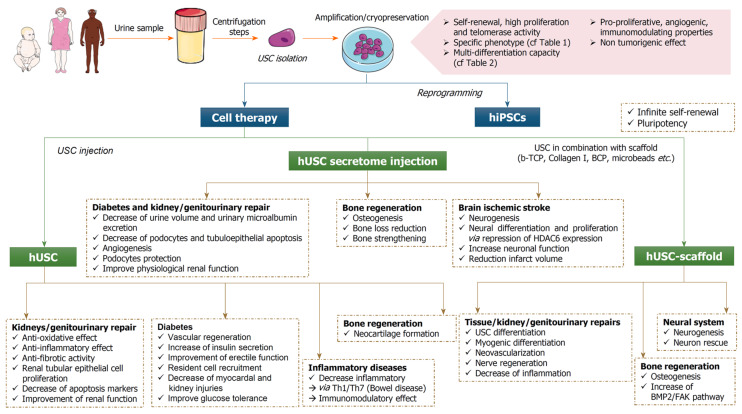
Cell therapy, ., the use of cells to repair an affected tissue or organ, is at the forefront of regenerative and personalized medicine. Among the multiple cell types that have been used for this purpose [including adult stem cells such as mesenchymal stem cells or pluripotent stem cells], urine-derived stem cells (USCs) have aroused interest in the past years. USCs display classical features of mesenchymal stem cells such as differentiation capacity and immunomodulation. Importantly, they have the main advantage of being isolable from one sample of voided urine with a cheap and unpainful procedure, which is broadly applicable, whereas most adult stem cell types require invasive procedure. Moreover, USCs can be differentiated into renal cell types. This is of high interest for renal cell therapy-based regenerative approaches. This review will firstly describe the isolation and characterization of USCs. We will specifically present USC phenotype, which is not an object of consensus in the literature, as well as detail their differentiation capacity. In the second part of this review, we will present and discuss the main applications of USCs. These include use as a substrate to generate human induced pluripotent stem cells, but we will deeply focus on the use of USCs for cell therapy approaches with a detailed analysis depending on the targeted organ or system. Importantly, we will also focus on the applications that rely on the use of USC-derived products such as microvesicles including exosomes, which is a strategy being increasingly employed. In the last section, we will discuss the remaining barriers and challenges in the field of USC-based regenerative medicine.
细胞疗法,即利用细胞修复受影响的组织或器官,处于再生医学和个性化医学的前沿。在用于此目的的多种细胞类型中(包括成人干细胞,如间充质干细胞或多能干细胞),尿液来源的干细胞(USCs)在过去几年引起了人们的关注。USCs具有间充质干细胞的典型特征,如分化能力和免疫调节。重要的是,它们的主要优势在于可以通过一种廉价且无痛的程序从一份晨尿样本中分离出来,这种方法广泛适用,而大多数成人干细胞类型需要侵入性操作。此外,USCs可以分化为肾细胞类型。这对于基于肾细胞疗法的再生方法具有高度意义。本综述将首先描述USCs的分离和特征。我们将特别介绍USCs的表型,这在文献中尚无共识,同时详细阐述它们的分化能力。在本综述的第二部分,我们将介绍并讨论USCs的主要应用。这些应用包括用作生成人类诱导多能干细胞的底物,但我们将深入关注USCs在细胞疗法中的应用,并根据靶向器官或系统进行详细分析。重要的是,我们还将关注依赖于使用USC衍生产品(如包括外泌体在内的微泡)的应用,这是一种越来越常用的策略。在最后一部分,我们将讨论基于USC的再生医学领域中仍然存在的障碍和挑战。