Université du Québec en Outaouais, Department of Nursing Research, Saint-Jérôme, QC, Canada.
Centre Intégré de Santé et de Services de Sociaux des Laurentides, Direction de la Santé Publique, Saint-Jérôme, Québec, Canada.
PLoS One. 2020 Nov 12;15(11):e0242212. doi: 10.1371/journal.pone.0242212. eCollection 2020.
Nosocomial infections place a heavy burden on patients and healthcare providers and impact health care institutions financially. Reducing nosocomial infections requires an integrated program of prevention and control using key clinical best care practices. No instrument currently exists that measures these practices in terms of personnel time and material costs.
To develop and validate an instrument that would measure nosocomial infection control and prevention best care practice costs, including estimates of human and material resources.
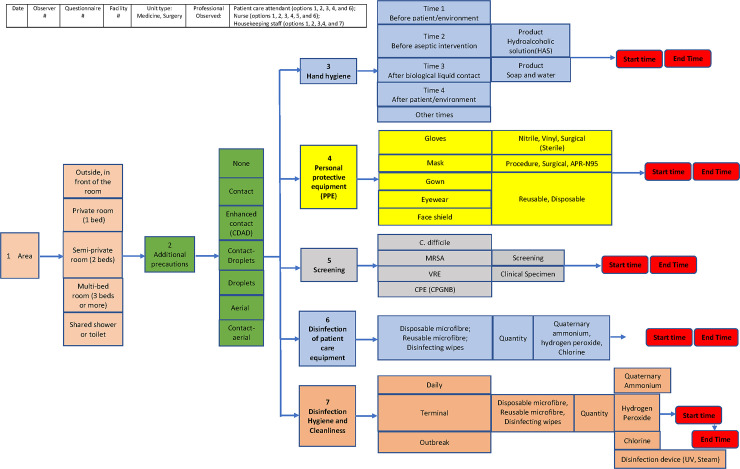
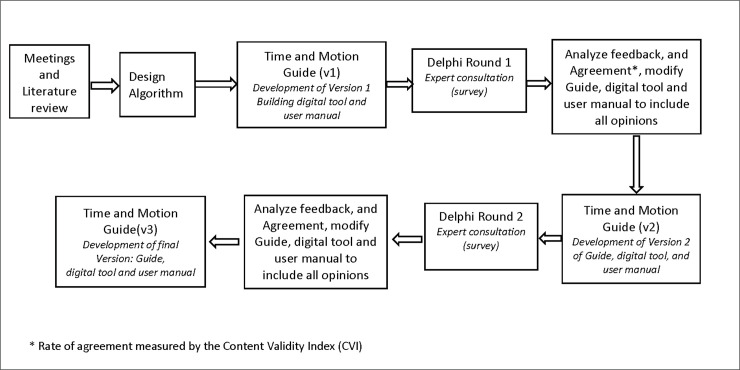
An evaluation of the literature identified four practices essential for the control of pathogens: hand hygiene, hygiene and sanitation, screening and additional precaution. To reflect time, materials and products used in these practices, our team developed a time and motion guide. Iterations of the guide were assessed in a Delphi technique; content validity was established using the content validity index and reliability was assessed using Kruskall Wallis one-way ANOVA of rank test.
Two rounds of Delphi review were required; 88% of invited experts completed the assessment. The final version of the guide contains eight dimensions: Identification [83 items]; Personnel [5 items]; Additional Precautions [1 item]; Hand Hygiene [2 items]; Personal Protective Equipment [14 items]; Screening [4 items]; Cleaning and Disinfection of Patient Care Equipment [33 items]; and Hygiene and Sanitation [24 items]. The content validity index obtained for all dimensions was acceptable (> 80%). Experts statistically agreed on six of the eight dimensions.
DISCUSSION/CONCLUSION: This study developed and validated a new instrument based on expert opinion, the time and motion guide, for the systematic assessment of costs relating to the human and material resources used in nosocomial infection prevention and control. This guide will prove useful to measure the intensity of the application of prevention and control measures taken before, during and after outbreak periods or during pandemics such as COVID-19.
医院感染给患者和医疗保健提供者带来了沉重的负担,并对医疗机构的财务状况造成了影响。减少医院感染需要采用预防和控制的综合计划,使用关键的临床最佳护理实践。目前没有一种工具可以衡量这些实践在人员时间和材料成本方面的情况。
开发和验证一种能够衡量医院感染控制和预防最佳护理实践成本的工具,包括对人力和物力资源的估计。
对文献的评估确定了控制病原体的四项基本实践:手卫生、卫生和环境卫生、筛查和额外预防措施。为了反映这些实践中使用的时间、材料和产品,我们的团队开发了一个时间和动作指南。指南的迭代在德尔菲技术中进行了评估;使用内容效度指数确定内容效度,使用 Kruskal Wallis 单向方差分析的秩检验评估可靠性。
需要进行两轮德尔菲评估;88%的受邀专家完成了评估。指南的最终版本包含八个维度:识别[83 项];人员[5 项];额外预防措施[1 项];手卫生[2 项];个人防护装备[14 项];筛查[4 项];患者护理设备的清洁和消毒[33 项];以及卫生和环境卫生[24 项]。所有维度的内容效度指数均可接受(>80%)。专家在八个维度中的六个维度上达成了统计学共识。
讨论/结论:本研究基于专家意见开发并验证了一种新的工具,即时间和动作指南,用于系统评估与医院感染预防和控制相关的人力和物力资源成本。该指南将有助于衡量在暴发期间或在 COVID-19 等大流行期间之前、期间和之后采取的预防和控制措施的应用强度。