Department of Food Science, Nutrition, and Health Promotion, Mississippi State University, Starkville, MS 39762, USA.
Int J Environ Res Public Health. 2020 Nov 9;17(21):8268. doi: 10.3390/ijerph17218268.
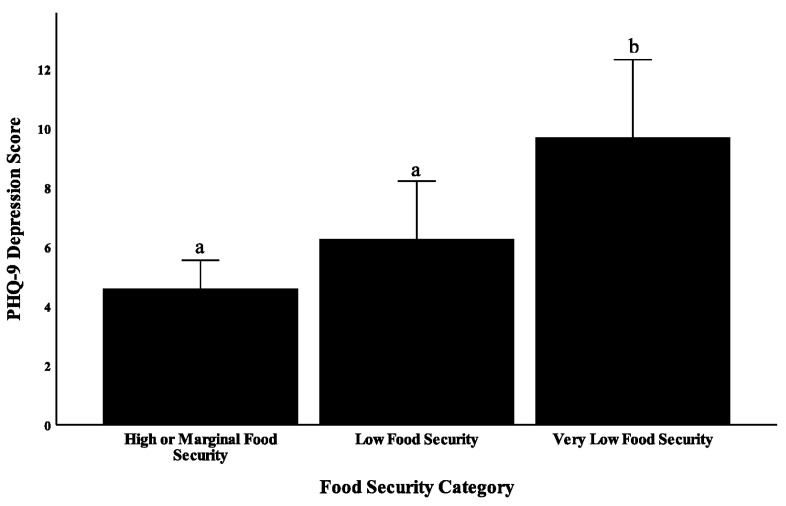
Food insecurity is common among college students in the United States and is associated with poorer health-related outcomes and academic performance. The aims of this study were to assess the prevalence of food insecurity at a large, public university in Mississippi, a state with the second highest rate of food insecurity in the nation, and to examine the associations between food insecurity, depression, and race in this group of students. Food security was measured using the United States Department of Agriculture Household Food Security Survey Module: Six-Item Short Form, and depression was measured using the Patient Health Questionnaire-9. In total, 131 students ages 18-24 participated in the study. Food insecurity was present in 38.2% of students surveyed. The odds of food insecurity were higher among African American students compared to Caucasian students (OR = 3.50, 95% CI: 1.38, 8.90). Students with very low food security had 4.52-times greater odds of having depression than food-secure students ( = 0.011, 95% CI: 1.42, 14.36). Neither body mass index nor body fat percentage were associated with food security status. Further research is needed on strategies to address the risk of depression among food-insecure college students and the racial disparity in food insecurity rates present among college students.
食物不安全在美国大学生中很常见,与较差的健康相关结果和学业表现有关。本研究的目的是评估密西西比州一所大型公立大学的食物不安全发生率,该州的食物不安全发生率在全美排名第二,并研究该组学生中食物不安全、抑郁和种族之间的关联。使用美国农业部家庭粮食安全调查模块:六项目短表来衡量粮食安全,使用患者健康问卷-9 来衡量抑郁。共有 131 名年龄在 18-24 岁的学生参加了这项研究。调查中有 38.2%的学生存在食物不安全问题。与白人学生相比,非裔美国学生的食物不安全可能性更高(OR=3.50,95%CI:1.38,8.90)。与食物安全的学生相比,极不安全食物的学生患抑郁症的几率高出 4.52 倍(=0.011,95%CI:1.42,14.36)。体重指数和体脂百分比均与食物安全状况无关。需要进一步研究解决食物不安全大学生抑郁风险的策略,以及大学生中存在的食物不安全率的种族差异。