Department of Physics and Graduate Institute of Biophysics, National Central University, Taoyuan City 32001, Taiwan.
Biomolecules. 2020 Nov 9;10(11):1528. doi: 10.3390/biom10111528.
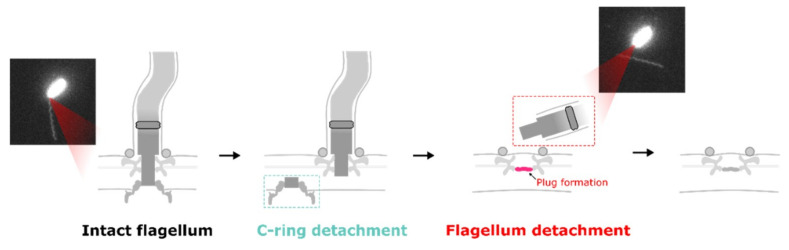
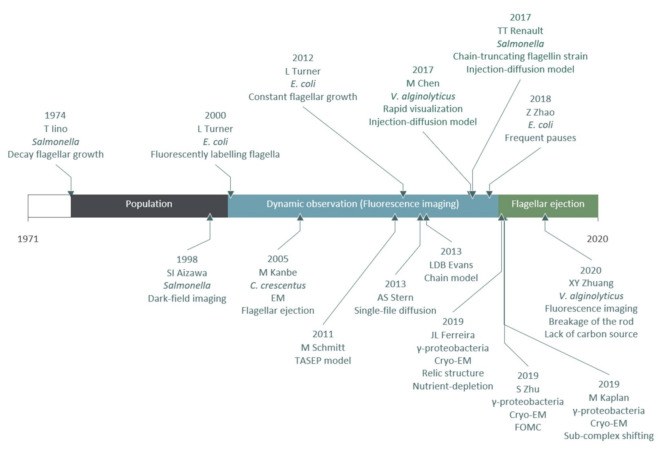
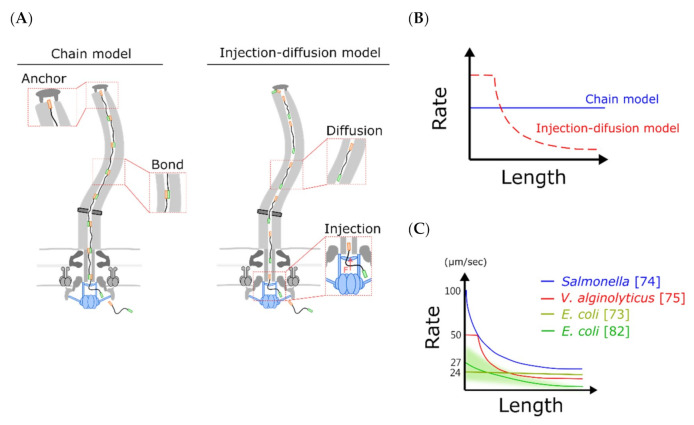
The bacterial flagellar filament is an extracellular tubular protein structure that acts as a propeller for bacterial swimming motility. It is connected to the membrane-anchored rotary bacterial flagellar motor through a short hook. The bacterial flagellar filament consists of approximately 20,000 flagellins and can be several micrometers long. In this article, we reviewed the experimental works and models of flagellar filament construction and the recent findings of flagellar filament ejection during the cell cycle. The length-dependent decay of flagellar filament growth data supports the injection-diffusion model. The decay of flagellar growth rate is due to reduced transportation of long-distance diffusion and jamming. However, the filament is not a permeant structure. Several bacterial species actively abandon their flagella under starvation. Flagellum is disassembled when the rod is broken, resulting in an ejection of the filament with a partial rod and hook. The inner membrane component is then diffused on the membrane before further breakdown. These new findings open a new field of bacterial macro-molecule assembly, disassembly, and signal transduction.
细菌鞭毛丝是一种细胞外管状蛋白结构,充当细菌游动的推进器。它通过一个短钩与膜锚定的旋转细菌鞭毛马达相连。细菌鞭毛丝由大约 20000 个鞭毛蛋白组成,长度可达数微米。本文综述了鞭毛丝组装的实验工作和模型,以及细胞周期中鞭毛丝射出的最新发现。鞭毛丝生长的长度依赖性衰减数据支持注入-扩散模型。鞭毛生长速率的衰减是由于长程扩散和堵塞导致的运输减少。然而,鞭毛丝不是可渗透的结构。在饥饿状态下,几种细菌会主动放弃它们的鞭毛。当杆断裂时,鞭毛会解体,导致部分杆和钩被射出,然后内部膜成分在进一步降解之前在膜上扩散。这些新发现为细菌大分子组装、解体和信号转导开辟了一个新的领域。