Electrical Engineering and Computer Science Department, University of California, Merced, CA 95340, USA.
Mechanical Engineering Department, University of California, Merced, CA 95340, USA.
Sensors (Basel). 2020 Nov 10;20(22):6427. doi: 10.3390/s20226427.
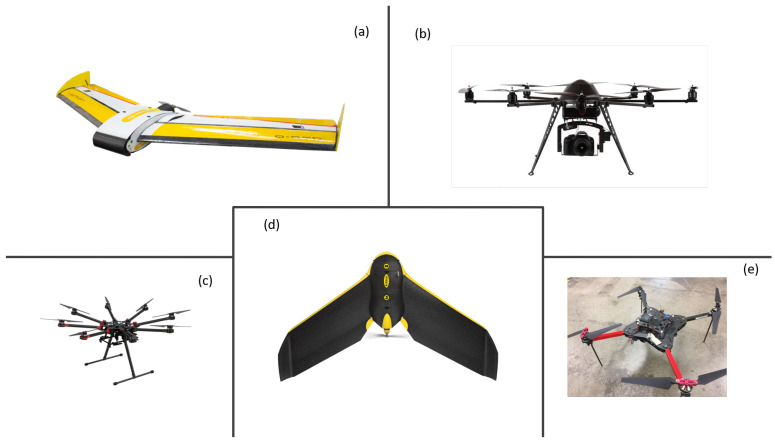
Estimating evapotranspiration (ET) has been one of the most critical research areas in agriculture because of water scarcity, the growing population, and climate change. The accurate estimation and mapping of ET are necessary for crop water management. Traditionally, researchers use water balance, soil moisture, weighing lysimeters, or an energy balance approach, such as Bowen ratio or eddy covariance towers to estimate ET. However, these ET methods are point-specific or area-weighted measurements and cannot be extended to a large scale. With the advent of satellite technology, remote sensing images became able to provide spatially distributed measurements. However, the spatial resolution of multispectral satellite images is in the range of meters, tens of meters, or hundreds of meters, which is often not enough for crops with clumped canopy structures, such as trees and vines. Unmanned aerial vehicles (UAVs) can mitigate these spatial and temporal limitations. Lightweight cameras and sensors can be mounted on the UAVs and take high-resolution images. Unlike satellite imagery, the spatial resolution of the UAV images can be at the centimeter-level. UAVs can also fly on-demand, which provides high temporal imagery. In this study, the authors examined different UAV-based approaches of ET estimation at first. Models and algorithms, such as mapping evapotranspiration at high resolution with internalized calibration (METRIC), the two-source energy balance (TSEB) model, and machine learning (ML) are analyzed and discussed herein. Second, challenges and opportunities for UAVs in ET estimation are also discussed, such as uncooled thermal camera calibration, UAV image collection, and image processing. Then, the authors share views on ET estimation with UAVs for future research and draw conclusive remarks.
估算蒸散量(ET)一直是农业领域最关键的研究领域之一,因为水资源短缺、人口增长和气候变化。准确估算和绘制 ET 是作物水分管理所必需的。传统上,研究人员使用水量平衡、土壤湿度、称重蒸渗仪或能量平衡方法,如波文比或涡度协方差塔来估算 ET。然而,这些 ET 方法是点特定或区域加权测量,无法扩展到大规模。随着卫星技术的出现,遥感图像能够提供空间分布的测量。然而,多光谱卫星图像的空间分辨率在米、数十米或数百米范围内,对于树冠结构密集的作物(如树木和葡萄藤)来说通常不够。无人机 (UAV) 可以减轻这些时空限制。轻型摄像机和传感器可以安装在 UAV 上,并拍摄高分辨率图像。与卫星图像不同,UAV 图像的空间分辨率可以达到厘米级。UAV 还可以按需飞行,提供高时间分辨率的图像。在这项研究中,作者首先检查了不同的基于 UAV 的 ET 估算方法。在此分析和讨论了模型和算法,例如使用内部校准(METRIC)以高分辨率映射蒸散量、两源能量平衡(TSEB)模型和机器学习(ML)。其次,还讨论了 UAV 在 ET 估算中的挑战和机遇,例如非冷却热像仪校准、UAV 图像采集和图像处理。然后,作者分享了对未来研究中使用 UAV 进行 ET 估算的看法,并得出结论性意见。