Central Queensland University, School of Health, Medical and Applied Sciences, 554-700 Yaamba Road, Rockhampton, QLD, 4701, Australia.
Department of Pharmacy and Intensive Care Unit, Rockhampton Hospital, Canning Street, Rockhampton, QLD, 4700, Australia.
BMC Anesthesiol. 2020 Nov 12;20(1):283. doi: 10.1186/s12871-020-01194-5.
There are scenarios where pre-mixing and infusing analgesic and anaesthetic agents as a single intravenous (IV) solution is highly desirable; however, it is important to ensure the agents are compatible when mixed. As such, the long-term stability of a remifentanil-propofol mixture, and means of improving this, were assessed across a range of remifentanil concentrations, diluents, and time points.
Remifentanil was reconstituted with ultrapure water, 0.9% saline, 20% saline, or 8.4% sodium bicarbonate solution (the latter two chosen for their pH characteristics, rather than their use in pharmaceutical reconstitution) and then mixed with propofol (1%) or further diluted with water to derive concentrations of 10-50 μg mL. Remifentanil and propofol concentrations were determined initially and then periodically for up to 24 h using high performance liquid chromatography (HPLC). Mass spectrometry (MS) was used to detect degradation products in solutions containing 30 μg mL of remifentanil. Statistical analysis was performed using ANOVA and Student's t-test, with a significance value of 0.05.
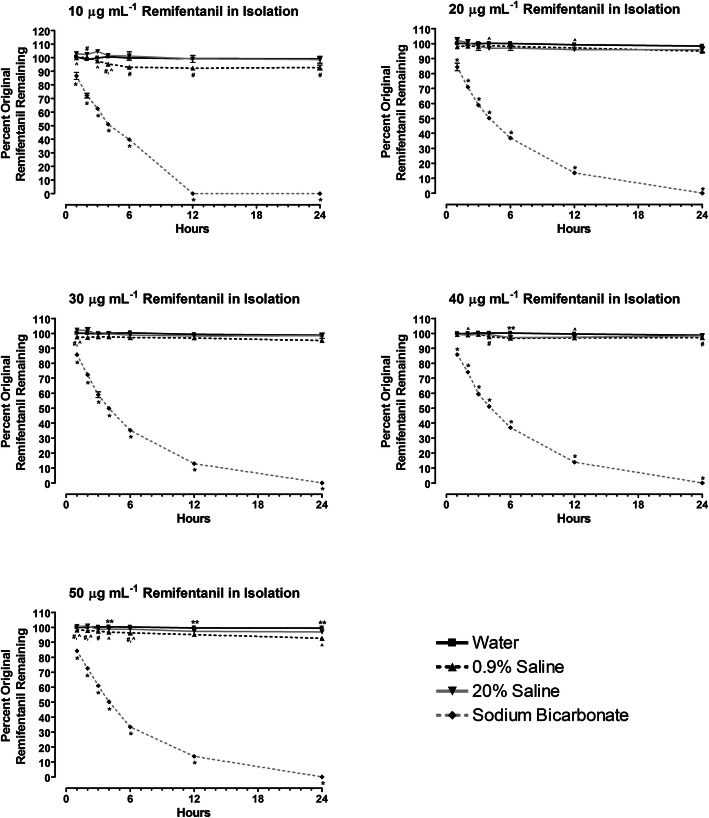
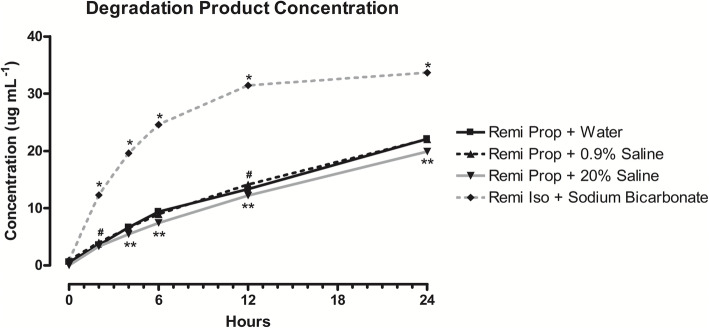
Isolated remifentanil (pH < 4) and propofol (pH 7.35) did not degrade significantly when reconstituted with water or saline solution over 24 h, while remifentanil reconstituted with sodium bicarbonate degraded significantly (P < 0.001, pH 8.65). Mixing with propofol substantially increased the pH of the mixture and resulted in significant remifentanil degradation for all reconstitution solutions used, while propofol remained stable (pH 6.50). The amount of degradation product detected in samples containing isolated remifentanil and a mixture of the drugs was proportional to the remifentanil degradation observed.
Remifentanil stability is affected by both the reconstitution solution used and when mixed with propofol, with pH appearing to be a contributing factor to degradation. If the pH of the solution and concentration of remifentanil are correctly controlled, e.g. through the use of a more acidic diluent, an admixture of remifentanil and propofol may be useful clinically.
在某些情况下,将镇痛和麻醉药物预先混合并注入单一的静脉(IV)溶液中是非常理想的;然而,混合时确保药物相容是很重要的。因此,评估了瑞芬太尼-丙泊酚混合物在一系列瑞芬太尼浓度、稀释剂和时间点下的长期稳定性,以及改善这种稳定性的方法。
瑞芬太尼用超纯水、0.9%生理盐水、20%生理盐水或 8.4%碳酸氢钠溶液(选择后两者是因为它们的 pH 值特性,而不是因为它们在药物配制中的使用)重新配制,然后与丙泊酚(1%)混合,或用进一步用水稀释,得到 10-50μg·mL 的浓度。使用高效液相色谱法(HPLC)在最初和随后的 24 小时内定期测定瑞芬太尼和丙泊酚的浓度。使用质谱(MS)检测含有 30μg·mL 瑞芬太尼的溶液中的降解产物。使用方差分析和学生 t 检验进行统计分析,显著性值为 0.05。
单独的瑞芬太尼(pH<4)和丙泊酚(pH7.35)在 24 小时内用超纯水或生理盐水重新配制时没有明显降解,而用碳酸氢钠重新配制的瑞芬太尼则明显降解(P<0.001,pH8.65)。与丙泊酚混合会大大增加混合物的 pH 值,导致所有使用的再配制溶液中的瑞芬太尼显著降解,而丙泊酚保持稳定(pH6.50)。在含有单独的瑞芬太尼和药物混合物的样品中检测到的降解产物的量与观察到的瑞芬太尼降解成正比。
瑞芬太尼的稳定性受到所用再配制溶液和与丙泊酚混合的影响,pH 值似乎是降解的一个因素。如果正确控制溶液的 pH 值和瑞芬太尼的浓度,例如通过使用更酸性的稀释剂,瑞芬太尼和丙泊酚的混合物在临床上可能是有用的。