The Wellcome Centre for Human Genetics, Nuffield Department of Medicine, University of Oxford, Oxford, OX3 7BN, UK.
The Wellcome Centre for Human Genetics, Nuffield Department of Medicine, University of Oxford, Oxford, OX3 7BN, UK; Oxford Centre for Diabetes, Endocrinology and Metabolism, Radcliffe Department of Medicine, University of Oxford, Oxford, OX3 7LE, UK.
Am J Hum Genet. 2020 Dec 3;107(6):1011-1028. doi: 10.1016/j.ajhg.2020.10.009. Epub 2020 Nov 12.
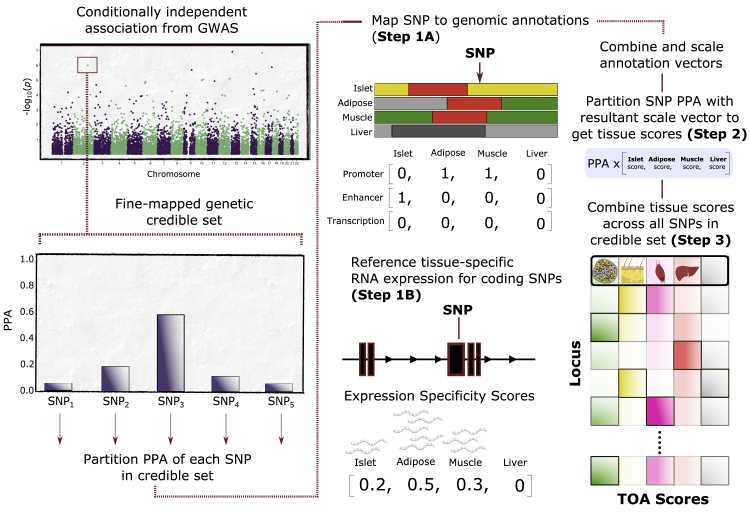
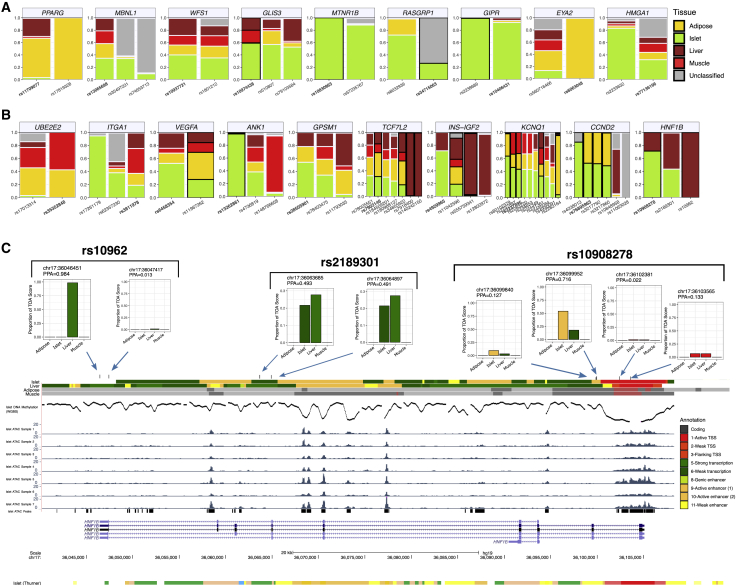
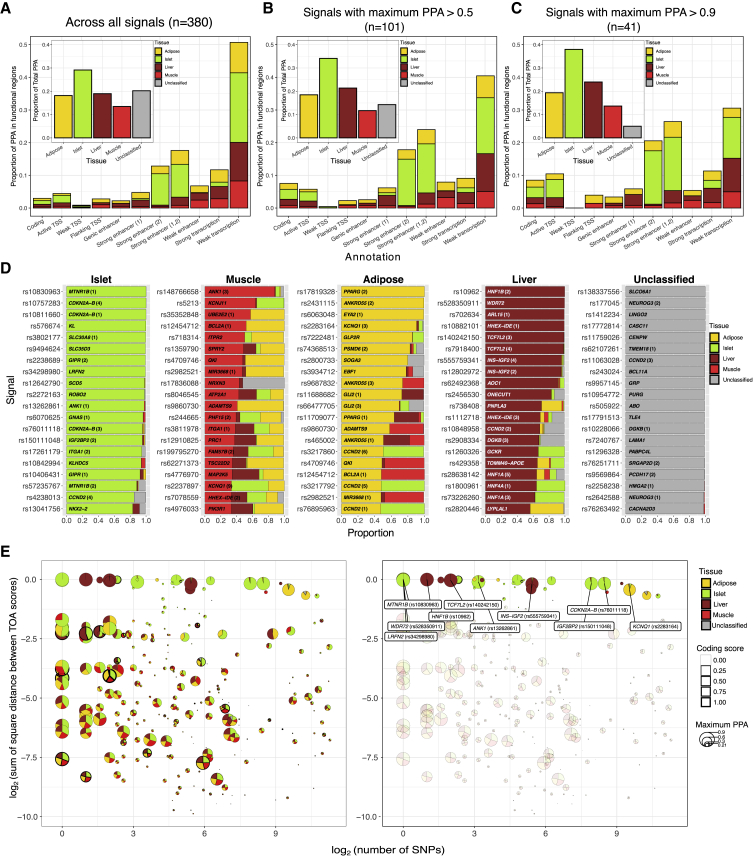
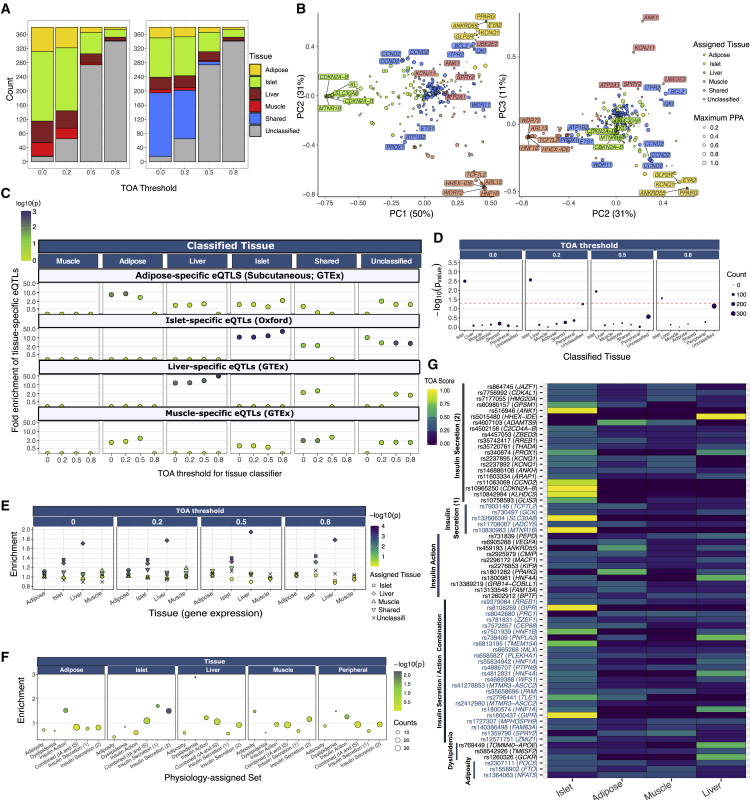
Resolving the molecular processes that mediate genetic risk remains a challenge because most disease-associated variants are non-coding and functional characterization of these signals requires knowledge of the specific tissues and cell-types in which they operate. To address this challenge, we developed a framework for integrating tissue-specific gene expression and epigenomic maps to obtain "tissue-of-action" (TOA) scores for each association signal by systematically partitioning posterior probabilities from Bayesian fine-mapping. We applied this scheme to credible set variants for 380 association signals from a recent GWAS meta-analysis of type 2 diabetes (T2D) in Europeans. The resulting tissue profiles underscored a predominant role for pancreatic islets and, to a lesser extent, adipose and liver, particularly among signals with greater fine-mapping resolution. We incorporated resulting TOA scores into a rule-based classifier and validated the tissue assignments through comparison with data from cis-eQTL enrichment, functional fine-mapping, RNA co-expression, and patterns of physiological association. In addition to implicating signals with a single TOA, we found evidence for signals with shared effects in multiple tissues as well as distinct tissue profiles between independent signals within heterogeneous loci. Lastly, we demonstrated that TOA scores can be directly coupled with eQTL colocalization to further resolve effector transcripts at T2D signals. This framework guides mechanistic inference by directing functional validation studies to the most relevant tissues and can gain power as fine-mapping resolution and cell-specific annotations become richer. This method is generalizable to all complex traits with relevant annotation data and is made available as an R package.
解决介导遗传风险的分子过程仍然是一个挑战,因为大多数与疾病相关的变体是非编码的,并且这些信号的功能表征需要了解它们作用的特定组织和细胞类型。为了解决这个挑战,我们开发了一种整合组织特异性基因表达和表观基因组图谱的框架,通过从贝叶斯精细映射中系统地划分后验概率,为每个关联信号获得“作用组织”(TOA)分数。我们将该方案应用于欧洲人 2 型糖尿病(T2D)的最近 GWAS 荟萃分析中 380 个关联信号的可信集变体。所得的组织特征强调了胰腺胰岛的主要作用,其次是脂肪组织和肝脏,特别是在精细映射分辨率更高的信号中。我们将所得的 TOA 分数纳入基于规则的分类器中,并通过与顺式 eQTL 富集、功能精细映射、RNA 共表达和生理关联模式的数据进行比较来验证组织分配。除了暗示具有单个 TOA 的信号外,我们还发现了在多个组织中具有共同作用的信号以及在异质基因座内独立信号之间具有不同组织特征的证据。最后,我们证明了 TOA 分数可以直接与 eQTL 共定位耦合,以进一步解决 T2D 信号中的效应转录物。该框架通过将功能验证研究引导到最相关的组织中来指导机制推断,并且随着精细映射分辨率和细胞特异性注释的丰富,它可以获得更大的功效。该方法可推广到具有相关注释数据的所有复杂特征,并以 R 包的形式提供。