Radiology Department, Huadong Hospital, affiliated to Fudan University, Shanghai, China.
Department of Electronic Engineering, Shanghai Jiao Tong University, Shanghai, P.R. China; MoE Key Lab of Artificial Intelligence, AI Institute, Shanghai Jiao Tong University, Shanghai, P.R. China; Dianei Technology, Shanghai, P.R. China.
EBioMedicine. 2020 Dec;62:103106. doi: 10.1016/j.ebiom.2020.103106. Epub 2020 Nov 10.
Diagnosis of rib fractures plays an important role in identifying trauma severity. However, quickly and precisely identifying the rib fractures in a large number of CT images with increasing number of patients is a tough task, which is also subject to the qualification of radiologist. We aim at a clinically applicable automatic system for rib fracture detection and segmentation from CT scans.
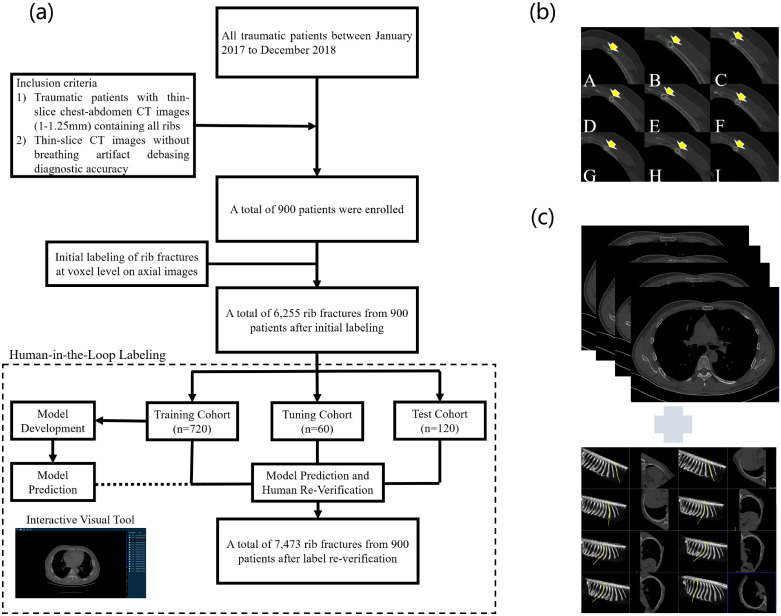
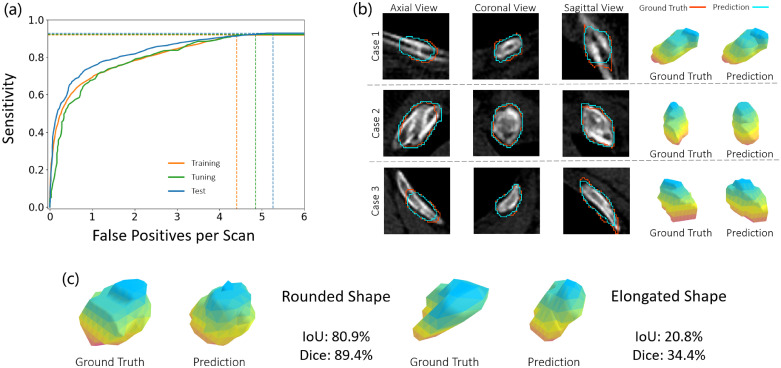
A total of 7,473 annotated traumatic rib fractures from 900 patients in a single center were enrolled into our dataset, named RibFrac Dataset, which were annotated with a human-in-the-loop labeling procedure. We developed a deep learning model, named FracNet, to detect and segment rib fractures. 720, 60 and 120 patients were randomly split as training cohort, tuning cohort and test cohort, respectively. Free-Response ROC (FROC) analysis was used to evaluate the sensitivity and false positives of the detection performance, and Intersection-over-Union (IoU) and Dice Coefficient (Dice) were used to evaluate the segmentation performance of predicted rib fractures. Observer studies, including independent human-only study and human-collaboration study, were used to benchmark the FracNet with human performance and evaluate its clinical applicability. A annotated subset of RibFrac Dataset, including 420 for training, 60 for tuning and 120 for test, as well as our code for model training and evaluation, was open to research community to facilitate both clinical and engineering research.
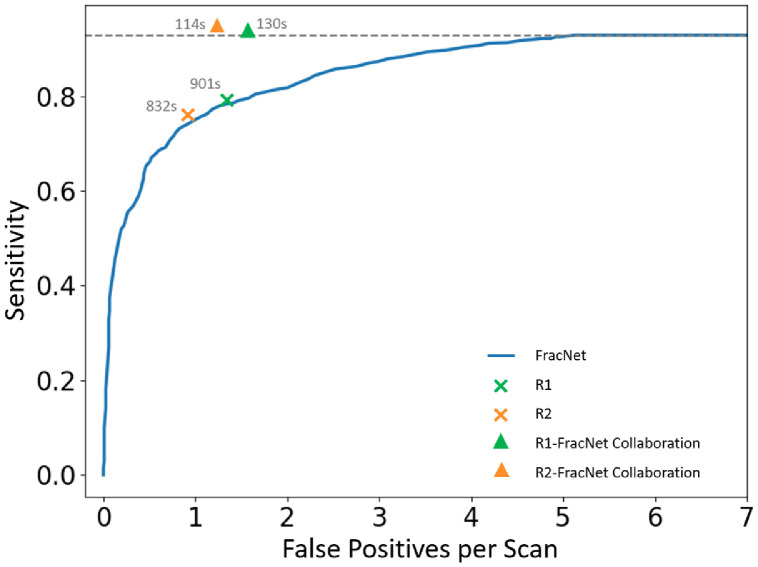
Our method achieved a detection sensitivity of 92.9% with 5.27 false positives per scan and a segmentation Dice of 71.5%on the test cohort. Human experts achieved much lower false positives per scan, while underperforming the deep neural networks in terms of detection sensitivities with longer time in diagnosis. With human-computer collobration, human experts achieved higher detection sensitivities than human-only or computer-only diagnosis.
The proposed FracNet provided increasing detection sensitivity of rib fractures with significantly decreased clinical time consumed, which established a clinically applicable method to assist the radiologist in clinical practice.
A full list of funding bodies that contributed to this study can be found in the Acknowledgements section. The funding sources played no role in the study design; collection, analysis, and interpretation of data; writing of the report; or decision to submit the article for publication .
肋骨骨折的诊断对于确定创伤严重程度起着重要作用。然而,在越来越多的患者中,快速准确地识别大量 CT 图像中的肋骨骨折是一项艰巨的任务,这也取决于放射科医生的资格。我们的目标是开发一种临床适用的自动系统,用于从 CT 扫描中检测和分割肋骨骨折。
总共纳入了来自一个中心的 900 名患者的 7473 例创伤性肋骨骨折,这些骨折是通过人机交互的标注过程进行标注的。我们开发了一种深度学习模型,名为 FracNet,用于检测和分割肋骨骨折。720、60 和 120 名患者分别被随机分为训练队列、调优队列和测试队列。自由反应 ROC(FROC)分析用于评估检测性能的灵敏度和假阳性率,交并比(IoU)和骰子系数(Dice)用于评估预测肋骨骨折的分割性能。观察者研究,包括独立的人类研究和人类协作研究,用于将 FracNet 与人类性能进行基准测试,并评估其临床适用性。RibFrac 数据集的一个标注子集,包括 420 个用于训练,60 个用于调优,120 个用于测试,以及我们用于模型训练和评估的代码,向研究界开放,以促进临床和工程研究。
我们的方法在测试队列中实现了 92.9%的检测灵敏度,假阳性率为每扫描 5.27 个,分割 Dice 为 71.5%。人类专家的每扫描假阳性率要低得多,而在检测灵敏度方面逊于深度学习网络,诊断时间更长。在人机协作下,人类专家的检测灵敏度高于人类或计算机单独诊断。
所提出的 FracNet 提供了越来越高的肋骨骨折检测灵敏度,同时显著减少了临床所需的时间,为协助放射科医生进行临床实践建立了一种临床适用的方法。
对这项研究有贡献的资助机构的完整名单可以在致谢部分找到。资助机构在研究设计、数据收集、分析和解释、报告撰写或决定提交文章发表方面没有发挥作用。