Department of Science and Technology, University of Sannio, via de Sanctis snc, 82100 Benevento, Italy.
CEBAS-CSIC, Department of Soil and Water Conservation, Campus Universitario de Espinardo, 30100 Murcia, Spain.
Int J Mol Sci. 2020 Nov 11;21(22):8455. doi: 10.3390/ijms21228455.
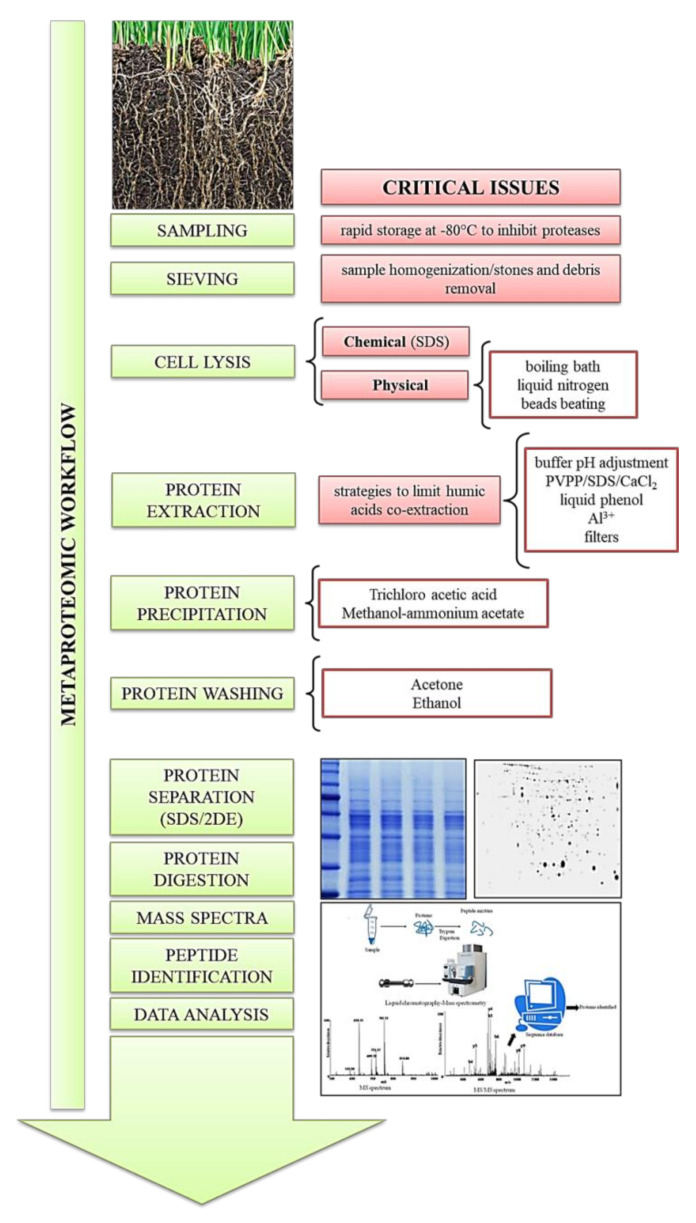
Soil is a complex matrix where biotic and abiotic components establish a still unclear network involving bacteria, fungi, archaea, protists, protozoa, and roots that are in constant communication with each other. Understanding these interactions has recently focused on metagenomics, metatranscriptomics and less on metaproteomics studies. Metaproteomic allows total extraction of intracellular and extracellular proteins from soil samples, providing a complete picture of the physiological and functional state of the "soil community". The advancement of high-performance mass spectrometry technologies was more rapid than the development of ad hoc extraction techniques for soil proteins. The protein extraction from environmental samples is biased due to interfering substances and the lower amount of proteins in comparison to cell cultures. Soil sample preparation and extraction methodology are crucial steps to obtain high-quality resolution and yields of proteins. This review focuses on the several soil protein extraction protocols to date to highlight the methodological challenges and critical issues for the application of proteomics to soil samples. This review concludes that improvements in soil protein extraction, together with the employment of ad hoc metagenome database, may enhance the identification of proteins with low abundance or from non-dominant populations and increase our capacity to predict functional changes in soil.
土壤是一个复杂的基质,其中生物和非生物成分建立了一个仍不清楚的网络,涉及细菌、真菌、古菌、原生生物、原生动物和根系,它们彼此之间不断进行着交流。最近,对这些相互作用的理解主要集中在宏基因组学、宏转录组学上,而较少涉及宏蛋白质组学研究。宏蛋白质组学允许从土壤样品中提取细胞内和细胞外蛋白质的总提取物,提供了“土壤群落”的生理和功能状态的完整图像。高性能质谱技术的进步比专门用于土壤蛋白质的提取技术的发展要快。由于干扰物质的存在以及与细胞培养相比蛋白质数量较少,从环境样品中提取蛋白质存在偏差。土壤样品的制备和提取方法是获得高质量分辨率和蛋白质产量的关键步骤。本文综述了迄今为止几种土壤蛋白质提取方案,以突出蛋白质组学应用于土壤样品的方法学挑战和关键问题。本文综述认为,土壤蛋白质提取的改进,加上专门的宏基因组数据库的使用,可能会增强对低丰度或非优势种群蛋白质的鉴定,并提高我们预测土壤功能变化的能力。