Fernández-Martínez Miguel Ángel, Dos Santos Severino Rita, Moreno-Paz Mercedes, Gallardo-Carreño Ignacio, Blanco Yolanda, Warren-Rhodes Kimberley, García-Villadangos Miriam, Ruiz-Bermejo Marta, Barberán Albert, Wettergreen David, Cabrol Nathalie, Parro Víctor
Centro de Astrobiología (CAB, CSIC-INTA), Madrid, Spain.
Carl Sagan Center, SETI Institute, Mountain View, CA, United States.
Front Microbiol. 2019 Jul 24;10:1641. doi: 10.3389/fmicb.2019.01641. eCollection 2019.
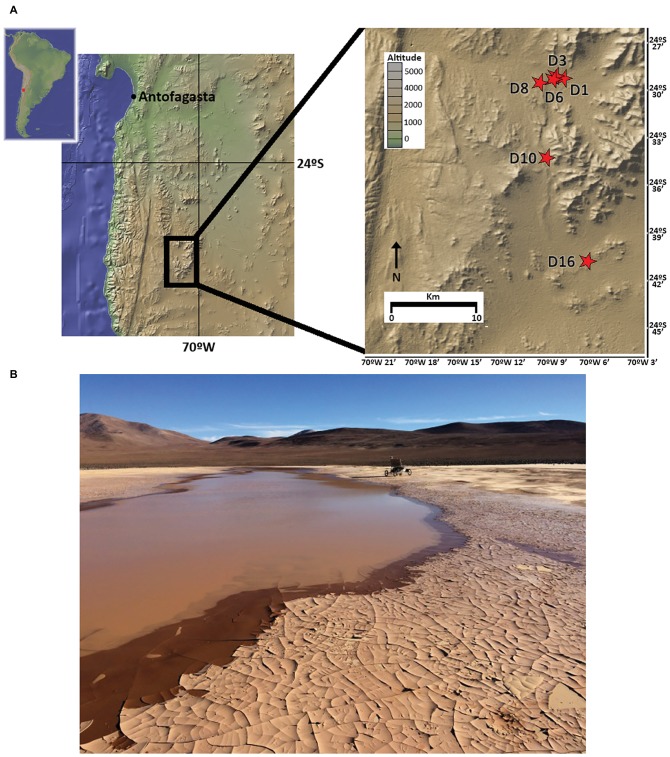
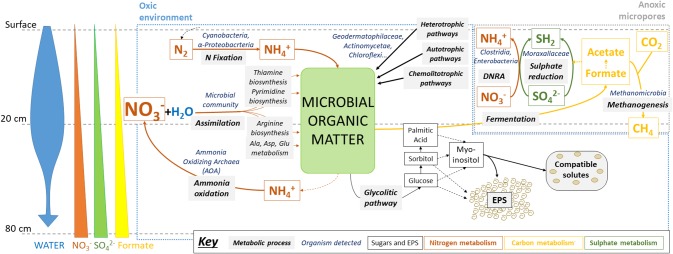
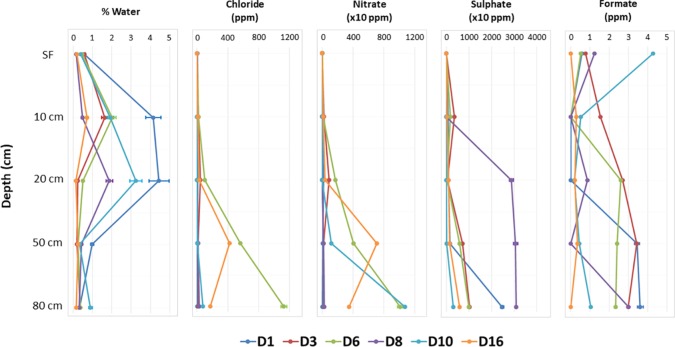
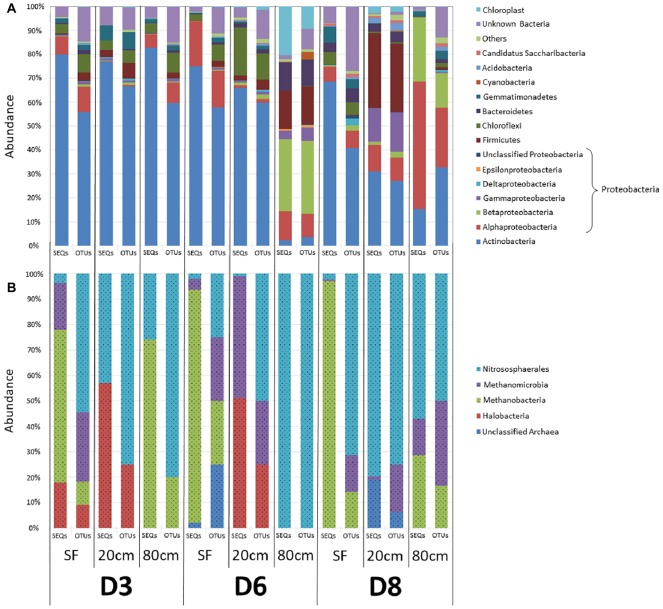
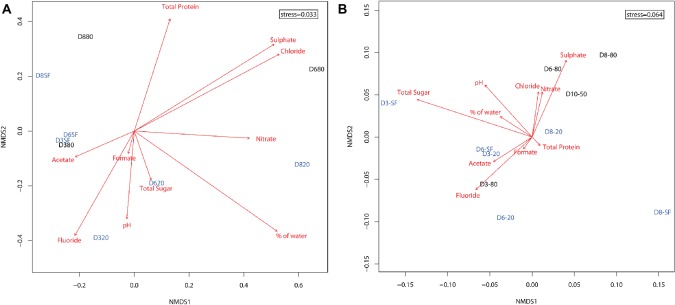
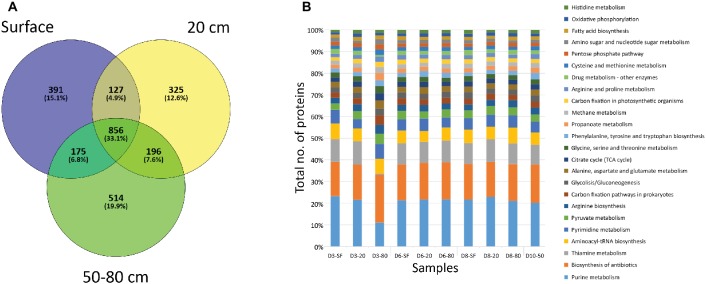
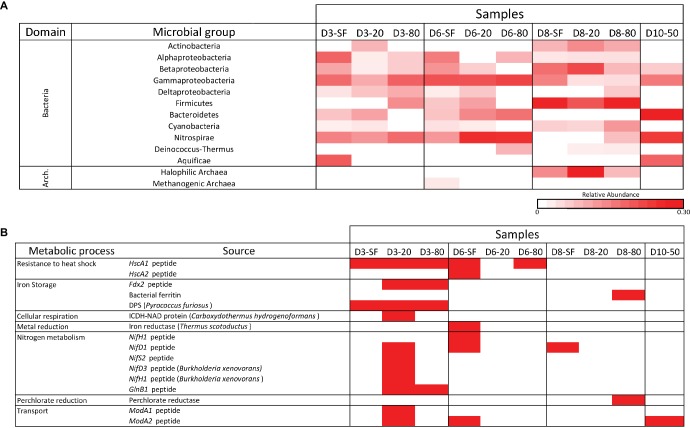
The Atacama Desert, the oldest and driest desert on Earth, displays significant rains only once per decade. To investigate how microbial communities take advantage of these sporadic wet events, we carried out a geomicrobiological study a few days after a heavy rain event in 2015. Different physicochemical and microbial community analyses were conducted on samples collected from playas and an alluvial fan from surface, 10, 20, 50, and 80 cm depth. Gravimetric moisture content peaks were measured in 10 and 20 cm depth samples (from 1.65 to 4.1% w/w maximum values) while, in general, main anions such as chloride, nitrate, and sulfate concentrations increased with depth, with maximum values of 13-1,125; 168-10,109; and 9,904-30,952 ppm, respectively. Small organic anions such as formate and acetate had maximum concentrations from 2.61 to 3.44 ppm and 6.73 to 28.75 ppm, respectively. Microbial diversity inferred from DNA analysis showed Actinobacteria and Alphaproteobacteria as the most abundant and widespread bacterial taxa among the samples, followed by Chloroflexi and Firmicutes at specific sites. Archaea were mainly dominated by Nitrososphaerales, Methanobacteria, with the detection of other groups such as Halobacteria. Metaproteomics showed a high and even distribution of proteins involved in primary metabolic processes such as energy production and biosynthetic pathways, and a limited but remarkable presence of proteins related to resistance to environmental stressors such as radiation, oxidation, or desiccation. The results indicated that extra humidity in the system allows the microbial community to repair, and prepare for the upcoming hyperarid period. Additionally, it supplies biomarkers to the medium whose preservation potential could be high under strong desiccation conditions and relevant for planetary exploration.
阿塔卡马沙漠是地球上最古老、最干燥的沙漠,每十年才会有一次显著降雨。为了研究微生物群落如何利用这些零星的湿润事件,我们在2015年一场暴雨过后的几天开展了一项地质微生物学研究。对从盐滩和冲积扇采集的不同深度(地表、10厘米、20厘米、50厘米和80厘米)的样本进行了不同的物理化学和微生物群落分析。重量含水量峰值出现在10厘米和20厘米深度的样本中(最大重量百分比从1.65%到4.1%),而一般来说,主要阴离子如氯离子、硝酸根离子和硫酸根离子的浓度随深度增加,最大值分别为13 - 1125 ppm、168 - 10109 ppm和9904 - 30952 ppm。小分子有机阴离子如甲酸根离子和乙酸根离子的最大浓度分别为2.61 - 3.44 ppm和6.73 - 28.75 ppm。通过DNA分析推断的微生物多样性表明,放线菌和α-变形菌是样本中最丰富、分布最广的细菌类群,其次是特定位点的绿弯菌门和厚壁菌门。古菌主要由亚硝化球菌目、甲烷杆菌主导,还检测到了其他类群如嗜盐菌。元蛋白质组学显示,参与能量产生和生物合成途径等初级代谢过程的蛋白质分布广泛且含量较高,而与抗辐射、氧化或干燥等环境应激源相关的蛋白质含量有限但显著。结果表明,系统中的额外湿度使微生物群落得以修复,并为即将到来的极度干旱期做好准备。此外,它还为介质提供了生物标志物,在强烈干燥条件下这些生物标志物的保存潜力可能很高,这对于行星探索具有重要意义。