Division of Rheumatology, Children's Hospital of Philadelphia, Philadelphia, PA, 19104, USA.
Center for Pediatric Clinical Effectiveness, Children's Hospital of Philadelphia Research Institute, 2716 South St, 11th Floor, Philadelphia, PA, 19146, USA.
Pediatr Rheumatol Online J. 2020 Nov 13;18(1):88. doi: 10.1186/s12969-020-00485-y.
We sought to evaluate racial disparities in disease outcomes among children with polyarticular juvenile idiopathic arthritis (JIA) during a treat-to-target (TTT) intervention with clinical decision support (CDS).
This was a retrospective analysis of a TTT-CDS strategy integrated into clinical practice for children with polyarticular JIA at a single center from 2016 to 2019. The primary outcome was the clinical Juvenile Arthritis Disease Activity Score (cJADAS-10). We used multivariable linear regression to assess racial differences in disease outcomes at the index visit (first visit after implementation). The effect of race on disease outcomes over time was estimated using linear mixed-effects models, stratified by incident or prevalent disease.
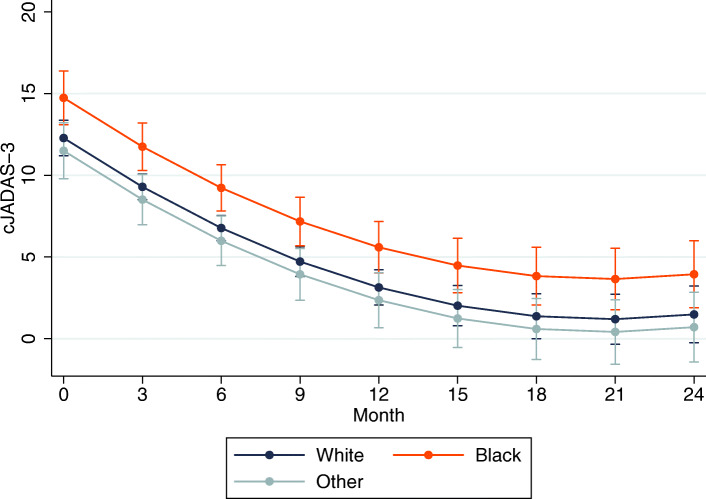
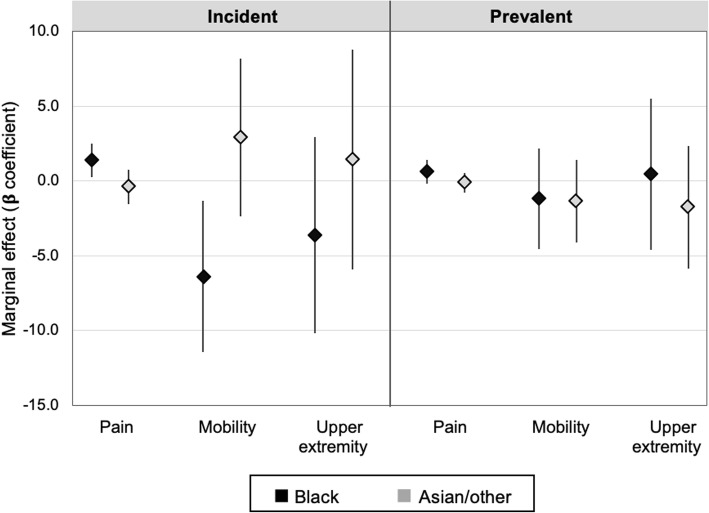
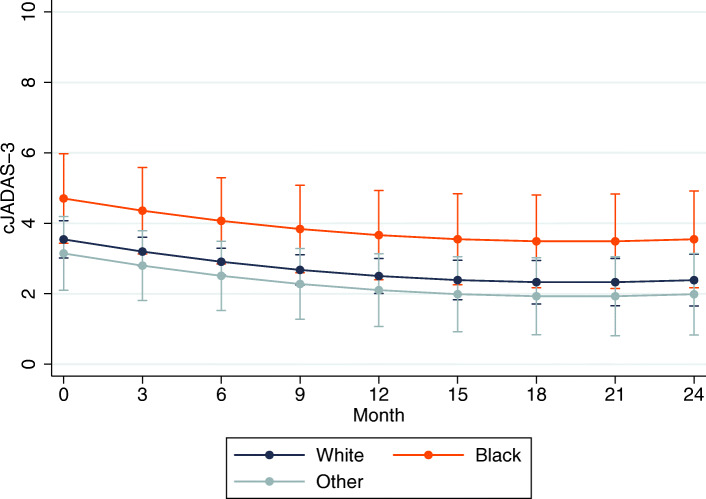
We included 159 children with polyarticular JIA, of which 74, 13 and 13% were white, black, and Asian/other, respectively. cJADAS-10 improved significantly over time for all race categories, while the rates of improvement did not differ by race in incident (p = 0.53) or prevalent cases (p = 0.58). cJADAS-10 over time remained higher among black children compared to white children (β 2.5, p < 0.01 and β 1.2, p = 0.08 for incident and prevalent cases, respectively). Provider attestation to CDS use at ≥50% of encounters was associated with a 3.9 greater reduction in cJADAS-10 among black children compared to white children (p = 0.02).
Despite similar rates of improvement over time by race, disparities in JIA outcomes persisted throughout implementation of a TTT-CDS approach. More consistent CDS use may have a greater benefit among black children and needs to be explored further.
我们旨在评估在以临床决策支持(CDS)为基础的达标治疗(TTT)干预中,儿童多关节型幼年特发性关节炎(JIA)患者的疾病结局存在的种族差异。
这是一项回顾性分析,纳入了 2016 年至 2019 年期间,一家单中心将 TTT-CDS 策略整合到临床实践中治疗儿童多关节型 JIA 的研究。主要结局是临床幼年特发性关节炎疾病活动评分(cJADAS-10)。我们使用多变量线性回归评估了在指数就诊(实施后首次就诊)时疾病结局的种族差异。使用线性混合效应模型,根据新发或现患疾病分层,评估了种族对疾病结局随时间变化的影响。
我们纳入了 159 名患有多关节型 JIA 的儿童,其中白人、黑人、亚洲/其他种族的患者分别占 74%、13%和 13%。所有种族类别的 cJADAS-10 均随时间显著改善,而新发(p=0.53)或现患(p=0.58)病例中,改善率没有因种族而异。与白人儿童相比,黑人儿童的 cJADAS-10 随时间的增长仍然较高(新发和现患病例中,β 分别为 2.5,p<0.01 和 β 为 1.2,p=0.08)。如果医生在≥50%的就诊时确认使用 CDS,那么与白人儿童相比,黑人儿童的 cJADAS-10 会降低 3.9(p=0.02)。
尽管种族之间的改善率相似,但在 TTT-CDS 方法实施期间,JIA 结局的差异仍然存在。更一致地使用 CDS 可能对黑人儿童有更大的益处,需要进一步探索。