Shi Alvin, Kasumova Gyulnara G, Michaud William A, Cintolo-Gonzalez Jessica, Díaz-Martínez Marta, Ohmura Jacqueline, Mehta Arnav, Chien Isabel, Frederick Dennie T, Cohen Sonia, Plana Deborah, Johnson Douglas, Flaherty Keith T, Sullivan Ryan J, Kellis Manolis, Boland Genevieve M
Computer Science and Artificial Intelligence Laboratory, Massachusetts Institute of Technology (MIT), Cambridge, MA, USA.
Broad Institute of Harvard and MIT, Cambridge, MA, USA.
Sci Adv. 2020 Nov 13;6(46). doi: 10.1126/sciadv.abb3461. Print 2020 Nov.
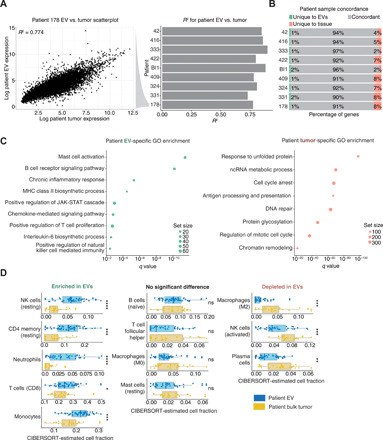
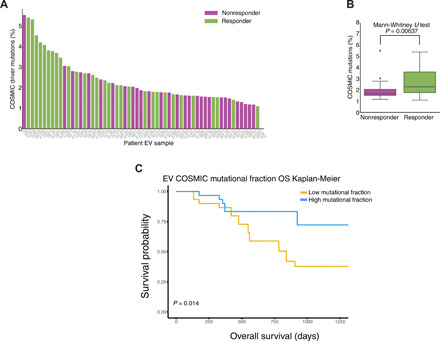
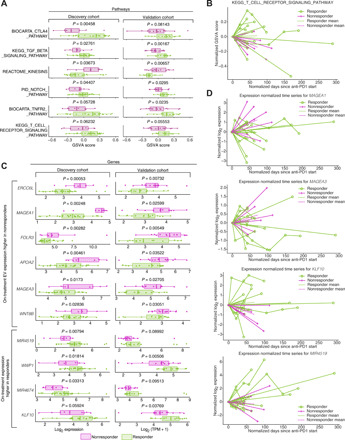
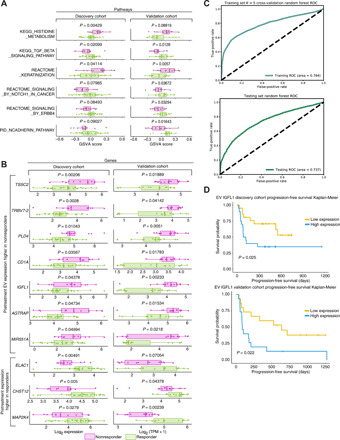
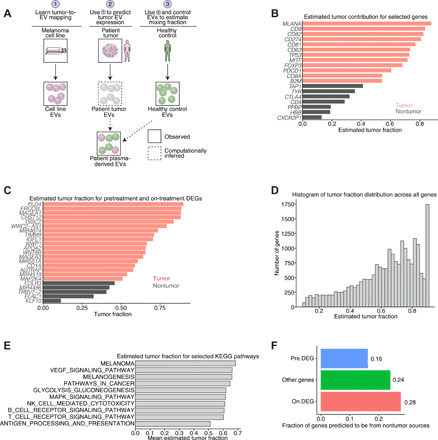
Immune checkpoint inhibitors (ICIs) show promise, but most patients do not respond. We identify and validate biomarkers from extracellular vesicles (EVs), allowing non-invasive monitoring of tumor- intrinsic and host immune status, as well as a prediction of ICI response. We undertook transcriptomic profiling of plasma-derived EVs and tumors from 50 patients with metastatic melanoma receiving ICI, and validated with an independent EV-only cohort of 30 patients. Plasma-derived EV and tumor transcriptomes correlate. EV profiles reveal drivers of ICI resistance and melanoma progression, exhibit differentially expressed genes/pathways, and correlate with clinical response to ICI. We created a Bayesian probabilistic deconvolution model to estimate contributions from tumor and non-tumor sources, enabling interpretation of differentially expressed genes/pathways. EV RNA-seq mutations also segregated ICI response. EVs serve as a non-invasive biomarker to jointly probe tumor-intrinsic and immune changes to ICI, function as predictive markers of ICI responsiveness, and monitor tumor persistence and immune activation.
免疫检查点抑制剂(ICI)显示出前景,但大多数患者没有反应。我们从细胞外囊泡(EV)中识别并验证生物标志物,从而能够对肿瘤内在和宿主免疫状态进行非侵入性监测,并预测ICI反应。我们对50例接受ICI治疗的转移性黑色素瘤患者的血浆来源的EV和肿瘤进行了转录组分析,并用30例仅EV的独立队列进行了验证。血浆来源的EV和肿瘤转录组相关。EV谱揭示了ICI耐药和黑色素瘤进展的驱动因素,显示出差异表达的基因/通路,并与对ICI的临床反应相关。我们创建了一个贝叶斯概率反卷积模型来估计肿瘤和非肿瘤来源的贡献,从而能够解释差异表达的基因/通路。EV RNA测序突变也区分了ICI反应。EV作为一种非侵入性生物标志物,可共同探测肿瘤内在和免疫对ICI的变化,作为ICI反应性的预测标志物,并监测肿瘤持续存在和免疫激活。