Department of Surgery, School of Medicine, Cheeloo College of Medicine, Shandong University, Jinan, China.
Department of General Surgery, Qilu Hospital of Shandong University, Jinan, China.
Aging (Albany NY). 2020 Nov 10;12(23):23761-23777. doi: 10.18632/aging.103964.
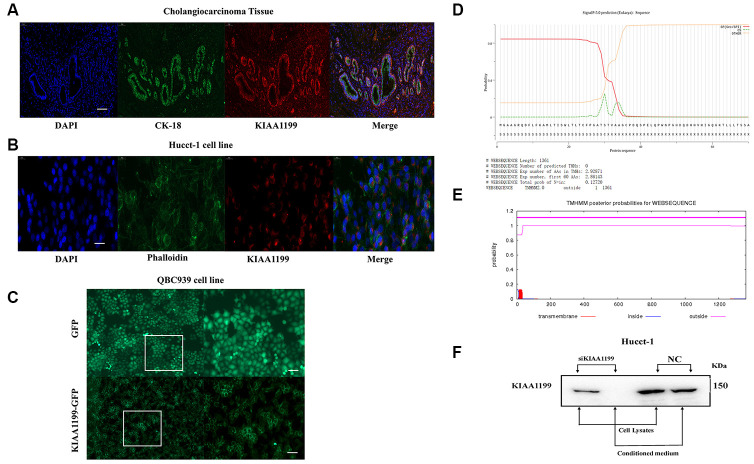
Cell proliferation and migration are the determinants of malignant tumor progression, and a better understanding of related genes will lead to the identification of new targets aimed at preventing the spread of cancer. Some studies have shown that KIAA1199 (CEMIP) is a transmembrane protein expressed in many types of noncancerous cells and cancer cells. However, the potential role of KIAA1199 in the progression of cholangiocarcinoma (CCA) remains unclear.
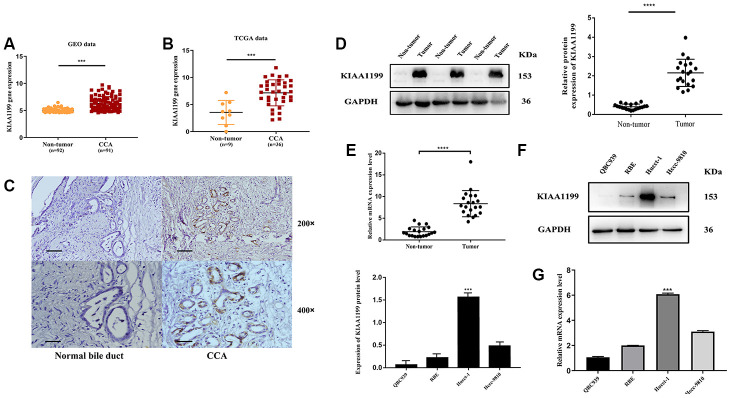
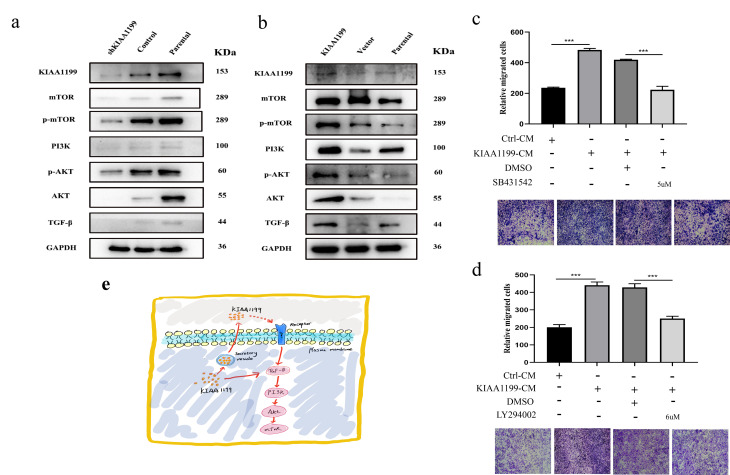
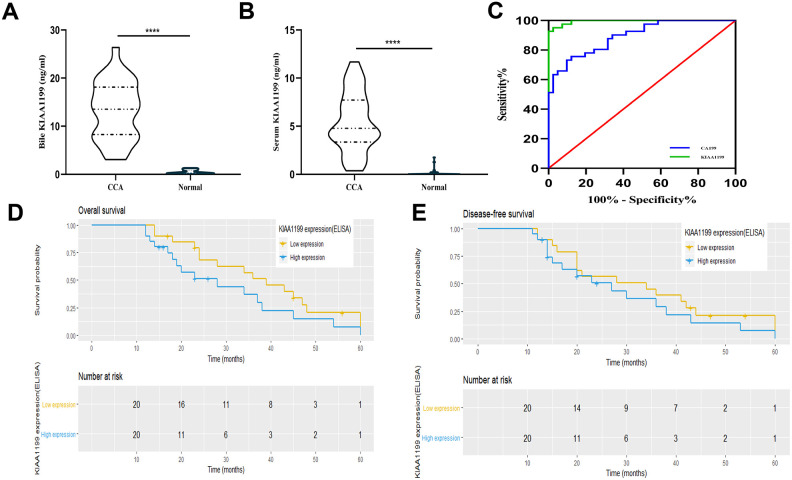
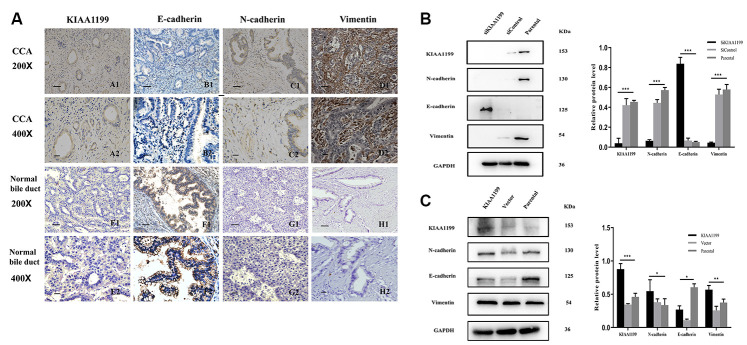
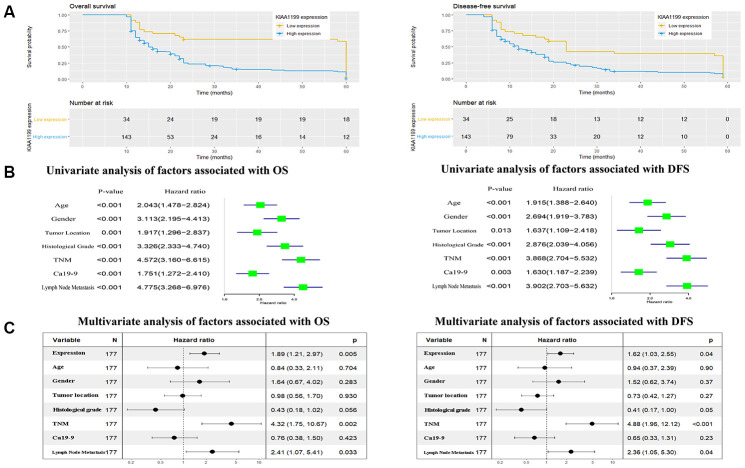
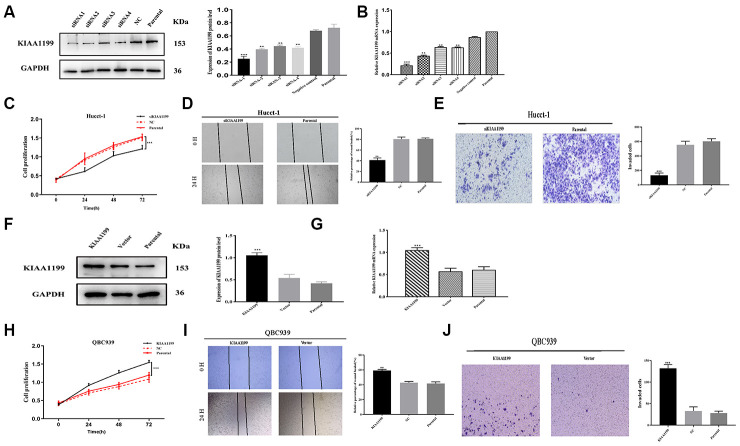
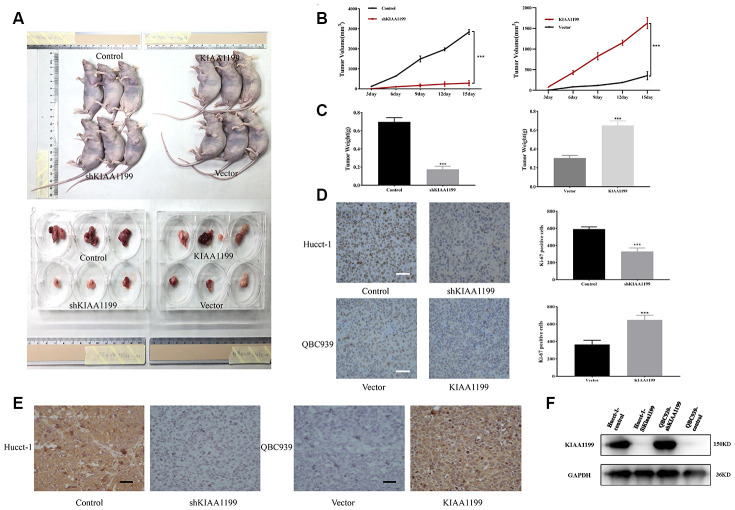
Analysis of cancer-related databases showed that KIAA1199 is overexpressed in CCA. ELISA, immunohistochemistry, Western blotting and qPCR indicated high expression levels of KIAA1199 in serum, CCA tissues and CCA cell lines. In the serum (n = 41) and large sample validation (n = 177) cohorts, higher KIAA1199 expression was associated with shorter overall survival and disease-free survival times. At the cellular level, KIAA1199 overexpression (OE) promoted CCA growth and metastasis. Subcutaneous tumor xenograft experiments showed that KIAA1199 enhances CCA cell proliferation. Additionally, the expression levels of components in the EMT-related TGF-β pathway changed significantly after KIAA1199 upregulation and silencing.
KIAA1199 is a promising new diagnostic molecule and therapeutic target in CCA. The serum KIAA1199 level can be used as a promising clinical tool for predicting the overall postoperative outcomes of patients with CCA.
CCA-related KIAA1199 data were downloaded from the Gene Expression Omnibus (GEO) and The Cancer Genome Atlas (TCGA) databases. To assess the prognostic impact of KIAA1199, an enzyme-linked immunosorbent assay (ELISA) was used to measure the serum level of KIAA1199 in 41 patients who underwent surgical resection. Immunohistochemical staining, Western blotting and qPCR were used to verify and retrospectively review the expression levels of KIAA1199 in cancer tissue specimens from 177 CCA patients. The effect of KIAA1199 on CCA was evaluated by cell-based functional assays and subcutaneous tumor xenograft experiments. The expression levels of proteins associated with epithelial-mesenchymal transition (EMT) and activation of relevant signaling pathways were measured via Western blotting.
细胞增殖和迁移是恶性肿瘤进展的决定因素,对相关基因的更好理解将导致发现新的目标,以防止癌症的扩散。一些研究表明,KIAA1199(CEMIP)是一种在多种非癌细胞和癌细胞中表达的跨膜蛋白。然而,KIAA1199 在胆管癌(CCA)进展中的潜在作用尚不清楚。
对癌症相关数据库的分析表明,KIAA1199 在 CCA 中过表达。ELISA、免疫组织化学、Western blot 和 qPCR 表明,血清、CCA 组织和 CCA 细胞系中 KIAA1199 的表达水平较高。在血清(n=41)和大样本验证(n=177)队列中,较高的 KIAA1199 表达与总生存时间和无病生存时间较短相关。在细胞水平上,KIAA1199 过表达(OE)促进了 CCA 的生长和转移。皮下肿瘤异种移植实验表明,KIAA1199 增强了 CCA 细胞的增殖。此外,在 KIAA1199 上调和沉默后,EMT 相关 TGF-β 通路中的成分表达水平发生了显著变化。
KIAA1199 是 CCA 中一种有前途的新诊断分子和治疗靶标。血清 KIAA1199 水平可作为预测 CCA 患者术后总体预后的有前途的临床工具。
从基因表达综合数据库(GEO)和癌症基因组图谱(TCGA)数据库中下载与 CCA 相关的 KIAA1199 数据。为了评估 KIAA1199 的预后影响,使用酶联免疫吸附试验(ELISA)测量了 41 例接受手术切除的患者的血清 KIAA1199 水平。免疫组织化学染色、Western blot 和 qPCR 用于验证和回顾性分析 177 例 CCA 患者的癌组织标本中 KIAA1199 的表达水平。通过细胞功能测定和皮下肿瘤异种移植实验评估 KIAA1199 对 CCA 的影响。通过 Western blot 测量与上皮-间充质转化(EMT)和相关信号通路激活相关的蛋白表达水平。