Microbiology Immunology Department and The Research Institute of the University of Bucharest, Faculty of Biology, University of Bucharest, 020956 Bucharest, Romania.
Department of Biochemistry and Molecular Biology, Faculty of Biology, University of Bucharest, 020956 Bucharest, Romania.
Int J Mol Sci. 2020 Nov 12;21(22):8527. doi: 10.3390/ijms21228527.
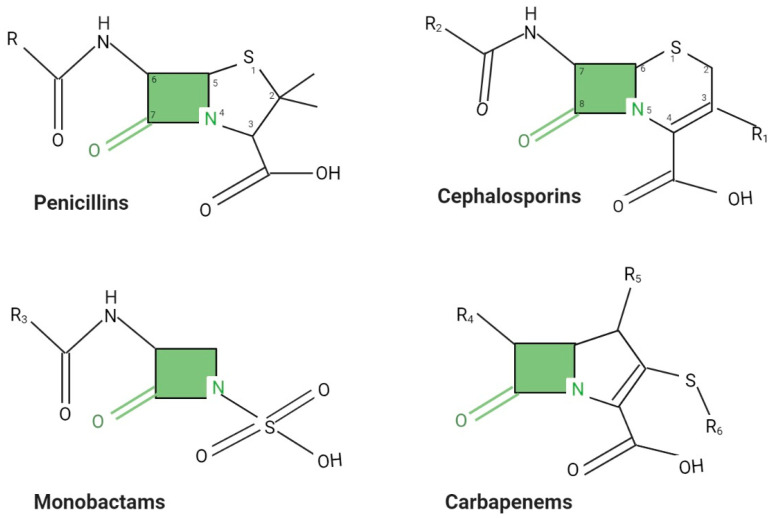
Since the discovery of penicillin by Alexander Fleming in 1929 as a therapeutic agent against staphylococci, β-lactam antibiotics (BLAs) remained the most successful antibiotic classes against the majority of bacterial strains, reaching a percentage of 65% of all medical prescriptions. Unfortunately, the emergence and diversification of β-lactamases pose indefinite health issues, limiting the clinical effectiveness of all current BLAs. One solution is to develop β-lactamase inhibitors (BLIs) capable of restoring the activity of β-lactam drugs. In this review, we will briefly present the older and new BLAs classes, their mechanisms of action, and an update of the BLIs capable of restoring the activity of β-lactam drugs against ESKAPE ( spp., , and spp.) pathogens. Subsequently, we will discuss several promising alternative approaches such as bacteriophages, antimicrobial peptides, nanoparticles, CRISPR (clustered regularly interspaced short palindromic repeats) cas technology, or vaccination developed to limit antimicrobial resistance in this endless fight against Gram-negative pathogens.
自 1929 年亚历山大·弗莱明发现青霉素作为治疗葡萄球菌的药物以来,β-内酰胺类抗生素(BLAs)一直是对抗大多数细菌菌株最成功的抗生素类别,占所有处方的 65%。不幸的是,β-内酰胺酶的出现和多样化带来了不确定的健康问题,限制了所有当前 BLAs 的临床效果。一种解决方案是开发能够恢复β-内酰胺类药物活性的β-内酰胺酶抑制剂(BLIs)。在这篇综述中,我们将简要介绍较旧和新型的 BLAs 类别、它们的作用机制,以及能够恢复β-内酰胺类药物对 ESKAPE( spp.、 spp.、 spp. 和 spp.)病原体活性的 BLIs 的最新进展。随后,我们将讨论几种有前途的替代方法,例如噬菌体、抗菌肽、纳米颗粒、CRISPR(成簇规律间隔短回文重复)cas 技术或疫苗接种,以限制在与革兰氏阴性病原体的这场无休止的斗争中对抗生素耐药性的发展。