Li Cheng, Kang Bingxian, Zhang Ting, Gu Hongru, Man Qingqing, Song Pengkun, Liu Zhen, Chen Jingyi, Wang Xile, Xu Bin, Zhao Wenhua, Zhang Jian
National Institute for Nutrition and Health, Chinese Center for Disease Control and Prevention, 27 Nanwei Road, Xicheng District, Beijing 100050, China.
Wuyuan County Center for Disease Control and Prevention, 105 Shiji Road, Wuyuan, Inner Mongolia 015100, China.
Healthcare (Basel). 2020 Nov 12;8(4):479. doi: 10.3390/healthcare8040479.
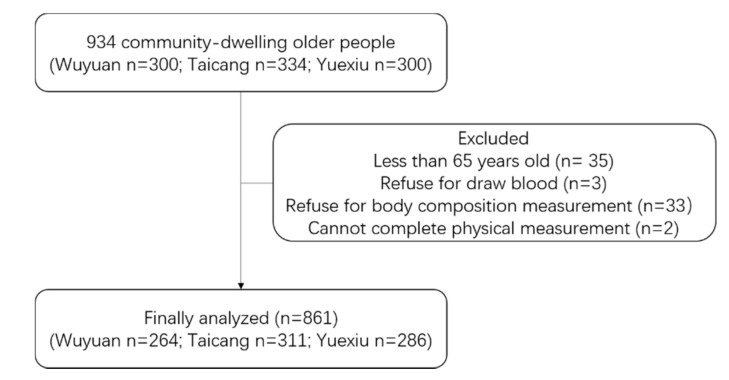
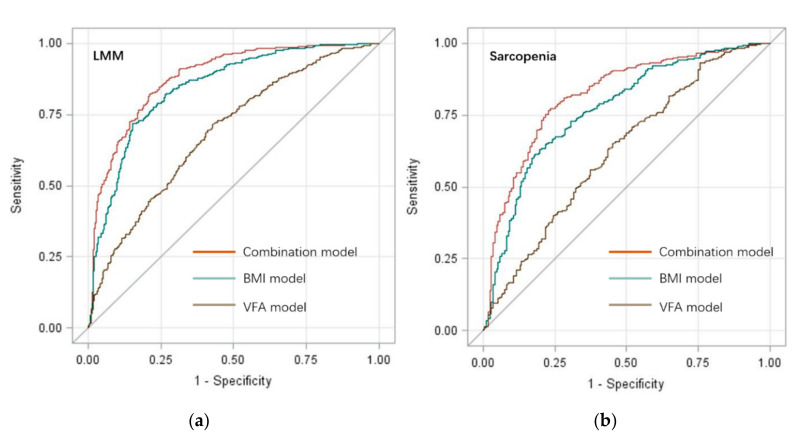
The association between obesity and sarcopenia remains controversial. The present study was conducted to explore the associations among body mass index (BMI), visceral fat area (VFA), and sarcopenia in older people and analyze their potential mechanisms. This cross-sectional study included 861 community-dwelling older Chinese people from three regions of China. BMI, VFA, muscle mass, muscle strength, physical performance, body composition, and metabolic markers were measured. Muscle mass and muscle strength were positively correlated with BMI, but were negatively correlated with VFA. Simple overweight/obesity was negatively associated with sarcopenia (OR = 0.07, 95% CI = 0.030.18), and the OR value was lower than combined obesity (OR = 0.16, 95% CI = 0.090.28). Fat free mass and total body protein were positively associated with high BMI but negatively associated with high VFA. Furthermore, high VFA was adversely associated with some metabolic risk factors of sarcopenia. Combination of BMI and VFA increased diagnostic efficiency of low muscle mass and sarcopenia. In conclusion, high BMI was negatively associated with sarcopenia, while high VFA attenuated the negative association between high BMI and sarcopenia. The opposite association may partially be attributed to their different associations with body composition and metabolic risk factors of sarcopenia. Therefore, bedsides BMI, VFA and its interaction with BMI should be considered in sarcopenia prevention.
肥胖与肌肉减少症之间的关联仍存在争议。本研究旨在探讨老年人的体重指数(BMI)、内脏脂肪面积(VFA)与肌肉减少症之间的关联,并分析其潜在机制。这项横断面研究纳入了来自中国三个地区的861名居住在社区的中国老年人。测量了BMI、VFA、肌肉量、肌肉力量、身体机能、身体成分和代谢指标。肌肉量和肌肉力量与BMI呈正相关,但与VFA呈负相关。单纯超重/肥胖与肌肉减少症呈负相关(OR = 0.07,95%CI = 0.030.18),且OR值低于合并肥胖(OR = 0.16,95%CI = 0.090.28)。去脂体重和全身蛋白与高BMI呈正相关,但与高VFA呈负相关。此外,高VFA与肌肉减少症的一些代谢危险因素呈负相关。BMI和VFA的联合使用提高了低肌肉量和肌肉减少症的诊断效率。总之,高BMI与肌肉减少症呈负相关,而高VFA减弱了高BMI与肌肉减少症之间的负相关。这种相反的关联可能部分归因于它们与肌肉减少症的身体成分和代谢危险因素的不同关联。因此,在预防肌肉减少症时应考虑床边BMI、VFA及其与BMI的相互作用。