Department of Seafood and Nutrition, Institute of Marine Research, NO-5817 Bergen, Norway.
Department of Clinical Science, Faculty of Medicine, University of Bergen, NO-5020 Bergen, Norway.
Nutrients. 2020 Nov 13;12(11):3483. doi: 10.3390/nu12113483.
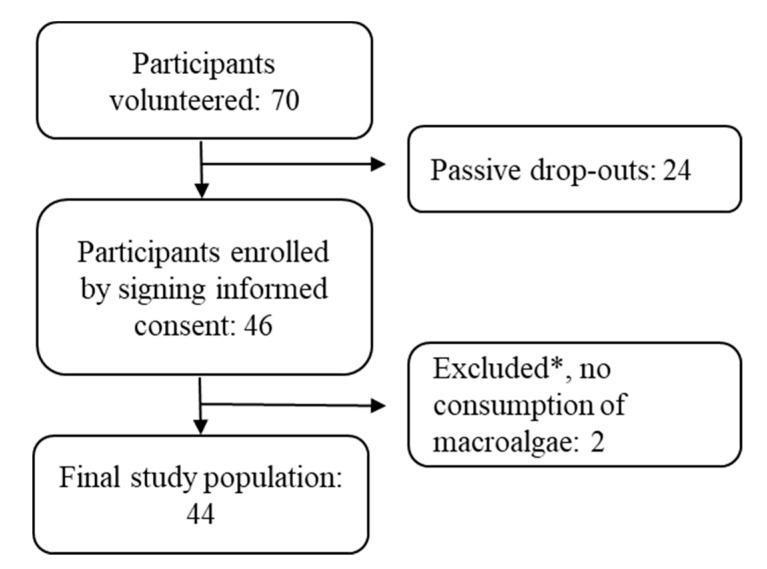
Seaweeds, or macroalgae, may be a good dietary iodine source but also a source of excessive iodine intake. The main aim in this study was to describe the iodine status and thyroid function in a group of macroalgae consumers. Two urine samples were collected from each participant ( = 44) to measure urinary iodine concentration (UIC) after habitual consumption of seaweed. Serum thyroid stimulating hormone (TSH), free thyroxine (fT), free triiodothyronine (fT), and peroxidase autoantibody (TPOAb), were measured in a subgroup ( = 19). A food frequency questionnaire and an iodine-specific 24 h recall were used to assess iodine intake and macroalgae consumption. The median (p25-p75) UIC was 1200 (370-2850) μg/L. Median (p25-p75) estimated dietary iodine intake, excluding macroalgae, was 110 (78-680) μg/day, indicating that seaweed was the major contributor to the iodine intake. TSH levels were within the reference values, but higher than in other comparable population groups. One third of the participants used seaweeds daily, and sugar kelp, winged kelp, dulse and laver were the most common species. Labelling of iodine content was lacking for a large share of the products consumed. This study found excessive iodine status in macroalgae consumers after intake of dietary seaweeds. Including macroalgae in the diet may give excessive iodine exposure, and consumers should be made aware of the risk associated with inclusion of macroalgae in their diet.
海藻,或大型藻类,可能是一个很好的饮食碘来源,但也是碘摄入过量的一个来源。本研究的主要目的是描述一组海藻消费者的碘状况和甲状腺功能。从每个参与者(n=44)中收集了两份尿液样本,以测量在习惯性食用海藻后的尿碘浓度(UIC)。在亚组(n=19)中测量了血清促甲状腺激素(TSH)、游离甲状腺素(fT)、游离三碘甲状腺原氨酸(fT)和过氧化物酶自身抗体(TPOAb)。使用食物频率问卷和碘特异性 24 小时回忆来评估碘摄入量和海藻摄入量。UIC 的中位数(p25-p75)为 1200(370-2850)μg/L。中位数(p25-p75)估计不包括海藻的饮食碘摄入量为 110(78-680)μg/天,表明海藻是碘摄入量的主要来源。TSH 水平在参考值范围内,但高于其他可比人群组。三分之一的参与者每天食用海藻,其中海带、裙带菜、紫菜和海苔是最常见的品种。所食用的大部分产品都缺乏碘含量标签。本研究发现,在摄入膳食海藻后,海藻消费者的碘状况过高。在饮食中包括海藻可能会导致碘暴露过量,消费者应该意识到将海藻纳入饮食中所带来的风险。