Department of Social Sciences, Institute for Research on Sociology and Economic Inequalities (IRSEI), University of Luxembourg, 4365 Esch-sur-Alzette, Luxembourg.
Department of Health Psychology, Metz Saulcy Campus, University of Lorraine, 54395 Grand Est, France.
Int J Environ Res Public Health. 2020 Nov 15;17(22):8458. doi: 10.3390/ijerph17228458.
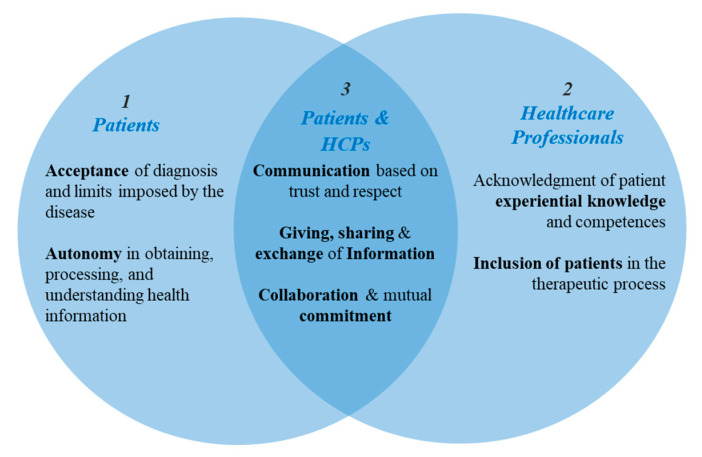
Healthcare has long been marked by the authoritative-physician-passive-patient interaction, with patients seeking help and physicians seeking to restore patients back to health. However, globalisation, social movements, and technological advancements are transforming the nature of this relationship. We aim to identify core values that influence the power dynamic between patients and healthcare professionals, and determine how to steer these interactions towards partnership, a more suitable approach to current healthcare needs. Patients with chronic diseases (10 men, 18 women) and healthcare professionals (11 men, 12 women) were interviewed, sessions transcribed, and the framework method used to thematically analyse the data. Validation was done through analyst triangulation and member check recheck. Core values identified as influencing the patient-healthcare professional power dynamic include: (A) values that empower patients (acceptance of diagnosis and autonomy); (B) values unique to healthcare professionals (HCPs) (acknowledging patients experiential knowledge and including patients in the therapeutic process); and (C) shared capitals related to their interactions (communication, information sharing and exchange, collaboration, and mutual commitment). These interdependent core values can be considered prerequisites to the implementation of the patient-as-partner approach in healthcare. Partnership would imply a paradigm shift such that stakeholders systematically examine each other's perspective, motivations, capabilities, and goals, and then adapt their interactions in this accord, for optimal outcome.
长期以来,医疗保健一直以权威医生-被动病人的互动为标志,病人寻求帮助,医生寻求使病人恢复健康。然而,全球化、社会运动和技术进步正在改变这种关系的性质。我们旨在确定影响医患权力动态的核心价值观,并确定如何将这些互动引导为伙伴关系,这是当前医疗保健需求更合适的方法。我们采访了患有慢性病的患者(10 名男性,18 名女性)和医疗保健专业人员(11 名男性,12 名女性),对会议进行了转录,并使用框架方法对数据进行主题分析。通过分析师三角剖分和成员重新检查来验证。确定影响医患权力动态的核心价值观包括:(A)赋予患者权力的价值观(接受诊断和自主权);(B)医疗保健专业人员(HCPs)特有的价值观(承认患者的经验知识并让患者参与治疗过程);和(C)与他们的互动相关的共同资本(沟通、信息共享和交流、合作和相互承诺)。这些相互依存的核心价值观可以被视为在医疗保健中实施以患者为中心的伙伴关系方法的前提。伙伴关系将意味着范式转变,即利益相关者系统地检查彼此的观点、动机、能力和目标,然后根据这一共识调整他们的互动,以达到最佳结果。