Hanna Rewais B, Nies Matthew, Lang Pamela J, Halanski Matthew
University of Wisconsin Departments of Orthopedics & Rehabilitation, Madison, Wisconsin, USA.
Children's Hospital of Omaha, Omaha, Nebraska, USA.
J Child Orthop. 2020 Oct 1;14(5):466-472. doi: 10.1302/1863-2548.14.200105.
The purpose of this study is to evaluate the use of the tourniquet and its effect on post-operative pain in the paediatric population following lower leg procedures.
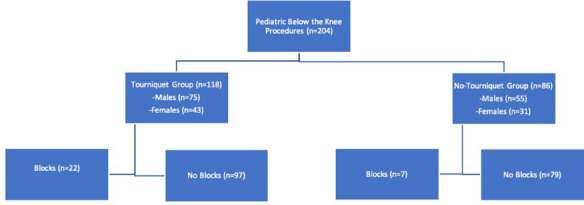
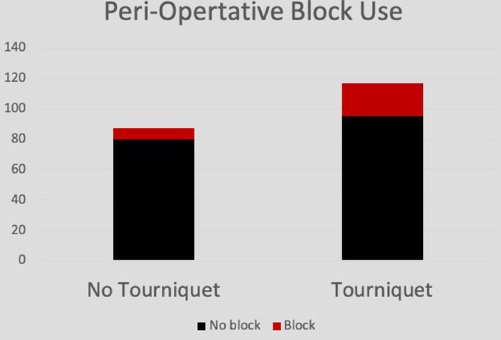
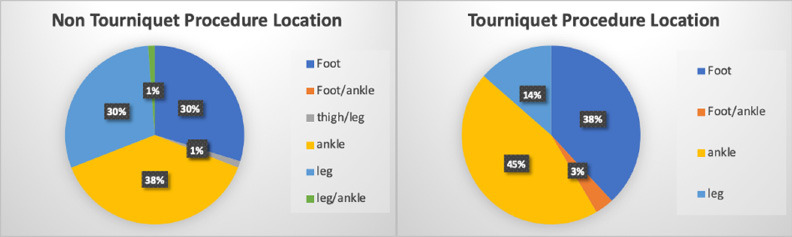
A retrospective study of paediatric patients (under the age of 18) undergoing inpatient orthopaedic procedure below the knee performed at a single academic institution between 1st December 2013 and 31st January 2019 was conducted. Primary outcome measures of total opioid consumption during hospital stay and pre-operative nerve block utilization were retrieved from the electronic medical record (EMR). Secondary outcome measures of blood loss, tourniquet time, procedure time and length of hospital stay were also retrieved. Student's t-tests were used to assess statistical significance between two sample means.
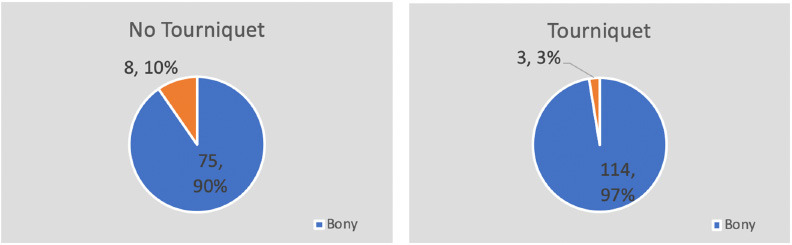
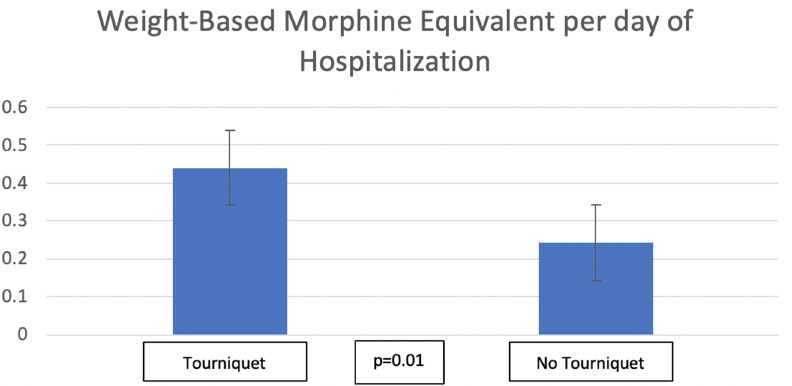
The final analysis included 204 paediatric procedures, 118 of which used a tourniquet and 86 of which did not. Paediatric patients with a tourniquet had significantly more opioid consumption post-operatively in the form of weight-based morphine equivalents/length of stay (p = 0.01) compared to those who had no tourniquet. This held true for males (p = 0.049) and females (p = 0.04) respectively. We did not see an increase in wound complications or return trips to the operating room in the tourniquet cohort. All procedures included an osseous component except one procedure in the non-tourniquet group.
Minimizing opioid consumption may be achieved by avoiding tourniquet use in paediatric patients with lower leg procedures. In non-anaemic paediatric patients, it is reasonably risk-free to perform these surgeries without the use of tourniquet to decrease opioid dependence in the post-operative period.
III.
本研究旨在评估小儿下肢手术后止血带的使用情况及其对术后疼痛的影响。
对2013年12月1日至2019年1月31日在单一学术机构接受膝下骨科住院手术的18岁以下儿科患者进行回顾性研究。从电子病历(EMR)中获取住院期间总阿片类药物消耗量和术前神经阻滞使用情况的主要结局指标。还获取了失血量、止血带使用时间、手术时间和住院时间的次要结局指标。采用学生t检验评估两个样本均值之间的统计学显著性。
最终分析纳入204例儿科手术,其中118例使用了止血带,86例未使用。与未使用止血带的儿科患者相比,使用止血带的儿科患者术后以基于体重的吗啡当量/住院时间形式表示的阿片类药物消耗量显著更多(p = 0.01)。男性(p = 0.049)和女性(p = 0.04)分别如此。我们未观察到止血带组伤口并发症增加或返回手术室的情况。除非止血带组的一例手术外,所有手术均包括骨成分。
对于小儿下肢手术患者,避免使用止血带可减少阿片类药物的消耗。在非贫血的儿科患者中,不使用止血带进行这些手术以降低术后阿片类药物依赖在合理范围内无风险。
III级