Department of Basic Medical Sciences, Neuroscience and Sense Organs, Orthopaedic, Trauma and Spine Unit, UOSD Spinal Deformity Center, School of Medicine, University of Bari Aldo Moro, AOU Consorziale "Policlinico", Piazza Giulio Cesare 11, 70100, Bari, Italy.
Orthopaedic and Trauma Unit, Department of Basic Medical Sciences, Neuroscience and Sense Organs, Spine Unit, University of Bari Aldo Moro, AOU Consorziale "Policlinico", Bari, Italy.
Spine Deform. 2021 Mar;9(2):549-557. doi: 10.1007/s43390-020-00225-y. Epub 2020 Nov 18.
This prospective observational study aims to assess the MA brace effectiveness in hyperkyphosis correction, focusing also on patients' compliance of bracing and its psychological impact.
Patients referring to our spine outpatient department with Scheuermann's kyphosis (SK) from January 2011 to January 2017 were prospectively recruited. Patients were divided into two groups, according to their global thoracic kyphosis (TK): Group-A TK < 60°, Group-B TK ≥ 60°. The MA brace was prescribed according to SRS criteria. Full spine X-rays were analyzed at conventional times: at the beginning of treatment (T0), at 6-months follow-up (T1, in-brace X-rays), at the end of treatment (T2) and at 2-year minimum follow-up from bracing removal (T3). At T, T and T all the patients were assessed using the Italian Version of the SRS-22 Patient Questionnaire (I-SRS22). Variability between and within-groups was assessed; a p value < 0.05 was considered significant.
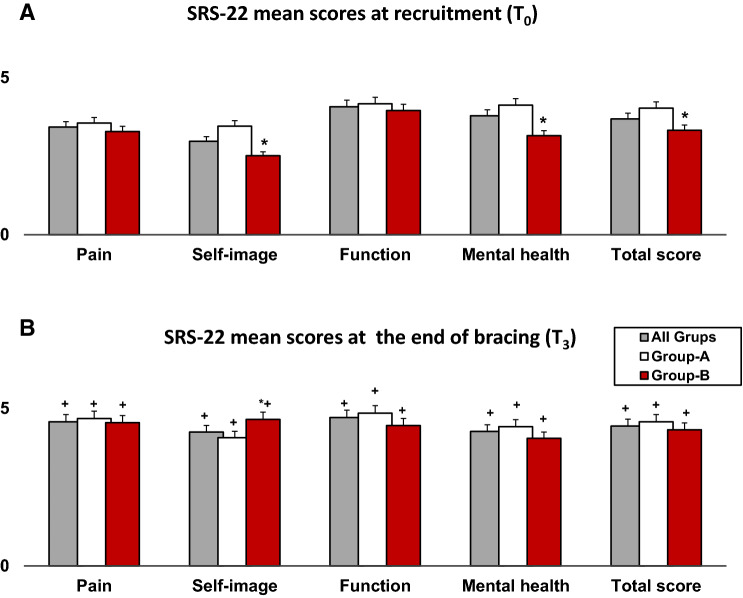
192 adolescents (87 girls and 105 boys, mean age 13.1) were recruited. The mean global TK at recruitment was 61.9° ± 11.3°, the mean follow-up time was 57.4 months. A good patients' reported compliance was observed: 84.9% of patients used the brace as scheduled. A mean in-brace correction (in-brace TK) of 37.4% was observed and a mean final correction (TK) of 31.6%. At final follow-up (T3), curve reduction (ΔTK ≤ - 5°) was observed in 60.4% of patients and curve stabilization (- 5° < ΔTK < 5) in 29.7% of patients. At baseline, worse SRS22-mental health (p = 0.023) and self-image mean scores (p = 0.001) were observed in Group-B, compared with Group-A. At the end of treatment (T2), an improvement of all items was observed, wit significantly better improvement of self-image domain in Group-B.
The MA brace has shown to be effective in the management of SK; good patients' reported compliance and a positive effect on the patients' mental status were recorded.
本前瞻性观察研究旨在评估 MA 支具在矫正脊柱后凸中的有效性,并重点关注患者对支具的依从性及其心理影响。
2011 年 1 月至 2017 年 1 月,我们脊柱门诊收治的 Scheuermann 后凸(SK)患者被前瞻性招募。根据患者整体胸椎后凸(TK),将患者分为两组:A 组 TK<60°,B 组 TK≥60°。根据 SRS 标准,为患者定制 MA 支具。在常规时间点分析全脊柱 X 线片:治疗开始时(T0)、6 个月随访时(T1,支具内 X 线片)、治疗结束时(T2)和支具去除后至少 2 年随访时(T3)。在 T0、T1 和 T3 时,所有患者均使用意大利版 SRS-22 患者问卷(I-SRS22)进行评估。评估组内和组间的差异;p 值<0.05 被认为具有统计学意义。
共纳入 192 名青少年(87 名女性和 105 名男性,平均年龄 13.1 岁)。招募时整体 TK 平均为 61.9°±11.3°,平均随访时间为 57.4 个月。观察到患者报告的依从性良好:84.9%的患者按计划使用支具。观察到支具内矫正(支具内 TK)平均 37.4%,最终矫正(TK)平均 31.6%。在最终随访(T3)时,60.4%的患者观察到曲线减少(ΔTK≤-5°),29.7%的患者观察到曲线稳定(-5°<ΔTK<5°)。在基线时,与 A 组相比,B 组的 SRS22-心理健康(p=0.023)和自我形象平均分(p=0.001)较差。在治疗结束时(T2),所有项目均有改善,B 组自我形象域的改善明显更好。
MA 支具在 SK 治疗中显示出有效性;记录到患者的报告依从性良好,并对患者的精神状态产生积极影响。