Department of Pathology, National University Hospital, Singapore, Singapore.
Department of Pathology, Yong Loo Lin School of Medicine, National University of Singapore, Singapore, Singapore.
Clin Mol Hepatol. 2021 Jan;27(1):44-57. doi: 10.3350/cmh.2020.0181. Epub 2020 Nov 19.
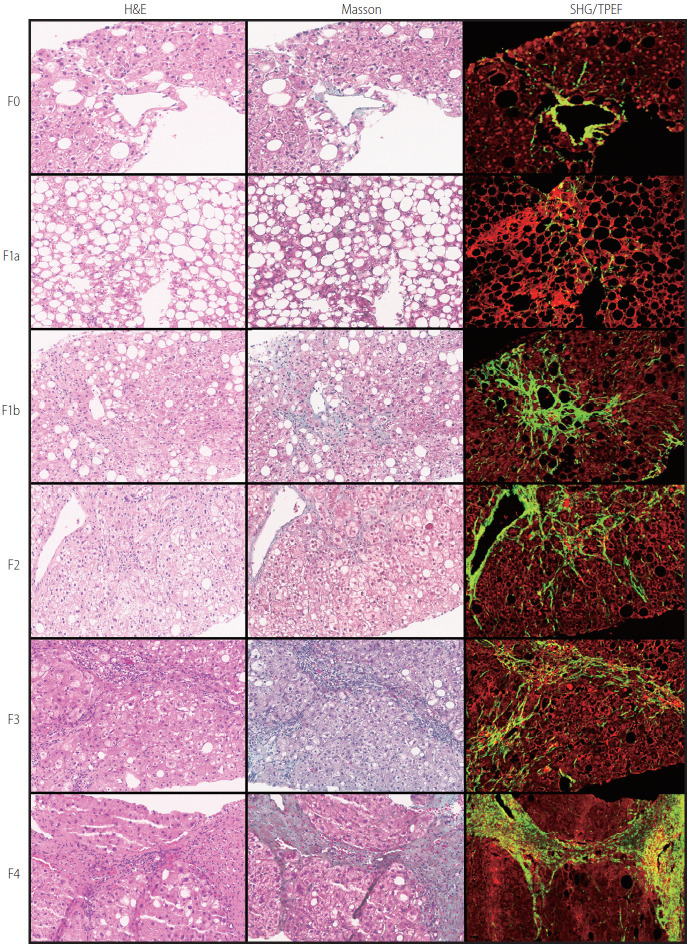
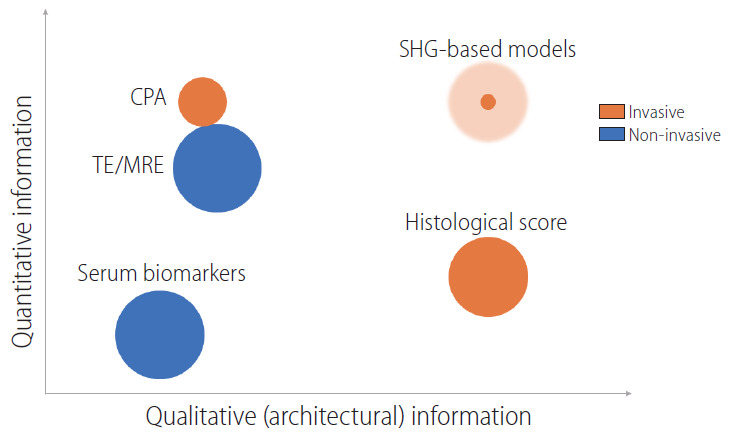
Nonalcoholic fatty liver disease/nonalcoholic steatohepatitis (NAFLD/NASH) is a major cause of liver fibrosis and cirrhosis. Accurate assessment of liver fibrosis is important for predicting disease outcomes and assessing therapeutic response in clinical practice and clinical trials. Although noninvasive tests such as transient elastography and magnetic resonance elastography are preferred where possible, histological assessment of liver fibrosis via semiquantitative scoring systems remains the current gold standard. Collagen proportionate area provides more granularity by measuring the percentage of fibrosis on a continuous scale, but is limited by the absence of architectural input. Although not yet used in routine clinical practice, advances in second harmonic generation/two-photon excitation fluorescence (SHG/TPEF) microscopy imaging show great promise in characterising architectural features of fibrosis at the individual collagen fiber level. Quantification and calculation of different detailed variables of collagen fibers can be used to establish algorithm-based quantitative fibrosis scores (e.g., qFibrosis, q-FPs), which have been validated against fibrosis stage in NAFLD. Artificial intelligence is being explored to further refine and develop quantitative fibrosis scoring methods. SHG-microscopy shows promise as the new gold standard for the quantitative measurement of liver fibrosis. This has reaffirmed the pivotal role of the liver biopsy in fibrosis assessment in NAFLD, at least for the near-future. The ability of SHG-derived algorithms to intuitively detect subtle nuances in liver fibrosis changes over a continuous scale should be employed to redress the efficacy endpoint for fibrosis in NASH clinical trials; this approach may improve the outcomes of the trials evaluating therapeutic response to antifibrotic drugs.
非酒精性脂肪性肝病/非酒精性脂肪性肝炎(NAFLD/NASH)是肝纤维化和肝硬化的主要原因。在临床实践和临床试验中,准确评估肝纤维化对于预测疾病结局和评估治疗反应非常重要。尽管瞬时弹性成像和磁共振弹性成像等非侵入性检查在可能的情况下是首选,但通过半定量评分系统对肝纤维化进行组织学评估仍然是目前的金标准。胶原比例面积通过在连续尺度上测量纤维化的百分比提供了更多的粒度,但受到缺乏结构输入的限制。尽管尚未在常规临床实践中使用,但二次谐波产生/双光子激发荧光(SHG/TPEF)显微镜成像的进展在个体胶原纤维水平上对纤维化的结构特征进行特征描述方面显示出巨大的潜力。可以对不同胶原纤维的详细变量进行量化和计算,以建立基于算法的定量纤维化评分(例如,qFibrosis、q-FPs),这些评分已在 NAFLD 中针对纤维化阶段进行了验证。正在探索人工智能以进一步改进和开发定量纤维化评分方法。SHG 显微镜有希望成为定量测量肝纤维化的新标准。这再次证实了肝活检在 NAFLD 纤维化评估中的关键作用,至少在不久的将来是如此。SHG 衍生算法直观地检测肝纤维化连续尺度上细微变化的能力应被用于纠正 NASH 临床试验中纤维化的疗效终点;这种方法可能会改善评估抗纤维化药物治疗反应的试验结果。