Department of Bioanalysis, Centre of Excellence in Mycotoxicology and Public Health, Faculty of Pharmaceutical Sciences, Ghent University, Ottergemsesteenweg 460, 9000 Ghent, Belgium.
Department of Pharmacology, Toxicology and Biochemistry, Faculty of Veterinary Medicine, Ghent University, Salisburylaan 133, 9820 Merelbeke, Belgium.
Toxins (Basel). 2020 Nov 16;12(11):719. doi: 10.3390/toxins12110719.
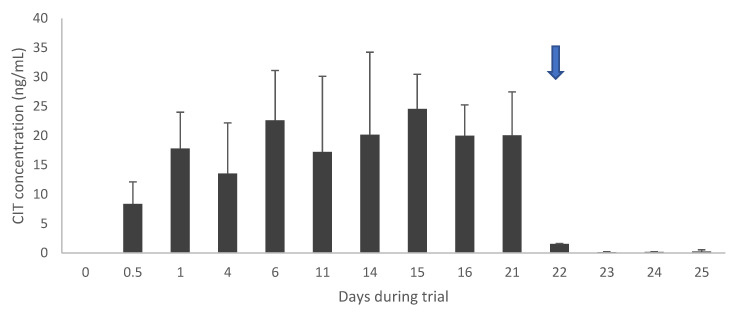
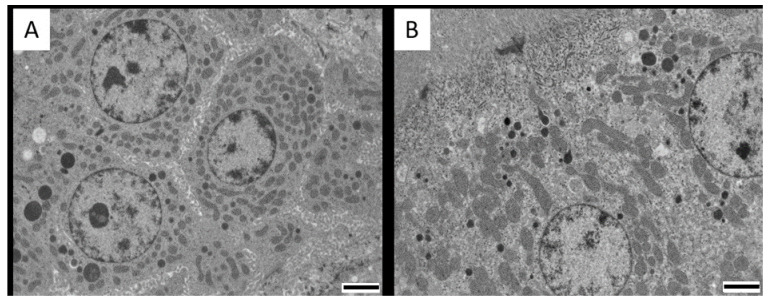
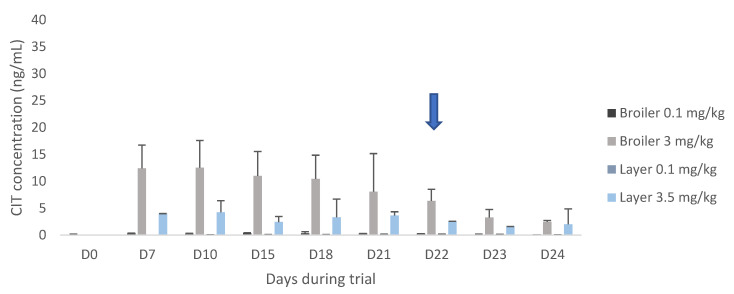
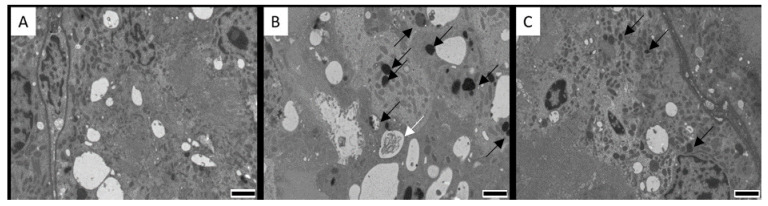
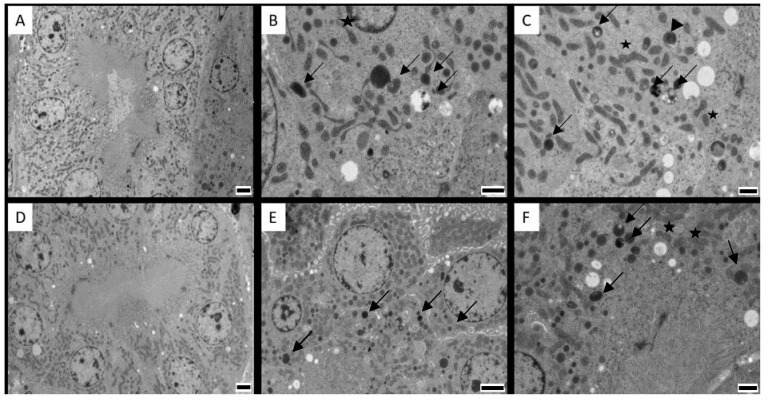
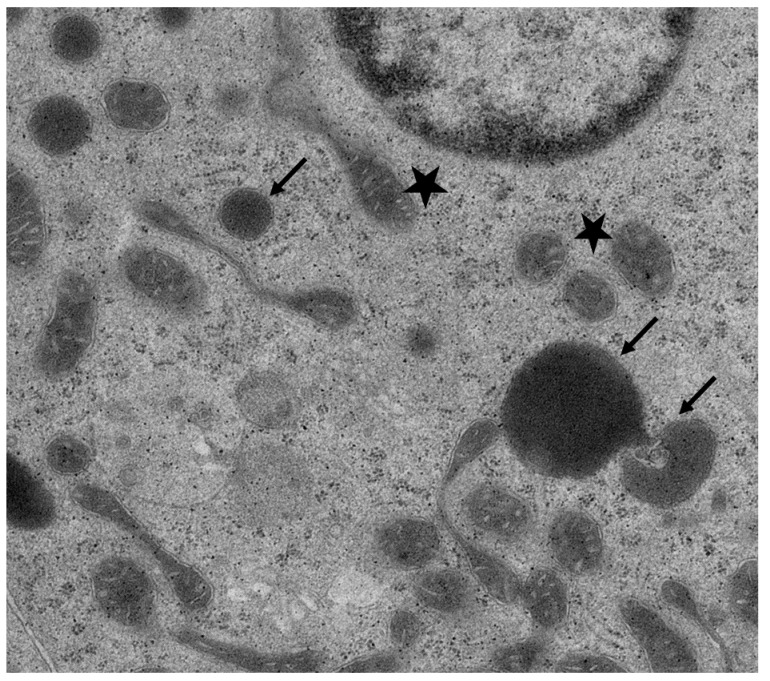
Citrinin (CIT) is a polyketide mycotoxin occurring in a variety of food and feedstuff, among which cereal grains are the most important contaminated source. Pigs and poultry are important livestock animals frequently exposed to mycotoxins, including CIT. Concerns are rising related to the toxic, and especially the potential nephrotoxic, properties of CIT. The purpose of this study was to clarify the histopathological effects on kidneys, liver, jejunum and duodenum of pigs, broiler chickens and laying hens receiving CIT contaminated feed. During 3 weeks, pigs (n = 16) were exposed to feed containing 1 mg CIT/kg feed or to control feed (n = 4), while 2 groups of broiler chickens and laying hens (n = 8 per group) received 0.1 mg CIT/kg feed (lower dose group) and 3 or 3.5 mg CIT/kg feed (higher dose group), respectively, or control feed (n = 4). CIT concentrations were quantified in plasma, kidneys, liver, muscle and eggs using a validated ultra-high performance liquid chromatography-tandem mass spectrometry (UHPLC-MS/MS) method. Kidneys, liver, duodenum and jejunum were evaluated histologically using light microscopy, while the kidneys were further examined using transmission electron microscopy (TEM). Histopathology did not reveal major abnormalities at the given contamination levels. However, a significant increase of swollen and degenerated mitochondria in renal cortical cells from all test groups were observed (p < 0.05). These observations could be related to oxidative stress, which is the major mechanism of CIT toxicity. Residues of CIT were detected in all collected tissues, except for muscle and egg white from layers in the lowest dose group, and egg white from layers in the highest dose group. CIT concentrations in plasma ranged between 0.1 (laying hens in lower dose group) and 20.8 ng/mL (pigs). In tissues, CIT concentrations ranged from 0.6 (muscle) to 20.3 µg/kg (liver) in pigs, while concentrations in chickens ranged from 0.1 (muscle) to 70.2 µg/kg (liver). Carry-over ratios from feed to edible tissues were between 0.1 and 2% in pigs, and between 0.1 and 6.9% in chickens, suggesting a low contribution of pig and poultry tissue-derived products towards the total dietary CIT intake for humans.
桔青霉素(CIT)是一种多酮类真菌毒素,存在于多种食品和饲料中,其中谷物是最重要的污染来源。猪和家禽是经常接触真菌毒素的重要家畜,包括 CIT。人们越来越关注 CIT 的毒性,尤其是其潜在的肾毒性。本研究旨在阐明接受被 CIT 污染的饲料的猪、肉鸡和蛋鸡的肾脏、肝脏、空肠和十二指肠的组织病理学影响。在 3 周的时间里,16 头猪(n = 16)暴露于含有 1 mg CIT/kg 饲料的饲料或对照饲料(n = 4),而两组肉鸡和蛋鸡(每组 n = 8)分别接受 0.1 mg CIT/kg 饲料(低剂量组)和 3 或 3.5 mg CIT/kg 饲料(高剂量组)或对照饲料(n = 4)。使用经过验证的超高效液相色谱-串联质谱法(UHPLC-MS/MS)在血浆、肾脏、肝脏、肌肉和鸡蛋中定量 CIT 浓度。使用光学显微镜评估肾脏、肝脏、十二指肠和空肠的组织病理学,而肾脏则进一步使用透射电子显微镜(TEM)检查。在给定的污染水平下,组织病理学未显示出主要异常。然而,所有测试组的肾皮质细胞中肿胀和退化的线粒体数量都显著增加(p < 0.05)。这些观察结果可能与 CIT 毒性的主要机制氧化应激有关。除了最低剂量组的肉鸡肌肉和蛋清以及最高剂量组的蛋鸡蛋清外,所有收集的组织中均未检测到 CIT 残留。血浆中的 CIT 浓度范围为 0.1(低剂量组的蛋鸡)至 20.8 ng/mL(猪)。在组织中,猪的 CIT 浓度范围从 0.6(肌肉)至 20.3 µg/kg(肝脏),而鸡的浓度范围从 0.1(肌肉)至 70.2 µg/kg(肝脏)。从饲料到可食用组织的转移率在猪中为 0.1%至 2%,在鸡中为 0.1%至 6.9%,这表明猪和家禽组织产品对人类总膳食 CIT 摄入量的贡献较低。