Wang Haiyan, Wu Jiangqi, Li Guang, Yan Lijuan
College of Forestry Gansu Agricultural University Lanzhou China.
College of Agriculture Gansu Agricultural University Lanzhou China.
Ecol Evol. 2020 Sep 29;10(21):12211-12223. doi: 10.1002/ece3.6852. eCollection 2020 Nov.
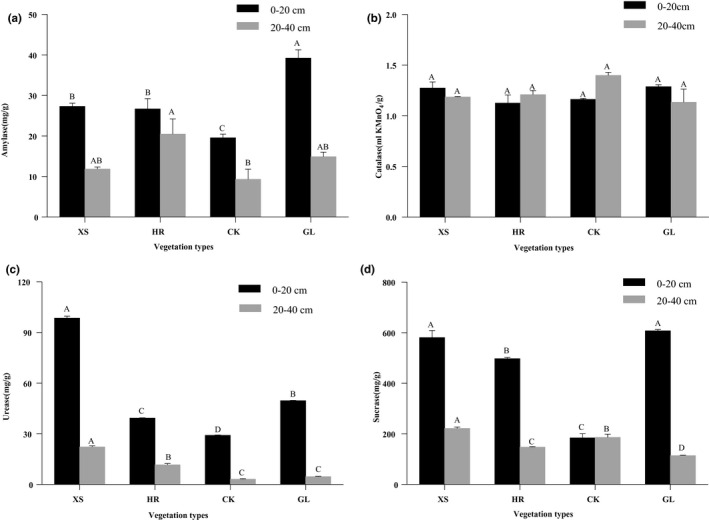
Knowledge of the soil organic carbon components and enzyme activities during long-term natural vegetation restoration is essential for managing the restoration of vegetation. In this study, the variations of soil organic carbon components (i.e., soil organic carbon (SOC), microbial biomass carbon (MBC), easily oxidized carbon (EOC), particulate organic carbon (POC)) and enzyme activities (i.e., amylase, catalase, urease, and sucrase) were measured in four vegetation types: control (grasslands, GL), forest (, XS), and shrublands (, HR; , CK). We found that vegetation types significantly affect soil organic carbon components and enzyme activities. The SOC content of the XS plot is higher than HR, CK, and GL by 88.43%, 117.09%, and 37.53% at the 0-20 cm layer; the soil SOC content of the XS plot is higher than HR and CK by 27.04% and 26.87%, and lower than GL 12.90% at the 20-40 cm layer. The highest POC and urease were observed in the XS plot at a depth of 0-20 cm, that is, 1.32 g/kg and 98.51 mg/kg, respectively. The highest EOC, amylase, and sucrase were observed in GL at a depth of 0-20 cm, that is, 5.44 g/kg, 39.23, and 607.62 mg/g. On the vertical section of the soil, the SOC fractions and the enzyme activities were greater in the upper layer than in the lower layer for each vegetation type except for MBC and catalase activity. Correlation analysis demonstrated that the SOC and POC content significantly influenced urease and sucrase activities and that MBC significantly influenced catalase activity. These results provide important information about SOC fractions and enzyme activities resulting from vegetation types in the Loess Plateau and also supplement our understanding of soil C sequestration in vegetation restoration.
了解长期自然植被恢复过程中的土壤有机碳组分和酶活性对于植被恢复管理至关重要。在本研究中,测定了四种植被类型(对照(草地,GL)、森林(XS)和灌丛(HR;CK))的土壤有机碳组分(即土壤有机碳(SOC)、微生物量碳(MBC)、易氧化碳(EOC)、颗粒有机碳(POC))和酶活性(即淀粉酶、过氧化氢酶、脲酶和蔗糖酶)的变化。我们发现植被类型显著影响土壤有机碳组分和酶活性。在0 - 20 cm土层,XS样地的SOC含量比HR、CK和GL分别高88.43%、117.09%和37.53%;在20 - 40 cm土层,XS样地的土壤SOC含量比HR和CK分别高27.04%和26.87%,比GL低12.90%。在0 - 20 cm深度处,XS样地的POC和脲酶最高,分别为1.32 g/kg和98.51 mg/kg。在0 - 20 cm深度处,GL的EOC、淀粉酶和蔗糖酶最高,分别为5.44 g/kg、39.23和607.62 mg/g。在土壤垂直剖面上,除MBC和过氧化氢酶活性外,各植被类型上层的SOC组分和酶活性均高于下层。相关性分析表明,SOC和POC含量显著影响脲酶和蔗糖酶活性,MBC显著影响过氧化氢酶活性。这些结果提供了有关黄土高原植被类型导致的SOC组分和酶活性的重要信息,也补充了我们对植被恢复中土壤碳固存的理解。